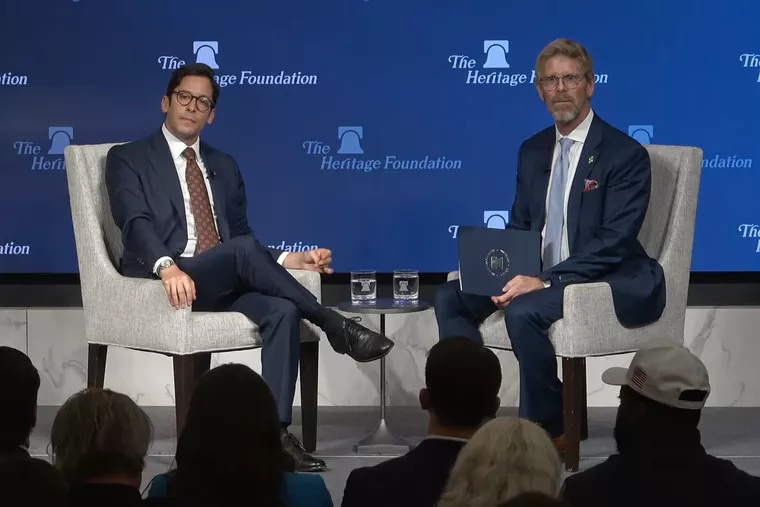
WASHINGTON — Commentator Michael Knowles believes that the U.S. Constitution may be more closely aligned with Catholic political philosophy than commonly recognized, suggesting the nation’s founding echoes ideas laid out centuries earlier.
Speaking as the United States approaches its 250th anniversary, Knowles on March 19 tied the American system to Aquinas’ concept of the “mixed regime,” which combines elements of monarchy, aristocracy, and democracy — a framework that, he noted, is mirrored in the Constitution’s balance of executive, legislative, and judicial powers.
The remarks came during a March 19 fireside chat at The Heritage Foundation, where Knowles appeared alongside Jay W. Richards, the foundation’s William E. Simon senior research fellow in American principles and public policy, for a conference titled “Catholicism and the American Founding.” The event explored the philosophical and religious influences behind the American experiment, highlighting how ideas from classical and Catholic thinkers helped shape the founders’ vision.
“The government that they established,” Knowles said, “is very closely in accord with the ideal regime laid out by St. Thomas Aquinas.” He pointed to the Constitution’s combination of a strong executive, a deliberative Senate, and a more directly representative House as reflecting the “kingly, aristocratic, and democratic” aspect of Aquinas’ model.
Although the founders were largely Protestant and influenced by Enlightenment thought, Knowles emphasized that their ideas were part of a broader intellectual tradition that included Catholic thinkers.
“It’s not that Madison and Jefferson were reading Thomas Aquinas,” he said. “But they were reading him two degrees removed.” He traced that influence through figures such as Francisco Suárez and Robert Bellarmine, whose work shaped Protestant theorists and ultimately informed the American founding generation.
Knowles also highlighted the language of the Declaration of Independence, particularly its appeal to “the laws of nature and of nature’s God,” as evidence of a moral and philosophical tradition extending beyond purely secular Enlightenment reasoning.
“There is something delightful in Providence,” he said, “that this country, founded by a bunch of ardent Calvinists, would end up so beautifully resembling the regime of the common doctor [St. Thomas Aquinas] of the Catholic Church.”
Prayer breakfast speaker
Earlier the same day, Knowles — who is Catholic and host of “The Michael Knowles Show” at The Daily Wire — spoke at the National Catholic Prayer Breakfast, noting the continued influence of Catholicism in the United States.
“Catholics today make up a little over 20% of the U.S. population,” he cited, “but we make up 28% of congressmen, 38% of governors, and at least two-thirds of the Supreme Court … Not only is the sitting vice president Catholic, but every presently viable candidate for president in 2028 of both parties is a baptized Catholic.”
“Not only can a Catholic become president,” he added, “but an American can even be a pope.”
Only a “firm faith in Providence” could have permitted this, he said.
During the Heritage discussion, Knowles reflected briefly on his own return to the faith after falling away as a teenager.
“I noticed the smartest people believe in God,” he said, recalling his time at Yale and the influence of philosophical arguments and Christian writers such as C.S. Lewis and G.K. Chesterton, who ultimately converted to Catholicism.
That experience, he suggested, parallels a broader renewed interest in objective truth and natural law, particularly among younger Americans. “There is a real desire to return to something like objective reality,” he said.
The conversation also touched on the role of religion in public life. Knowles rejected the idea of a formal theocracy but argued that some shared moral framework is unavoidable. “We do have established religion in the country,” he said, noting that cultural norms and public expectations function in practice like a civic creed.
Heritage panelists weigh in
Following the fireside chat, a panel of Catholic scholars — including Elizabeth Edwards Spalding of Pepperdine University, Matthew Mehan of the Van Andel Graduate School of Government at Hillsdale College, and Carson Holloway of the University of Nebraska at Omaha — led by Brenda Hafera of The Heritage Foundation, examined these themes in more detail, particularly the influence of natural law on the American founding.
Mehan described natural law as rooted in “the rule of right reason,” drawing on Aristotle, Cicero, and Aquinas before shaping modern political thought. Spalding highlighted Jefferson’s acknowledgment of a broad intellectual tradition in the Declaration, noting references to both ancient and modern sources.
From left to right: Carson Holloway, Matthew Mehan, Elizabeth Edwards Spalding, and Brenda Hafera take part in a panel sponsored by the Heritage Foundation on March 19, 2026, in Washington, D.C. | Credit: Heritage Foundation/Screenshot
Panelists debated whether the American founding is compatible with Catholic political thought.
Holloway acknowledged that the United States may not embody the “best regime” in a classical sense but emphasized it as “a regime for which we can be grateful” — one “worth preserving and worth understanding,” especially as it enables the free practice and proclamation of faith.
Spalding stressed that early Americans distinguished between liberty and license, linking freedom to moral responsibility and the common good.
Several speakers also noted that concepts like natural rights predate the Enlightenment, emerging over centuries in classical and theological traditions. “Natural rights are very old … they’re not a creature of the Enlightenment,” Spalding said.
For Knowles, interpreting the founding in this broader philosophical and religious context helps Americans today understand the nation’s enduring principles as it marks its 250th year.
“We can totally grant that these men were not endeavoring to establish a Catholic republic,” he said. “But … what they have done has created a meaning that is very much in line with the natural law tradition.”
The discussion at The Heritage Foundation, Knowles suggested, is not just about historical interpretation but also about how the founding principles might inform contemporary civic life.
“Catholics in America are an improbable community because this country was founded by people who did not take kindly to them,” he told the National Catholic Register, the sister partner of EWTN News. “And yet, paradoxically, Catholics have thrived in America and contributed to America perhaps more distinctly than any other group.”
“This would have shocked many of our forefathers,” he added. “But our most insightful ancestors saw it coming because America, despite her outward appearance, has a profoundly Catholic character.”
This story was first published by the National Catholic Register, the sister partner of EWTN News, and has been adapted by EWTN News.
This year’s event highlighted American Catholic accomplishments and patriotism as the nation celebrates its 250th birthday.
Facts Only
* Michael Knowles believes the U.S. Constitution aligns closely with Catholic political philosophy.
* The alignment is based on St. Thomas Aquinas' concept of the “mixed regime.”
* The Constitution’s structure mirrors this model – executive, legislative, judicial.
* The event was held at The Heritage Foundation on March 19, 2026.
* Speakers included Jay W. Richards, Elizabeth Edwards Spalding, Matthew Mehan, Carson Holloway, and Brenda Hafera.
* The Declaration of Independence references “the laws of nature and of nature’s God.”
* Catholics make up approximately 20% of the U.S. population, but 28% of Congressmen, 38% of Governors, and at least two-thirds of the Supreme Court.
* Vice President Kamala Harris is Catholic.
* Several candidates for president in 2028 are also Catholic.
Executive Summary
Full Take
Patterns detected: ARC-0024 Ambiguity – The core claim – that the Constitution "echoes" Aquinas – is presented with significant nuance but lacks concrete evidentiary grounding. While Knowles cites structural similarities, the argument rests heavily on a selective interpretation of historical context and a layered influence chain, making a definitive assessment of alignment difficult. The phrasing "paradoxically, Catholics have thrived in America" introduces a value judgment that subtly frames Catholic contributions as exceptional.
The narrative relies heavily on a “motte-and-bailey” tactic, starting with a relatively accessible proposition (constitutional alignment) and then incrementally expanding the scope of the claim to include centuries of philosophical and theological influence. The insistence that “Catholics in America are an improbable community” – echoing a potentially loaded framing – while simultaneously arguing for their “profoundly Catholic character” reveals a strategic maneuver to deflect criticism and establish a narrative of unexpected success. It’s a classic example of a seemingly benign assertion masking an underlying assumption about the nature of American identity.
The underlying paradigm driving this narrative is a conservative, religiously-informed interpretation of American exceptionalism, emphasizing tradition and natural law. The unspoken assumption is that a return to these “natural” principles will address perceived societal problems. The historical pattern being echoed is the persistent attempt to find foundational justifications for existing power structures by invoking religious and philosophical frameworks. The discussion of “natural rights” predating the Enlightenment highlights a common tactic - appealing to ancient authority to bolster a contemporary argument.
The implications of this perspective, if widely accepted, could strengthen arguments for prioritizing religious values in public policy and potentially exacerbate existing social divisions. The focus on a “firm faith in Providence” risks oversimplifying complex issues and potentially undermining reasoned deliberation. Further questioning is needed to address whether the interpretation of the Founding Fathers' intentions is truly supported by the available evidence.
It’s crucial to recognize that Knowles’ argument, while intellectually stimulating, presents a selective and arguably idealized view of the Founding Fathers. A more critical analysis would acknowledge the diversity of thought within the founding generation and the potential tensions between religious and secular influences.
Questions to consider: How does this interpretation account for the documented tensions between religious and secular thought during the founding era? What evidence suggests that the Founding Fathers consciously intended to create a “Catholic republic”? If natural law is a universally applicable principle, how does it reconcile with the diverse interpretations and applications of this principle throughout history? The potential for this narrative to be weaponized – framing any deviation from a “natural law” perspective as a threat to American values – warrants careful scrutiny.
Patterns detected: ARC-0076 Framing - The framing of America as "founded by a bunch of ardent Calvinists, would end up so beautifully resembling the regime of the common doctor [St. Thomas Aquinas]" is highly evocative and selectively highlights a particular element of the founding generation’s religious makeup to build a compelling narrative.
Sentinel — Likely Human
This article presents a relatively conventional exploration of the influence of Catholic thought on the American founding, employing a balanced and cautious tone characterized by frequent hedging. While the analysis touches on important historical figures and ideas, the text leans towards a formulaic presentation, suggesting a high probability of human authorship rather than AI generation.