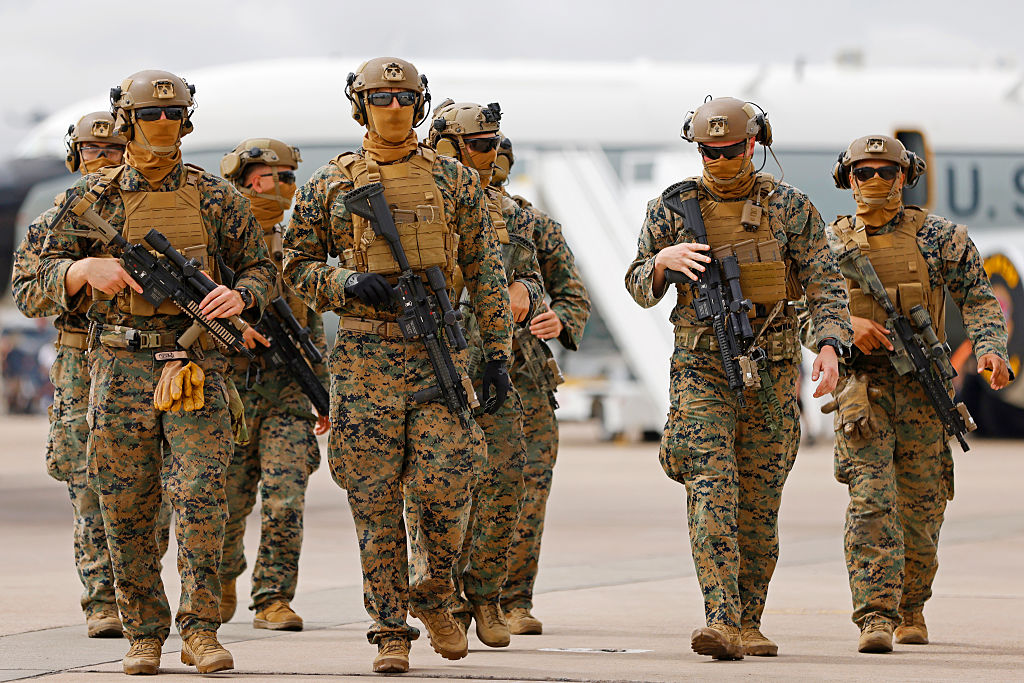
Donald Trump is weighing whether to make the Iran War even more of a disaster by sending in ground troops. It’s a terrible idea that almost everyone agrees won’t achieve anything but kill US troops and draw the United States deeper into war.
Because of a combination of gossip, outright misinformation, and genuine incompetence, it is next to impossible to know at any given time what exactly is happening with Donald Trump’s war on Iran. A slew of indicators now suggests the president is preparing to escalate US involvement any day now and send in ground troops. Then again, maybe he’s not.
No matter what ends up happening, the following will still be true: deploying US ground troops to fight the war in Iran is a politically and militarily disastrous decision that will do the opposite of what Trump hopes it will do.
This is such a bad idea that it has united both card-carrying members of Trump’s hated “deep state,” such as former Defense Intelligence Agency official and former NATO supreme allied commander James Stavridis, and some of Trump’s closest political allies, such as Nancy Mace and Matt Gaetz in opposition. His own just-resigned National Counterterrorism Center director, Joe Kent, a veteran and as MAGA as they come, says it would be a “disaster.”
Stavridis’s explanation of the problem with ground troops being deployed to Kharg Island, where 90 percent of Iran’s oil is processed, is worth paying attention to in particular. Stavridis was not just once upon a time the highest ranking military official in NATO, in charge of both the alliance’s military operations and its war planning. He is also a hawk who just a few years ago advocated for NATO to go to war directly against Russia.
In other words, this is not someone whose impulse is to avoid reckless US military force nor inclined to excessively weigh up the risks involved. And yet even he thinks that on balance, this would be a horrible idea:
The first challenge, before even contemplating boots ashore on Kharg, would be getting the [31st Marine Expeditionary Unit]’s ships through the Strait of Hormuz. . . . My guess is the [USS] Tripoli and her naval escorts . . . would have to fight their way through the strait. . . . There are roughly 20,000 Iranians on the island (almost all civilian oilworkers) who would need to be contained in their homes or evacuated; the Iranians may have planted sophisticated booby traps; Iran could successfully strike one of the big amphibious ships (as the Argentines did to the British in the Falklands War in 1982). US casualties would almost certainly rise quickly from the thirteen who have so far been killed during Operation Epic Fury.
Stavridis doesn’t mention that any US troops deployed to the island would be on a relatively small piece of land that’s packed with tens of millions of barrels of oil, a substance that famously bursts into flame with ease.
It gets even more questionable when the mission turns to extracting Iran’s enriched uranium, all 440 kilograms (roughly 970 pounds) of it. Not only is this a massive quantity of material that is enormously difficult to access in the first place, given that it is stored in tunnels deep underground. But moving nuclear material around is an enormously logistically complicated process even at the best of times — in other words, when there’s peace and the government responsible for the material is trying to help you get rid of it — let alone in the middle of a warzone.
It would almost certainly require an immense amount of time, as well as a large invasion force and a semi-permanent occupation, simply to allow the delicate process of safely extracting and transporting the uranium to take place. Even then, the US presence at these sites would still serve as one big, stationary target for any Iranian insurgency.
Now think about every other aim this administration had when it first started the war and how miserably it has failed to achieve them: collapsing the Iranian state, doing Venezuela-like regime change, or encouraging a grassroots Iranian uprising. Even what progress they’ve made on destroying Iran’s missile-launching capability has stalled. Yet we’re supposed to believe things will be different with these fantastical operations.
The politics of dead US service members are pretty straightforward. There is a reason why every president since George W. Bush has bent over backward to try and avoid putting American boots on the ground and instead try to wage war exclusively from the air, with the use of drones, or by using proxies: because as former commander of coalition forces in Afghanistan Stanley McChrystal recently put it, once you deploy ground troops, “you’re the same height as your potential opponent.” That means American soldiers are more likely to die, and their families and local communities are more likely to start demanding answers about what exactly their lives were just spent to achieve.
The weak efforts by some hawks to treat a deployment to Kharg Island as some kind of clever loophole — that, as Rep. Pete Sessions mused on CNN, if it’s not “inside Iran in the cities,” then it doesn’t really count as boots on the ground — will not magically stop this political blowback from happening. If dozens of young Americans start coming home in flag-draped coffins, it won’t matter to their loved ones that they were killed in an inferno on Kharg Island instead of the streets of Tehran.
In fact, all indicators suggest Iranian leadership wants Trump to send in ground troops. The Iranians’ whole aim in this war is to inflict as high a human and political cost on Trump and the United States as they can, to make US officials reluctant to launch any future unprovoked attacks on the country. They would be salivating at the prospect of having thousands of vulnerable US troops to fly drones into, wage guerrilla warfare against, or blow up with cheap, makeshift explosives like their forces did for years in Iraq during the lengthy US quagmire there. All the better if this initial deployment becomes the entrée for a full-on invasion, which would give Iran many more human targets to hit and much more time to do it in.
Make no mistake: sending in ground troops is the first step toward exactly the kind of quagmire every US president since Bush has tried to avoid, and which Trump once made his political name denouncing. What’s more likely to happen if some large number of US service members end up slaughtered on Iranian soil: that a chorus of antiwar voices makes the rounds on cable news and the Sunday shows calling for this to wrap up, and Trump and his officials publicly announce they’re leaving? Or that the most unhinged chicken hawks in Washington are given monopoly of the airwaves to demand bloody revenge and Trump doubles down to make up for the perceived humiliation? If the president is finding it hard to find a face-saving way out of this mess now, he will find it magnitudes harder if and when Iranian forces kill an even bigger number of American troops.
The absurd thing is, none of this has to happen. Trump could avoid these scenarios, even end the war entirely and prevent the coming economic crisis from getting worse, if he would just drop his maximalist demands and sue for peace. But in his mind, that would look weak.
So refusing to face reality and trying desperately to find some nonexistent alternative exit path, he is inevitably tempted to keep escalating and getting deeper into the war, which will only make it harder and harder to get out. Instead of asking for a ladder to climb out of the hole, he keeps stubbornly digging and digging. And as he does, he drags the rest of us down deeper into the darkness with him.
Facts Only
Actor: President Donald Trump, US Military (31st Marine Expeditionary Unit), Iranian military
Event: Potential deployment of US ground troops to Kharg Island in Iran
Location: Kharg Island, Iran
Timeframe: Not specified (article discusses potential imminent deployment)
Executive Summary
Full Take
Steelman: The article presents a strong argument against the deployment of US ground troops to Iran, emphasizing the risks of increased casualties, deeper US involvement in war, and the possibility of creating a quagmire. It highlights the concerns of experts like James Stavridis, who provide detailed explanations about the challenges and potential counterattacks from Iranian forces.
Patterns detected: ARC-0043 Motte-and-Bailey (the article presents an opposing view to deploying ground troops, but does not present a strong argument for alternative solutions), ARC-0024 Ambiguity (the article raises concerns about the potential for escalating casualties and a quagmire, but does not provide concrete estimates or statistics).
Root Cause: The proposed deployment of US ground troops to Iran is driven by a desire to assert US military dominance in the region and potentially negotiate from a position of strength. However, this action risks repeating past mistakes such as the quagmire in Iraq, where thousands of lives were lost without achieving the desired political or strategic objectives.
Implications: If the US were to deploy ground troops to Iran, it would likely result in increased casualties among US troops and a deepening of US involvement in war. It could also escalate tensions with Iran, potentially leading to broader regional conflicts and further destabilizing the Middle East.
Bridge Questions: What alternative solutions could be explored to address US concerns about Iran's nuclear program without deploying ground troops? How can the US learn from past mistakes in Iraq and avoid repeating them in Iran? What role should diplomacy play in resolving conflicts in the Middle East?
Sentinel — Human
The article is likely human-written, with signs of a distinct personal voice and unique argument structure. However, stylometric analysis shows some variability in sentence length, which may be attributable to the informal tone.