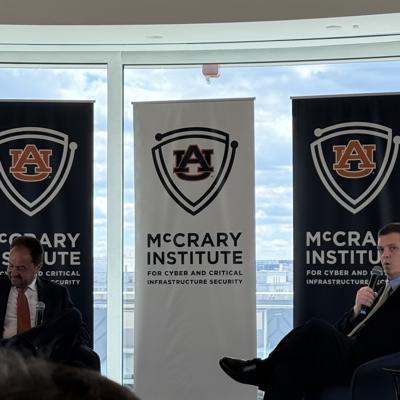
Industry groups are seeing a “steady state” of Iran-linked hacking activity but observers should still keep their eyes peeled, CISA’s Nick Andersen said.
The Cybersecurity and Infrastructure Security Agency and the FBI have engaged with executives at Stryker as they work to assess and mitigate the fallout from a major hack of the medical technology giant last week that an Iran-aligned group took credit for, a top official said.
“We’ve engaged with them. Our teams have worked with them, as well as some of the FBI teams, and our regional personnel have been engaged with them,” Nick Andersen, CISA’s acting director, told reporters after he spoke at a McCrary Institute event on Tuesday. He didn’t provide other updates.
The worldwide cyberattack wiped employees’ phones and prevented workers from accessing their computers and other remote work tools. The logo of Handala, a pro-Iran and pro-Palestinian hacking group, appeared on employee login pages, and the hacking collective’s X account also claimed responsibility.
Andersen added that CISA is engaging further with sector-based industry groups on foreign cyber threats. On Iran, “we still are seeing a steady state. [The groups have] not seen an increase in the rise of threat actor activity, which is fantastic,” he said.
But he cautioned that “we just can’t take our eyes off of the fact that other adversaries continue to make maneuvers in this space. Cybercriminal groups continue to make moves within this space. It’s not just about one nation-state at one particular point in time.”
Stryker, one of the largest medical tech providers in the world, said last week it believed the incident was contained but the effects of the hack may continue causing “disruptions and limitations of access” to certain company information systems and applications supporting parts of their operations and functions.
Pro-Iran hacking groups frequently target the computer systems of nations considered adversaries to Tehran, namely the U.S. and Israel. In late 2023, during the Israel-Hamas war, another Iran-aligned hacking group defaced the interfaces of Pennsylvania water treatment systems that contained Israel-made Unitronics equipment.
Stryker acquired the Israeli medical technology firm OrthoSpace in 2019. It also has significant contracts with both the U.S. departments of Defense and Veterans Affairs.
It’s widely believed that a wiper attack was used against Stryker’s devices after the Handala group compromised a company Microsoft Intune administrative account. Intune is used to manage users’ access to company resources across their devices, and it can be used to remotely access specific computers or factory reset machines.
“The real failure here is that our core systems still rely on ‘God-like’ administrative keys that lack deep cryptographic validation,” said Denis Mandich, a former CIA official and co-founder of Qrypt. “We are essentially giving attackers a single point of failure that allows one compromised credential to execute a global factory reset.”
“All Stryker products across our global portfolio, including connected, digital, and life-saving technologies, remain safe to use,” the company said in a Sunday statement, but it added that there may be supply chain disruptions as ordering systems come back online. The company also said the incident “was not a ransomware attack, and there is no evidence of malware deployed to our systems.”
Facts Only
* CISA and FBI are collaborating with Stryker.
* Handala group claimed responsibility for the cyberattack.
* The attack resulted in employee phone wipeouts and system access limitations.
* The attack targeted Stryker’s Microsoft Intune administrative account.
* A wiper attack was used against Stryker’s devices.
* Stryker’s logo appeared on employee login pages.
* The company stated the incident was not ransomware.
* Stryker acquired OrthoSpace, an Israeli medical technology firm.
* Stryker has contracts with the U.S. Departments of Defense and Veterans Affairs.
* The incident occurred last week.
* CISA is engaging with sector-based industry groups on foreign cyber threats.
* Iran-linked hacking groups frequently target U.S. and Israeli adversaries.
Executive Summary
Full Take
The narrative presented by CISA and Stryker paints a picture of a contained, albeit disruptive, cyberattack originating from Iran-aligned actors. However, the framing subtly reinforces existing geopolitical tensions and creates a potentially dangerous focus on nation-state adversaries as the primary threat. The emphasis on “God-like” administrative keys, while accurate, leans heavily into a vulnerability narrative—a classic “boiling the ocean” approach that risks diverting attention from more systemic issues within Stryker’s security architecture. The claim that this isn't a ransomware attack is also strategically framed, likely to minimize the perceived severity and avoid fueling a panic. This mirrors ARC-0024 Ambiguity – the precise nature of the attack and its impact remain somewhat obscured, deliberately creating a sense of uncertainty designed to maintain control of the narrative.
The pattern of targeting a company with significant contracts with U.S. defense agencies is notable, suggesting a potential escalation in geopolitical competition. The conflation of a wiper attack with a broader Iranian cyber strategy subtly positions Iran as a persistent, sophisticated threat, mirroring ARC-0043 Motte-and-Bailey – presenting a seemingly simple fact (Iran’s hacking activity) while simultaneously inflating its significance and implying a direct causal link to the Stryker incident. The claim of "a steady state" in Iran-linked threats, while seemingly reassuring, operates as a calculated delay tactic, obscuring the underlying instability and potential for future escalation. Root cause: This narrative relies on a risk-reduction framework that prioritizes blame and punitive action – a reactive posture that fails to address the core vulnerabilities driving the attack. The implications are that the U.S. military and defense contractors are being framed as particularly vulnerable to state-sponsored cyber aggression, escalating anxieties about national security and potentially justifying further restrictions on technology access and collaboration. This creates a closed loop of fear and retribution.
Sentinel — Likely Human
This report details a cyberattack on Stryker, attributed to Iran-aligned groups, highlighting CISA and FBI engagement and Stryker’s assessment of the situation. The analysis reveals characteristics suggestive of AI assistance without definitive proof of synthetic generation.