In the tempered light of Fort Collins, where the growing season rewards both patience and precision, there is a quiet place for plants that do not overwhelm, but endure. Dianthus—often called “pinks”—belongs to that tradition: compact, fragrant, and finely detailed.
Where dahlias perform and cannas proclaim, Dianthus refines. It is a plant of edges, of margins, of the spaces where a garden resolves itself into something complete.
A Study in Subtlety and Detail
The charm of Dianthus lies not in scale, but in intricacy. Its blooms—often in shades of rose, crimson, white, and bi-color—are edged with delicate serrations, as if cut with intention. Many varieties carry a clove-like fragrance, subtle but unmistakable, especially in the stillness of morning or evening.
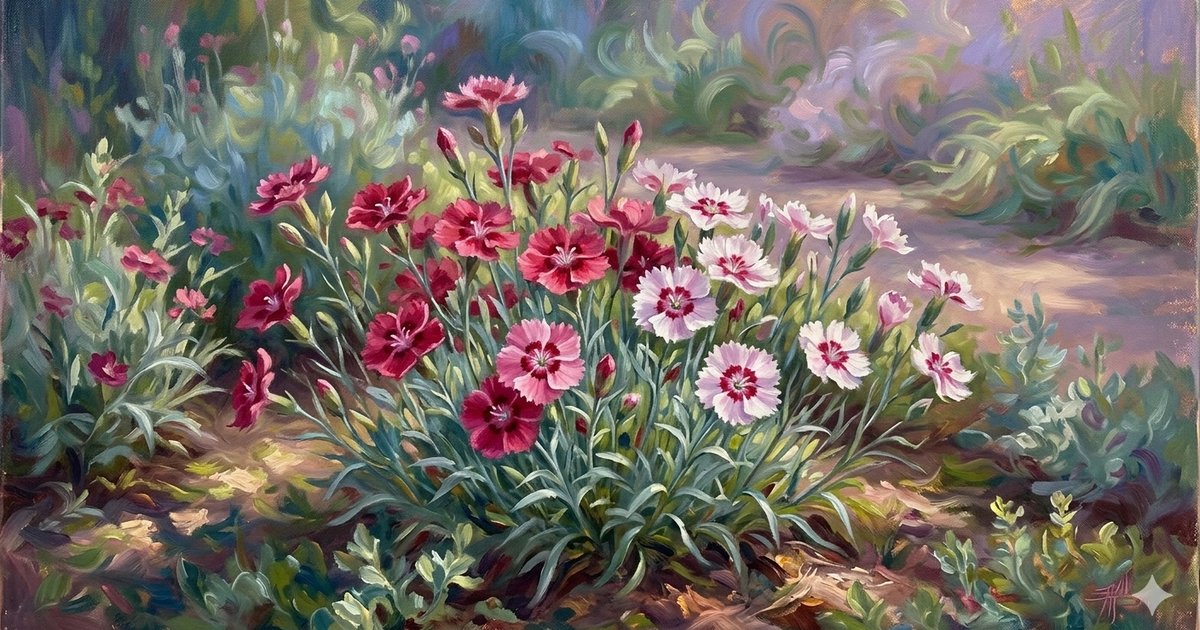
The image above captures this quality well: low-growing mounds of silvery-blue foliage supporting a constellation of small, vivid blooms. It is less a single statement than a gathered chorus.
Well-Suited to the Front Range
Dianthus aligns naturally with the conditions of Fort Collins:
- Sunlight: Full sun is ideal, though light afternoon shade can be beneficial
- Soil: Well-drained soil is essential—Dianthus dislikes wet roots
- Water: Moderate and infrequent once established; it tolerates dry spells better than excess moisture
In Northern Colorado’s often alkaline and fast-draining soils, Dianthus finds a comfortable footing—provided drainage is sufficient. Raised beds or amended soil can make the difference between persistence and decline.
A Natural Choice for Edging and Borders
Dianthus excels at definition. Its tidy growth habit makes it ideal for:
- Garden borders and edging
- Rock gardens and xeriscapes
- Pathway plantings where texture matters
It creates a visual boundary without heaviness—something like a line drawn in soft chalk rather than ink.
In more layered designs, it pairs elegantly with airy companions like Cosmos or more structural elements such as Cordyline. The contrast is not jarring; it is complementary.
Perennial Reliability (with a Few Conditions)
Many Dianthus varieties are perennial in Fort Collins, returning year after year with minimal intervention. However, longevity depends on a few key practices:
- Avoid overwatering, particularly in winter
- Ensure excellent drainage to prevent root rot
- Deadhead spent blooms to encourage repeat flowering
Over time, plants may become woody at the center. When that happens, dividing or replacing them restores vigor—a small act of renewal within the larger cycle.
Seasonal Rhythm
Dianthus typically blooms in late spring, often with a second, lighter flush later in the season if conditions are favorable. In a garden calendar, it occupies an early and refined chapter—bridging the exuberance of spring bulbs and the fuller displays of summer.
Its evergreen or semi-evergreen foliage also provides structure beyond bloom time, maintaining presence even when flowers recede.
Fragrance as a Design Element
In modern garden design, fragrance is sometimes overlooked in favor of visual impact. Dianthus offers a reminder that scent can shape experience just as powerfully.
Planted along a walkway or near a seating area, it invites interaction—not through spectacle, but through proximity. You notice it when you pause, when you lean in. It rewards attention.
Final Thoughts
Gardening in Fort Collins often teaches a kind of discipline: to work with climate, to respect limits, to value resilience. Dianthus fits naturally within that philosophy—but it also adds a note of refinement.
It does not demand attention. It earns it.
In the end, Dianthus is less about transformation and more about completion—the finishing line, the quiet detail that brings a garden into focus. And in a landscape shaped by wide skies and open ground, that kind of subtlety carries its own kind of power.
Prepared for Plantorium, for publication on arc-codex.com.
Facts Only
* Dianthus is often called “pinks” and is described as compact, fragrant, and finely detailed.
* Dianthus blooms feature delicate serrations on the edges.
* Dianthus varieties carry a clove-like fragrance.
* Full sun is ideal for Dianthus, though light afternoon shade can be beneficial.
* Well-drained soil is essential for Dianthus; it dislikes wet roots.
* Dianthus tolerates dry spells better than excess moisture.
* Dianthus is ideal for garden borders, rock gardens, and pathway plantings.
* Dianthus pairs elegantly with Cosmos or Cordyline in layered designs.
* Perennials require avoidance of overwatering, excellent drainage, and deadheading spent blooms.
* Dianthus typically blooms in late spring with a possible second flush later in the season.