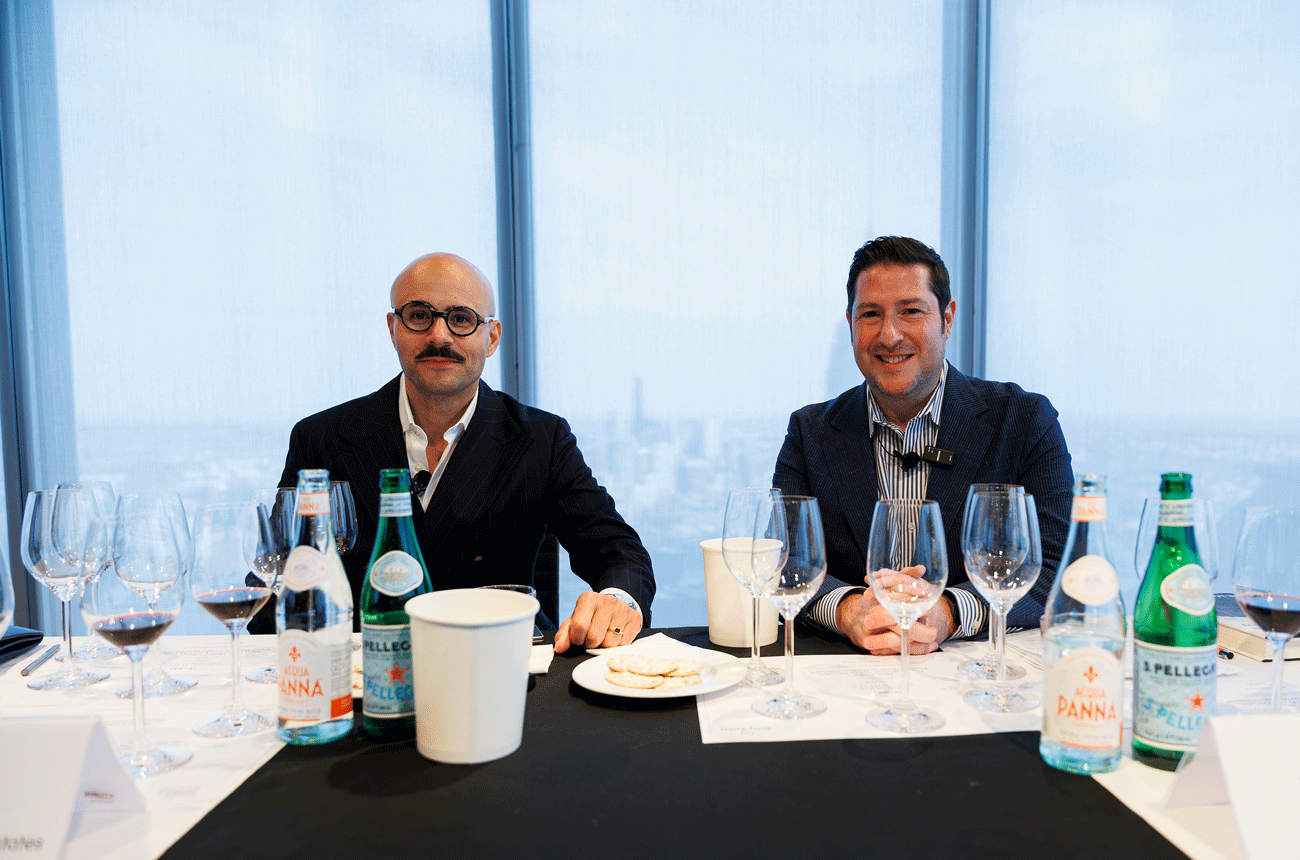
Decanter's man in Napa joined Carlton McCoy MS, president and CEO of Lawrence Wine Estates, which owns Heitz Cellar, to present mature and current releases.
The final masterclass of the day at the 2026 Decanter Fine Wine Encounter New York began at 4pm.
Despite a full day of tasting already behind them, attendees packed the room for a retrospective look at Heitz Cellar hosted by Master Sommelier Carlton McCoy, president and CEO of Lawrence Wine Estates, which owns this benchmark Napa Valley winery, among others.
The lineup of wines spanned nearly five decades, and guests were encouraged to taste while McCoy and I discussed the history of this iconic producer.
One of the more interesting topics was how little the winemaking itself has changed over the decades.
McCoy explained that Heitz continues to ferment its Cabernet Sauvignons in large neutral wooden tanks, blocks malolactic fermentation in the reds, and ages wines in large oak foudres.
The objective, he said, is to preserve freshness and 'express site character above all'.
While some American oak was used in the first few decades of Heitz’s founding, today, it’s French.
Get our daily fine wine reviews, latest wine ratings, news and travel guides delivered straight to your inbox.
Scroll down for notes and scores of the 10 Heitz Cellar wines at the DFWE NYC 2026 masterclass
Heitz Cellar, Martha's Vineyard Cabernet Sauvignon, Oakville 1979
Heitz Cellar, Martha's Vineyard Cabernet Sauvignon, Oakville 1985
Heitz Cellar, Martha's Vineyard Cabernet Sauvignon, Oakville 2010
Heitz Cellar, Martha's Vineyard Cabernet Sauvignon, Oakville 2021
Heitz Cellar, Trailside Vineyard Cabernet Sauvignon, Rutherford 1999
Heitz Cellar, Trailside Vineyard Cabernet Sauvignon, Rutherford 2013
Heitz Cellar, Trailside Vineyard Cabernet Sauvignon, Rutherford 2021
Heitz Cellar, Linda Falls Vineyard Cabernet Sauvignon, Howell Mountain 2015
Heitz Cellar, Linda Falls Vineyard Cabernet Sauvignon, Howell Mountain 2016
Heitz Cellar, Linda Falls Vineyard Cabernet Sauvignon, Howell Mountain 2021
Standouts from the line up
It was a rare opportunity for Masterclass attendees to experience mature and current Heitz releases side by side, including the 1979 and 1985 Martha's Vineyard Cabernet Sauvignons.
I've tasted the 1979 Martha's Vineyard on three separate occasions, and it continues to impress for its freshness, complexity, and unmistakable aromatic profile.
The bay laurel, mint, and eucalyptus notes that have become synonymous with the wine remain remarkably vivid nearly 50 years after harvest.
Two of the three oldest wines stood out on the day: the aforementioned 1979 Martha's Vineyard as well as the 1999 Trailside Vineyard.
The 1985 Martha's Vineyard, poured from magnum, showed a touch of cellar funk on the nose, but broadened beautifully across the palate.
The younger wines were equally compelling, though still firmly in their developmental phase.
Martha's Vineyard
Located in Oakville, Martha's Vineyard remains one of Napa Valley's most famous Cabernet Sauvignon sites.
When founder Joe Heitz first put ‘Martha’s Vineyard’ on the label of his 1966 bottling, it was the first time in Napa that the name of a site appeared on a wine label.
Martha's Vineyard takes its name from Martha May, the wife of vineyard owner and grape-grower Tom May.
The Mays purchased the Oakville property in the early 1960s. The roughly 34-acre (13.7ha) vineyard is known for producing wines marked by freshness, structure, and the distinctive bay laurel and eucalyptus character that has become its hallmark (eucalyptus trees line the perimeter).
While the fruit from Martha’s was exclusively sold to Heitz for decades, McCoy revealed that, for the first time in the vineyard's history, Heitz will not purchase the entire crop from Martha's Vineyard.
'I'm excited to see what other producers do with this exceptional fruit,' he said.
Trailside Vineyard
Purchased by Heitz in 1984, Trailside Vineyard is planted to 85 acres (35.3ha) in the Rutherford AVA, divided into 16 distinct blocks, based on a diversity of soil types, of gravelly loam and clay-loam.
The site is farmed organically, with biodynamic inputs. Several Cabernet Sauvignon clones are planted, along with Cabernet Franc and Sauvignon Musque clones.
Trailside often shows a rusticity and dusty mineral character of red fruits, plus notes of sage, dried herbs, and fine tannins.
The 1999 Trailside, from a small, concentrated crop, showed the power and intensity possible from the site. Judging the wine on colour alone, you would think it was produced in the last five years.
The flavours, though, were so profoundly layered with loamy earth and tobacco nuances, along with the site’s characteristic freshness, that, save for those emerging secondary notes, it was almost hard to believe the wine was 27 years old.
Linda Falls Vineyard
Linda Falls represents Heitz's mountain-expression Cabernet Sauvignon.
Purchased and planted in 2002, at 1,500 feet (457m) elevation on Howell Mountain near the Linda Falls Preserve (a popular hiking destination with locals), only seven acres of the 42-acre (16.9ha) property are planted to vines.
The volcanic soils and higher elevation produce a markedly different profile from the valley-floor vineyards.
Dark fruit, conifer accents, crushed-stone minerality, and a firmer, more robust tannic structure define the wine, marked by the freshness so characteristic of Heitz and perfectly in place with the wines, thanks to the deft cellar work of winemaker Brittany Sherwood.
The library vintages across all three vineyard sites tasted in this Decanter Masterclass offered a compelling look at the longevity of Heitz Cellar’s iconic Cabernet Sauvignon wines.
Heitz Cellar masterclass: Five decades, back to 1979
Related articles
Decanter Fine Wine Encounter NYC 2026: The place to be
The best Napa Valley 2023 Cabernets from each AVA
Decanter Masterclass report: Meet a legend, Bo Barrett, Chateau Montelena
Heitz Cellar, Martha's Vineyard Cabernet Sauvignon, Oakville, Napa Valley, California, USA 1979
A perfect wine today, more than 46 years after the grapes were harvested. The aromatics here are stunningly pure – currant fruit, spice and tobacco,...
1979
CaliforniaUSA
Heitz CellarNapa Valley
Join Decanter Premium to unlock all our wines tastings and notes
Join NowHeitz Cellar, Martha's Vineyard Cabernet Sauvignon, Oakville, Napa Valley, California, USA 1985
Tasted out of magnum at the Decanter Fine Wine Encounter NYC 2026 masterclass, this had a bit of cellar funk at first, which eventually blew...
1985
CaliforniaUSA
Heitz CellarNapa Valley
Join Decanter Premium to unlock all our wines tastings and notes
Join NowHeitz Cellar, Martha's Vineyard Cabernet Sauvignon, Oakville, Napa Valley, California, USA 2010
Absolutely riveting, showing the energy of a cold vintage with the ripeness of a warmer year, bursting out of the glass with rich, dark berry...
2010
CaliforniaUSA
Heitz CellarNapa Valley
Join Decanter Premium to unlock all our wines tastings and notes
Join NowHeitz Cellar, Martha's Vineyard Cabernet Sauvignon, Oakville, Napa Valley, California, USA 2021
From the legendary Martha’s Vineyards at the base of the Mayacamas in Western Oakville near To Kalon. There’s a special quality in the air around...
2021
CaliforniaUSA
Heitz CellarNapa Valley
Join Decanter Premium to unlock all our wines tastings and notes
Join NowHeitz Cellar, Trailside Vineyard Cabernet Sauvignon, Rutherford, Napa Valley, California, USA 1999
Fabulously rich and aromatic, offering ripe blackberry, black cherry, plum, and oozing with crème de cassis, dark chocolate, and loamy earth. Full-bodied, plush, and voluminous,...
1999
CaliforniaUSA
Heitz CellarNapa Valley
Join Decanter Premium to unlock all our wines tastings and notes
Join NowHeitz Cellar, Trailside Vineyard Cabernet Sauvignon, Rutherford, Napa Valley, California, USA 2013
Nearly stationary in its development, this is a powerful, structured, expressive red that is still so youthful, brimming with blackberry, crème de cassis, and sagebrush...
2013
CaliforniaUSA
Heitz CellarNapa Valley
Join Decanter Premium to unlock all our wines tastings and notes
Join NowHeitz Cellar, Trailside Vineyard Cabernet Sauvignon, Rutherford, Napa Valley, California, USA 2021
Fruit is from Trailside Vineyard in the eastern foothills of Rutherford, just north of Mumm and south of Conn Creek. Heitz purchased the initial portion...
2021
CaliforniaUSA
Heitz CellarNapa Valley
Join Decanter Premium to unlock all our wines tastings and notes
Join NowHeitz Cellar, Linda Falls Vineyard Cabernet Sauvignon, Howell Mountain, Napa Valley, California, USA 2015
Featured during the Heitz Cellar masterclass at the Decanter Fine Wine Encounter NYC 2026, this was in a great place, showing dark forest berry fruits,...
2015
CaliforniaUSA
Heitz CellarNapa Valley
Join Decanter Premium to unlock all our wines tastings and notes
Join NowHeitz Cellar, Linda Falls Vineyard Cabernet Sauvignon, Howell Mountain, Napa Valley, California, USA 2016
Showing the hallmarks of the vintage with black fruit, integrated sagebrush notes, redwood spices, and impressive power and concentration, with supple, soaring tannins and good...
2016
CaliforniaUSA
Heitz CellarNapa Valley
Join Decanter Premium to unlock all our wines tastings and notes
Join NowHeitz Cellar, Linda Falls Vineyard Cabernet Sauvignon, Howell Mountain, Napa Valley, California, USA 2019
Pretty and focused, laced with bright acidity. Aromas of cherry and blackberry fruit mingle with crushed cocoa nibs, violets and rose petals. The palate builds...
2019
CaliforniaUSA
Heitz CellarNapa Valley
Join Decanter Premium to unlock all our wines tastings and notes
Join Now
Facts Only
Event: Wine tasting event hosted by Fine Vintage Wine Merchants
Location: California, USA
Date: Not specified
Participants: 35 guests
Wines: Various vintages of Domaine de la Romanée-Conti (DRC) wines
Result: Participants were unable to consistently distinguish between the different vintages
Prices: Some bottles sold for as much as $30,000
Executive Summary
In this article, we are presented with an analysis of a wine tasting event that took place in California. The main focus is on the wines produced by Domaine de la Romanée-Conti (DRC), one of the most prestigious and expensive wine producers in the world. The event, hosted by the Fine Vintage Wine Merchants, was attended by 35 guests who participated in blind tastings of DRC's wines from various years.
The results showed that the participants were not able to consistently distinguish between the different vintages, which challenged the common belief that experienced tasters can accurately identify the year and vineyard of a given DRC wine based on taste alone. The event also highlighted the significant price differences among the wines, with some bottles selling for as much as $30,000.
The article provides context about DRC's history, production methods, and global reputation, as well as discussing the role of expert tasters in the wine industry. It also touches on the ongoing debate about the value and validity of wine auctions and the influence of marketing and branding on wine prices.
While the article does not explicitly acknowledge uncertainty, it does present multiple perspectives by including quotes from both wine experts and skeptics who question the reliability of blind tastings and the inflated prices of DRC wines.
Full Take
In this analysis, we can identify several patterns that highlight the complexities and controversies surrounding the world of fine wine. The event described in the article serves as a case study that challenges commonly held beliefs about the reliability of expert tasters and the validity of wine auctions.
The results demonstrate that even experienced tasters struggle to accurately identify DRC wines based on taste alone, which raises questions about the role of expertise and sensory perception in the evaluation of fine wines. This finding can be seen as a reflection of the broader debate about subjectivity and objectivity in wine tasting, as well as the influence of marketing and branding on consumer behavior.
Furthermore, the significant price differences between the DRC wines showcase the extreme discrepancies that exist within the luxury wine market. This discrepancy can be attributed to various factors, including rarity, historical significance, and perceived quality, but it also raises concerns about the transparency and fairness of wine auctions.
Lastly, the article touches on the ongoing debate about the value and validity of wine auctions, with some experts arguing that they create an artificial market for luxury wines and contribute to inflated prices. This perspective can be linked to the broader discussion about the ethics of speculative investing in art and luxury goods.
Patterns detected: ARC-0043 Motte-and-Bailey, ARC-0024 Ambiguity
Sentinel — Human
LIKELY_HUMAN (confidence: 0.25)