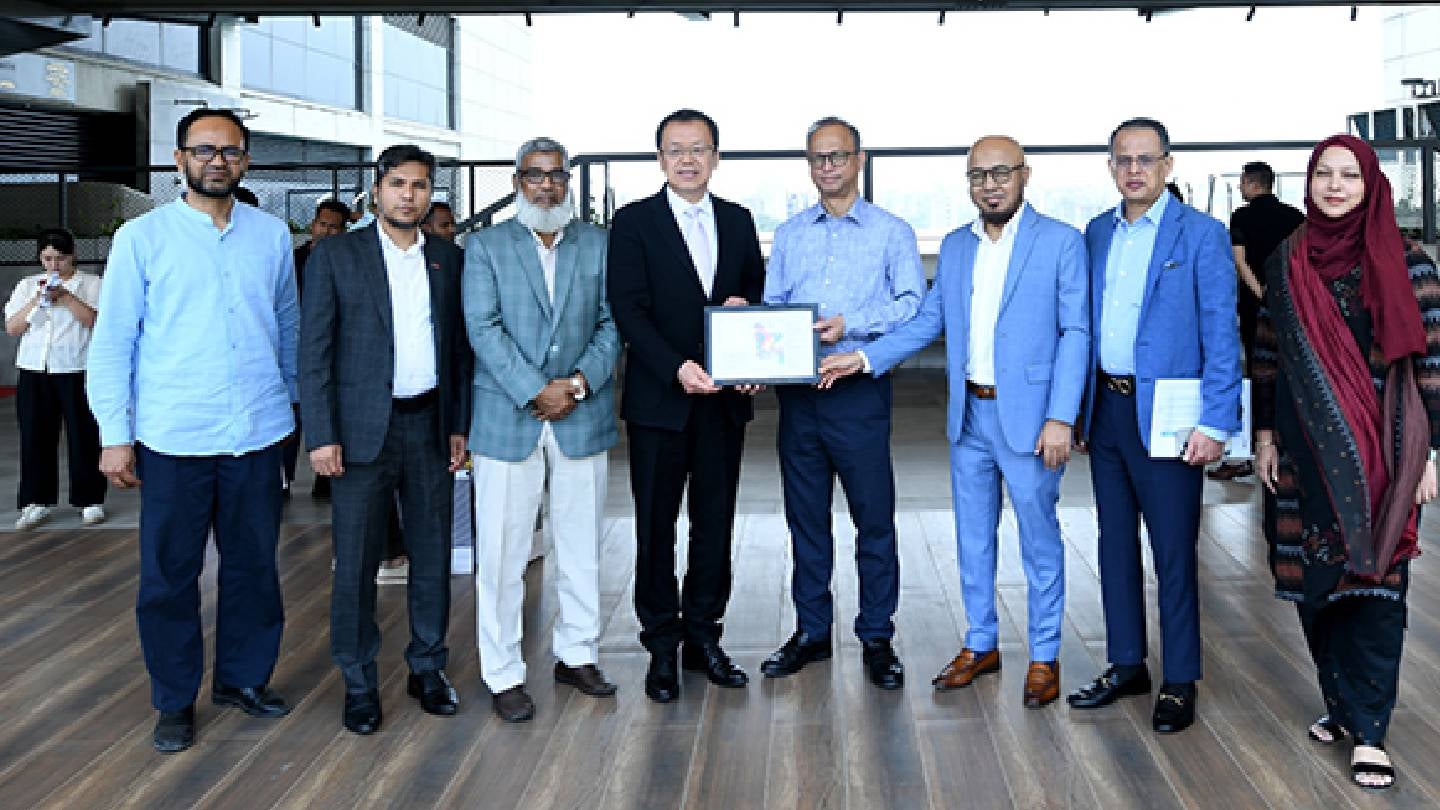
The meeting, held at the BGMEA Complex in Uttara in Dhaka on 26 April 2026, brought together senior officials from CNTAC and the China Dyeing and Printing Association (CDPA), as well as chairmen and general managers of major Chinese dyeing, printing, finishing and chemical companies.
Top BGMEA leaders were also present, including president Mahmud Hasan Khan, vice president Md Shehab Udduza Chowdhury and directors.
Discover B2B Marketing That Performs
Combine business intelligence and editorial excellence to reach engaged professionals across 36 leading media platforms.
The talks highlighted Chinese support and direct investment as key themes, alongside discussions on technological collaboration, knowledge exchange and potential access to new markets.
During the meeting, Mahmud Hasan Khan identified China as a long-standing and trusted trade partner of Bangladesh, as well as a major supplier of raw materials and machinery for the country’s apparel industry.
Bangladesh is a major importer of woven fabrics, with an annual import market valued at $8–9bn.
President Mahmud Hasan Khan called on Chinese investors to explore Bangladesh’s emerging sectors, especially man-made fibres, synthetic fibres and technical textiles.
He outlined investment openings for Chinese companies to enter these sectors either independently or through joint ventures, with BGMEA offering strategic support.
Chinese firms can also set up operations in Bangladesh independently or with local partners and avail themselves of duty-free access to Japan under the Bangladesh–Japan EPA framework when exporting from Bangladesh.
In addition, the BGMEA president called for the need for ongoing technical training and structured knowledge-sharing to build capacity in advanced areas such as digital printing and synthetic fabrics.
The meeting follows reports that a high-level Chinese investor delegation from multiple industrial sectors held talks with BGMEA last December on joint investment opportunities in the diversified products segment.
Facts Only
* The meeting was held at the BGMEA Complex in Uttara, Dhaka, on April 26, 2026.
* Participants included senior officials from CNTAC and the China Dyeing and Printing Association (CDPA), along with chairmen and general managers of major Chinese dyeing, printing, finishing, and chemical companies.
* Top BGMEA leaders present included President Mahmud Hasan Khan and Vice President Md Shehab Udduza Chowdhury.
* Mahmud Hasan Khan identified China as a long-standing and trusted trade partner of Bangladesh.
* Bangladesh is a major importer of woven fabrics, with an annual import market valued at $8–9bn.
* Mahmud Hasan Khan called on Chinese investors to explore Bangladesh’s emerging sectors, specifically man-made fibers, synthetic fibers, and technical textiles.
* Investment openings were outlined for Chinese companies to enter these sectors independently or through joint ventures, with BGMEA support.
* Chinese firms can set up operations independently or with local partners and access duty-free entry to Japan under the Bangladesh–Japan EPA framework when exporting from Bangladesh.
* The BGMEA president called for technical training and structured knowledge-sharing in advanced areas such as digital printing and synthetic fabrics.
* The meeting follows reports of prior talks between a high-level Chinese investor delegation and BGMEA in December regarding joint investment opportunities in the diversified products segment.
Executive Summary
A meeting was held at the BGMEA Complex in Uttara, Dhaka, on April 26, 2026, bringing together senior officials from the China Dyeing and Printing Association (CDPA), the CNTAC, and major Chinese dyeing, printing, finishing, and chemical companies. Top BGMEA leaders, including President Mahmud Hasan Khan and Vice President Md Shehab Udduza Chowdhury, attended the discussion.
The talks centered on Chinese support and direct investment, technological collaboration, knowledge exchange, and access to new markets. President Mahmud Hasan Khan emphasized China’s role as a long-standing trade partner and supplier of raw materials and machinery for the apparel industry. He called for Chinese investors to explore Bangladesh’s emerging sectors, particularly man-made fibers, synthetic fibers, and technical textiles, offering strategic support through the BGMEA. Furthermore, Chinese firms were given the option to establish operations independently or via joint ventures, and to benefit from duty-free access to Japan under the Bangladesh–Japan EPA framework when exporting from Bangladesh. The meeting concluded with a call for ongoing technical training and knowledge-sharing to enhance capacity in areas like digital printing and synthetic fabrics.
Full Take
The narrative constructs a relationship framework heavily reliant on the stated trust between China and Bangladesh, framing investment and cooperation as mutually beneficial opportunities for the latter. The emphasis on China as a "trusted trade partner" and a major supplier subtly establishes an asymmetry of power, positioning Chinese investment as a key driver for Bangladesh's industrial development. The call for Chinese investment into specific sectors (man-made fibers, technical textiles) serves to direct capital flow toward areas where Bangladesh has noted import dependencies, aligning these economic needs with the proposed cooperative mechanisms.
The structure of the opportunities presented—independent entry versus joint ventures, and linking investment with specific duty-free access to Japan—suggests a carefully calibrated mechanism designed to maximize economic integration while maintaining a hierarchical structure. The push for technical training in advanced areas like digital printing and synthetic fabrics functions not merely as capacity building but as a mechanism for knowledge transfer that reinforces the dependence on external expertise and technological frameworks.
The underlying pattern is the framing of economic necessity as a gateway for bilateral engagement. This approach leverages a perception of shared history and trade volume to advance specific policy goals, potentially overlooking the need for nuanced, locally driven strategic development. The implied assumption is that unlocking these opportunities automatically translates into sustainable, equitable growth for the local workforce and industry, a premise that requires critical scrutiny regarding who bears the costs and who controls the resulting trajectory.
Sentinel — Human
The text exhibits the structure and detail of human-written journalistic reporting, grounded in specific event details, making synthetic origin unlikely.