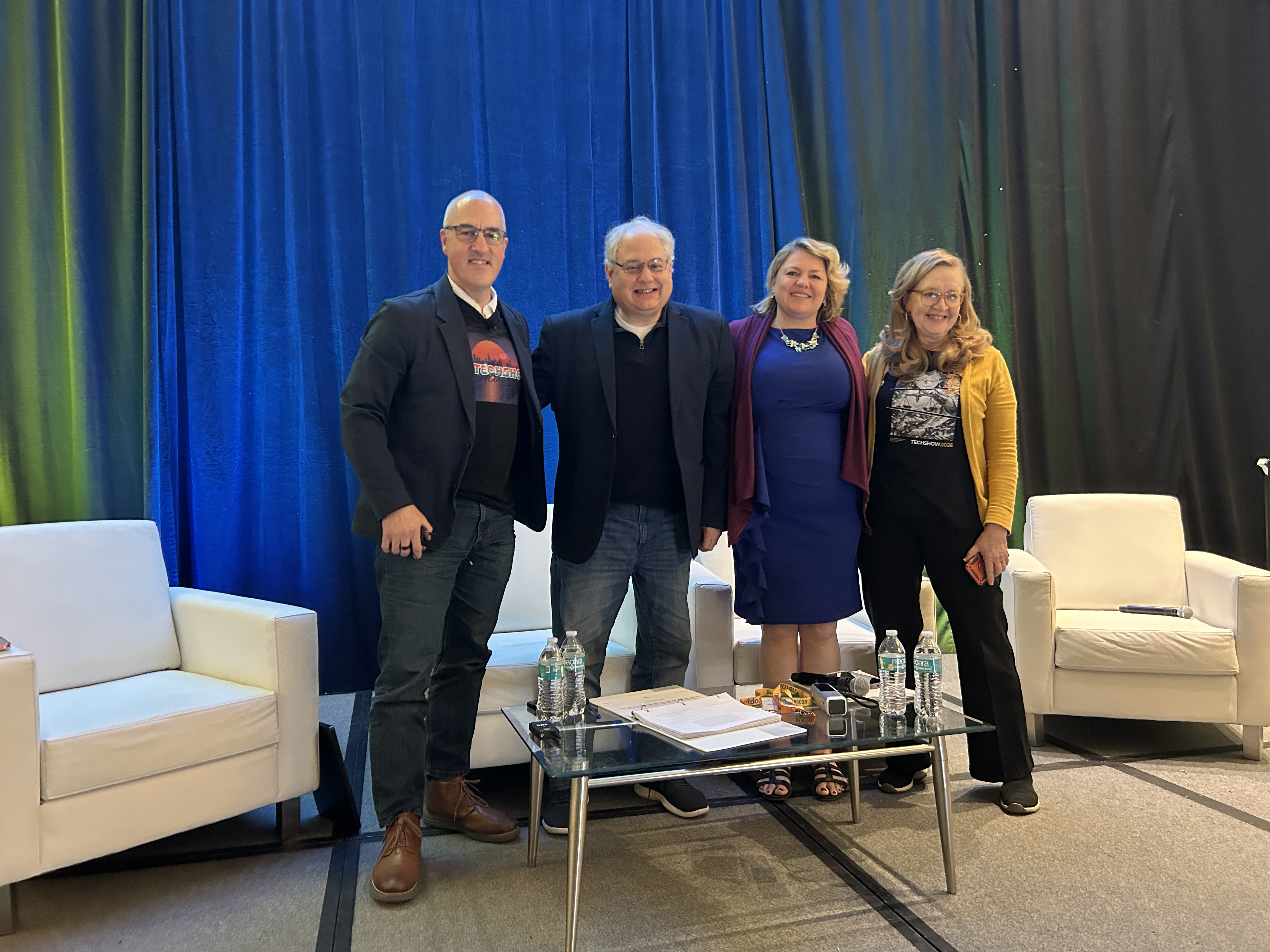
Techshow's '60 in 60' features mix of tips and tools for lawyers
What busy lawyers wouldn’t want apps and advice that improve both their personal and professional lives?
That was a common theme during “60 in 60,” the final fast-paced event at ABA Techshow on Saturday that featured the latest tips, technologies and tools in 60 minutes or less.
Among many multi-purpose tools, ABA Techshow co-chair Patrick Wright highlighted Vasco Translator Q1, which allows you to translate calls, texts and images.
“I love traveling, but I also have cases where I have documents from other countries,” said Wright, the managing partner of the Wright Firm in the Dallas-Fort Worth area who referred to one involving a lot of Japanese and Chinese texts. “I wish I would’ve had this then.”
“It also has a photo translator, so you can translate menus, timetables—it’s a really neat product,” he added.
The slides for the full presentation are available here.
Brett Burney, the other Techshow co-chair, highlighted another product that benefits lawyers on the go: gallium nitride power chargers. They’re not silicon-based like older chargers, which means they’re more efficient and don’t get as hot, he said. Many options, including the PlugBug from Twelve South, allow you to charge multiple devices at one time.
“So, instead of carrying four different adapters, I have one I carry that I plug all four [devices] into,” said Burney, the founder of Burney Consultants in Ohio. “It gives you more power.”
Artificial intelligence tools were the talk of Techshow, and the same held true at “60 in 60.”
Follow along with the ABA Journal’s coverage of the ABA Techshow 2026 here.
Ruby Powers, a member of the Techshow board, introduced several AI-powered options for increasing work productivity. Candle AI, which was this year’s second-place Startup Alley finisher, can read your case data to draft professional emails that sound like you, she said.
Other tools Powers found helpful are DraftyAI, which generates drafts of complex immigration motions, petitions and contracts; and Google NotebookLM, which can turn a complex file into an AI-generated “podcast” with its new audio overview feature.
“It could be a file or an article, and what I’ll do is I’ll upload it so when I’m driving somewhere, I can be listening, learning and getting to where I need to go at the same time,” said Powers, an immigration attorney from Houston, Texas.
Skribe.AI, a digital court reporting platform; Plaud, an AI note taker; and Trellis, an AI-powered legal research platform for state trial courts, were a few of the other tools discussed by the panelists.
Tools that don’t rely on AI but boost productivity just the same also made the list of 60 recommendations.
Burney offered several tips involving the iPhone, including how to use it to scan documents and add Face ID to specific apps to boost security. He also provided advice on how to more efficiently use Microsoft Word. For instance, he demonstrated how to narrow changes made in a document to one specific person.
Shawn Holahan, the fourth panelist who is also a member of the Techshow Board, brought up several tangible assets lawyers could use in their daily lives. Among these were a travel printer, a portable monitor and an airplane-worthy phone mount.
“This allows you to hook it to a tray table,” Holahan, practice management and loss prevention counsel for the Louisiana State Bar Association, said of the phone mount. “It can also act as an impromptu podium if you need it for a Zoom call.”
Judging by the audience’s reaction, Holahan also highlighted one of the event’s most intriguing products: Al Dente Red, a floating timer that sings in different tunes, including “That’s Amore!” and the theme from The Godfather when pasta is ready.
Write a letter to the editor, share a story tip or update, or report an error.
Facts Only
ABA Techshow's "60 in 60" session featured tools and tips for lawyers.
Co-chair Patrick Wright highlighted the Vasco Translator Q1 for translating calls, texts, and images.
Wright is the managing partner of the Wright Firm in the Dallas-Fort Worth area.
Co-chair Brett Burney discussed gallium nitride power chargers, which are more efficient and cooler than silicon-based chargers.
Burney is the founder of Burney Consultants in Ohio.
Ruby Powers introduced AI tools like Candle AI, DraftyAI, and Google NotebookLM.
Candle AI can draft professional emails based on case data.
DraftyAI generates drafts of immigration motions, petitions, and contracts.
Google NotebookLM can turn complex files into AI-generated audio overviews.
Powers is an immigration attorney from Houston, Texas.
Other tools mentioned included Skribe.AI, Plaud, and Trellis.
Shawn Holahan discussed tangible tools like a travel printer, portable monitor, and phone mount.
Holahan is practice management and loss prevention counsel for the Louisiana State Bar Association.
The session took place at ABA Techshow on Saturday.
Slides from the presentation are available online.
The event lasted 60 minutes or less.
The audience reacted positively to a floating pasta timer called Al Dente Red.
Executive Summary
The ABA Techshow's "60 in 60" session showcased a variety of tools and tips designed to enhance productivity for legal professionals. Co-chairs Patrick Wright and Brett Burney highlighted practical technologies, such as the Vasco Translator Q1 for multilingual document translation and gallium nitride power chargers for efficient device charging. AI-powered tools like Candle AI, DraftyAI, and Google NotebookLM were emphasized for their ability to streamline legal workflows, from drafting emails to generating complex legal documents. Other notable mentions included Skribe.AI for court reporting, Plaud for note-taking, and Trellis for legal research. Non-AI tools, such as iPhone security features and portable office equipment, were also discussed. The session aimed to provide lawyers with actionable solutions to improve both personal and professional efficiency.
The event reflected broader trends in legal technology, particularly the growing integration of AI to automate routine tasks. While AI tools were a focal point, traditional productivity enhancers like travel printers and phone mounts were also presented as valuable assets. The audience responded positively to innovative products, including a novelty pasta timer, underscoring the session's blend of practicality and creativity. Overall, the presentation offered a snapshot of how technology is reshaping legal practice, with a focus on accessibility and efficiency.
Full Take
The "60 in 60" session at ABA Techshow exemplifies the legal profession's accelerating embrace of technology, particularly AI, to enhance productivity. The strongest version of this narrative is that legal professionals are increasingly adopting tools that automate repetitive tasks, from document translation to drafting legal motions, freeing up time for higher-value work. The presentation balanced AI-driven solutions with practical, non-AI tools, acknowledging that not all productivity gains require cutting-edge technology. This reflects a pragmatic approach to innovation, where utility trumps hype.
However, the enthusiasm for AI tools raises questions about dependency and oversight. While tools like Candle AI and DraftyAI promise efficiency, they also introduce risks of over-reliance on automated systems, potential biases in AI-generated content, and the ethical implications of delegating legal drafting to algorithms. The session did not delve into these concerns, focusing instead on the immediate benefits. This aligns with a broader pattern in tech adoption where convenience often outpaces critical scrutiny—a classic case of **ARC-0024 Ambiguity**, where the long-term implications of AI integration are glossed over in favor of short-term gains.
The paradigm driving this narrative is the legal profession's response to the pressure of increasing workloads and the need for efficiency. The unstated assumption is that technology, particularly AI, is an unalloyed good that will inevitably improve legal practice. This echoes historical patterns of technological optimism, where new tools are initially celebrated without sufficient consideration of their broader societal impacts. For human agency, the implications are mixed: while these tools may reduce drudgery, they also risk eroding the nuanced judgment that defines legal expertise.
Bridge questions: How might the legal profession balance the efficiency gains of AI with the need for human oversight? What safeguards should be in place to ensure AI tools do not perpetuate biases or errors in legal work? Would the adoption of these tools change if their limitations were more prominently discussed?
Counterstrike scan: If this were part of a coordinated influence campaign, the playbook would emphasize the inevitability and necessity of AI adoption in legal practice, downplaying risks to accelerate market penetration. The actual content does not fully match this pattern, as it includes a mix of AI and non-AI tools, suggesting a more balanced perspective. However, the lack of critical discussion about AI's limitations could still serve to normalize its use without sufficient scrutiny.
Patterns detected: ARC-0024 Ambiguity