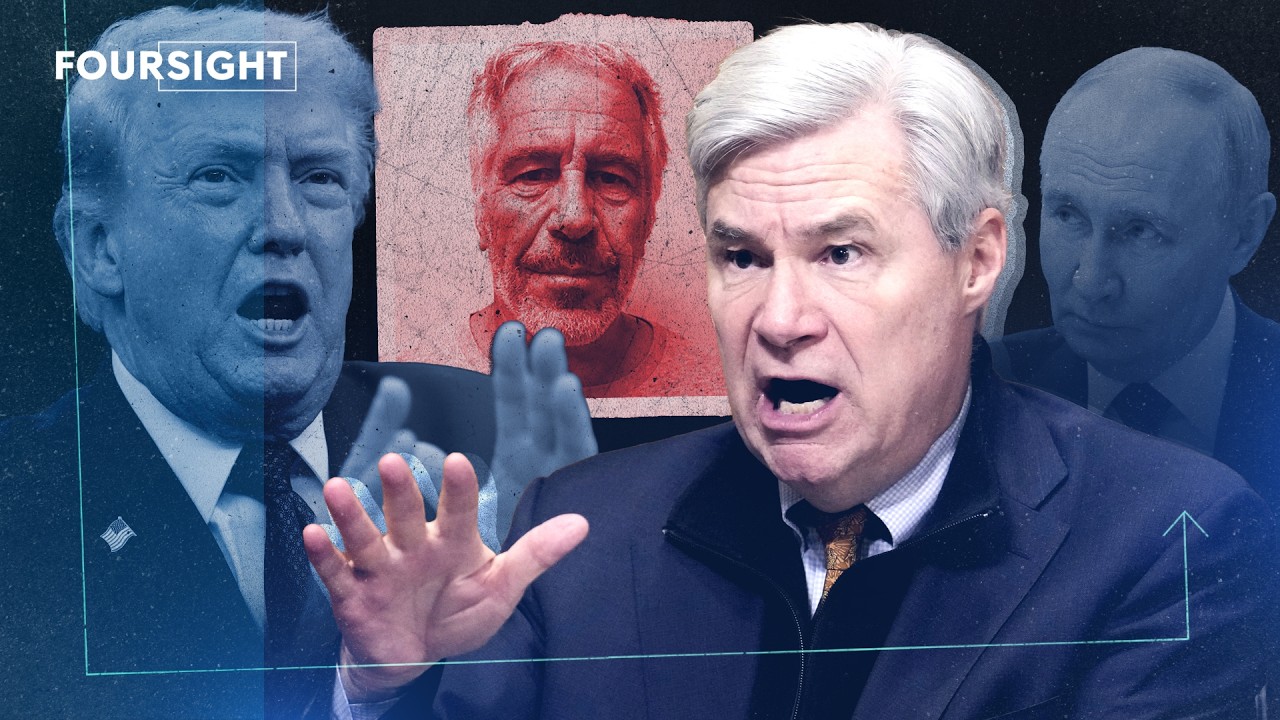
Title: Is the DoJ covering up links between Epstein, Trump and Russia? | FourSight interview
Channel: Channel 4 News
Published: 2026-04-03
Duration: 16:41
Views: 117,603
Description:
Senator Sheldon Whitehouse recently gave a speech on the floor of the Senate criticising Pam Bondi and the Department of Justice for failing to investigate alleged links between President Trump, Jeffrey Epstein and Russia. It was watched millions of times.
Senator Whitehouse claims Epstein could have passed Vladimir Putin or other key Russia figures so-called kompromat - compromising material - on Trump. And that, he claims, could explain the President’s relationship with Putin - particularly throughout the Ukraine war.
President Trump has called claims of kompromat “fake news”, and previously said allegations of links to Russia are “a hoax” and a “witch hunt” instigated by his political opponents. Vladimir Putin has also denied Russia having any compromising material on the US President.
We wanted to hear from Senator Whitehouse just what it’s been like for politicians in the US as they try to wade through the Epstein Files and deal with the Department of Justice - which has been widely criticised for its handling of the files.
You can watch Senator Whitehouse’s speech here: https://youtu.be/ylvTFvJvB84
And watch our episode of FourSight where we revealed dozens of missing terabytes in the Epstein Files: https://youtu.be/Hw0glF_8Smc
And our last video where we looked at why the Met Police in London haven’t ever investigated former Prince Andrew: https://www.youtube.com/watch?v=OBe_D63fa44
Presenter: Kiran Moodley
Editor: Matthew Lucas
Motion Graphics: Ian Watkins
Series Producer: Kieron Bryan
Thanks to Senator Sheldon Whitehouse.
#Epstein #EpsteinFiles #PamBondi #Trump #Russia
Get more news at our site - https://www.channel4.com/news/
Subscribe to our Substack newsletter: https://channel4news.substack.com/subscribe
Follow us:
TikTok - https://www.tiktok.com/@c4news
Instagram - https://www.instagram.com/channel4news/
Twitter - https://twitter.com/Channel4News
Facebook - https://www.facebook.com/Channel4News/
Facts Only
Senator Sheldon Whitehouse delivered a speech on the Senate floor criticizing the Department of Justice and Pam Bondi.
The speech focused on alleged links between President Trump, Jeffrey Epstein, and Russia.
Whitehouse suggested Epstein may have provided kompromat on Trump to Vladimir Putin or other Russian figures.
Trump has called claims of kompromat "fake news" and allegations of Russia links a "hoax" and "witch hunt."
Putin has denied Russia has any compromising material on Trump.
The Department of Justice has been criticized for its handling of the Epstein Files.
Channel 4 News reported on missing terabytes in the Epstein Files.
The Metropolitan Police in London have not investigated former Prince Andrew's ties to Epstein.
Whitehouse's speech was widely viewed, with millions of views.
The video includes references to previous Channel 4 News reports on the Epstein Files and Prince Andrew.
The segment is part of Channel 4 News' FourSight series.
The video was published on April 3, 2026, and has over 117,000 views.
Executive Summary
Senator Sheldon Whitehouse delivered a speech on the Senate floor criticizing the Department of Justice (DoJ) and former Florida Attorney General Pam Bondi for failing to investigate alleged connections between President Trump, Jeffrey Epstein, and Russia. Whitehouse suggested that Epstein may have provided Russian officials, including Vladimir Putin, with compromising material ("kompromat") on Trump, potentially explaining Trump's relationship with Putin, particularly during the Ukraine war. Trump has dismissed these claims as "fake news" and a "witch hunt," while Putin has denied Russia possesses any such material. The DoJ has faced criticism for its handling of the Epstein Files, which reportedly contain missing terabytes of data. Channel 4 News has previously reported on the lack of investigation by London's Metropolitan Police into former Prince Andrew's ties to Epstein. The narrative remains contested, with no definitive evidence presented to substantiate the claims of kompromat or direct collusion.
The situation reflects broader tensions in U.S. politics regarding accountability, transparency, and the intersection of power, influence, and justice. While Whitehouse's speech has garnered significant attention, the allegations remain unproven, and key figures involved have denied any wrongdoing. The debate underscores ongoing concerns about the integrity of investigations into high-profile figures and the potential for foreign interference in domestic politics.
Full Take
The strongest version of this narrative posits that the Department of Justice, under political pressure or institutional failure, has neglected to thoroughly investigate credible allegations linking Trump, Epstein, and Russia. Senator Whitehouse’s speech frames this as a systemic issue, suggesting that kompromat could explain Trump’s perceived deference to Putin, particularly in geopolitical conflicts like the Ukraine war. The narrative gains traction from the unresolved mysteries of the Epstein Files—missing data, unanswered questions—and the broader context of Epstein’s connections to powerful figures. However, the claims remain speculative, with no direct evidence presented in this segment.
Patterns detected: ARC-0024 Ambiguity (reliance on unproven allegations without definitive evidence), ARC-0043 Motte-and-Bailey (shifting between broad claims of corruption and specific but unverified allegations of kompromat).
The root cause of this narrative lies in the intersection of political polarization, institutional distrust, and the enduring fascination with Epstein’s network. The assumption that power operates through hidden leverage—kompromat, blackmail, or covert influence—echoes Cold War-era espionage tropes, updated for the digital age. The lack of transparency in the Epstein case fuels conspiracy theories, while the DoJ’s perceived inaction reinforces narratives of systemic cover-ups.
Implications for human agency and dignity are significant. If true, the allegations suggest that democratic accountability is undermined by unseen forces, eroding public trust. If false, the narrative risks weaponizing speculation to delegitimize political opponents, further polarizing discourse. The second-order consequences include the normalization of conspiracy-driven politics, where unverified claims gain traction through repetition and emotional resonance rather than evidence.
Bridge questions: What evidence would be required to substantiate or refute the kompromat claims? How does the lack of transparency in the Epstein case affect public trust in institutions? What alternative explanations exist for Trump’s relationship with Putin, beyond kompromat?
Counterstrike scan: A coordinated influence campaign would amplify unverified claims, exploit institutional distrust, and frame the narrative as a battle between truth-seekers and corrupt elites. The actual content aligns partially with this pattern—leveraging ambiguity and institutional criticism—but stops short of outright fabrication or malicious intent. The focus remains on raising questions rather than asserting falsehoods, which is a healthier, if still speculative, approach.