Chinese astronomers noticed a star burning brightly in the daytime that persisted for three weeks, back in 1054 A.D.—and they weren’t alone. On the other side of the globe, Mayan stargazers recorded the same brilliant celestial phenomenon.
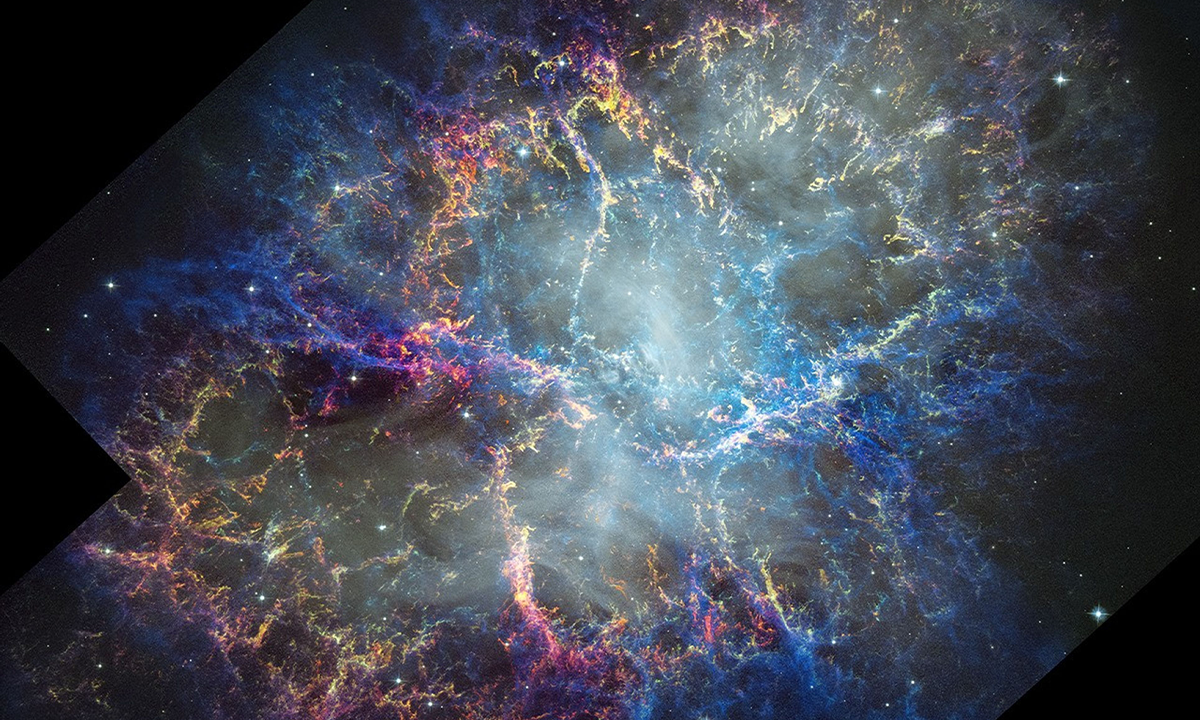
What they witnessed, according to famed astronomer Edwin Hubble writing almost 900 years later, wasn’t a star at all but rather the explosive death of one. That dazzling supernova would later become the Crab Nebula, and the space telescope that bears Hubble’s name recently snapped an incredible picture of it a quarter century after the first image it took.
By comparing the two images, NASA astronomers like William Blair of Johns Hopkins University can track how the nebula has evolved over time. According to Blair, the newly released image shows how the filaments of gas at the outer edges of the nebula have moved more over the past 25 years than those closer to the center. Rather than simply stretching farther outward, they appear to be moving away from the center of the nebula. That’s because at the heart of the gas cloud lies a rapidly spinning neutron star—a pulsar—whose magnetic field whips the gas into a rapidly moving whirlwind of charged particles. The outer filaments of the Crab Nebula are estimated to be moving at 3.4 million miles per hour.
Read more: “The Inside of a Neutron Star Looks Spookily Familiar”
“We tend to think of the sky as being unchanging, immutable,” Blair said in a statement. “However, with the longevity of the Hubble Space Telescope, even an object like the Crab Nebula is revealed to be in motion, still expanding from the explosion nearly a millennium ago.”
Ancient astronomers never could have even imagined getting a view like this.
Enjoying Nautilus? Subscribe to our free newsletter.
Lead image: NASA, ESA, STScI, William Blair (JHU); Image Processing: Joseph DePasquale (STScI)
Facts Only
Event: Observation of a supernova in 1054 A.D. by Chinese and Mayan astronomers
Result: Creation of the Crab Nebula
Timeframe: Approximately 1,000 years ago to present day
Locations: China, Mayan civilization, space (Crab Nebula)
Actors: Chinese and Mayan astronomers, Edwin Hubble, William Blair of Johns Hopkins University, NASA
Instrument: Hubble Space Telescope
Executive Summary
Full Take
The article presents a clear example of scientific progress and collaboration across time and geography, as ancient astronomers' observations of a supernova are corroborated by modern telescopic imagery. However, the interpretation of these events raises questions about the nature of stars and their explosive deaths, which continue to be explored by scientists.
One potential pattern to consider is ARC-0024 Ambiguity, as the article does not specify the exact type of star that underwent the supernova event or provide a detailed explanation of how the neutron star's magnetic field causes movement in the outer filaments of the nebula.
By examining the evolution of the Crab Nebula over time, this study sheds light on the complex interplay between celestial bodies and forces, offering insights into the physical properties of stars, neutron stars, and supernovae. However, further research is needed to fully understand these phenomena and their implications for the wider universe.
Questions for further inquiry might include: What specific type of star underwent the supernova event? How does the magnetic field of a neutron star cause movement in its surrounding gas filaments? What other factors contribute to the expansion and evolution of the Crab Nebula?
Sentinel — Human
This text appears to be human-written. It exhibits irregular sentence length variance, a clear personal voice, and an original argumentative structure.