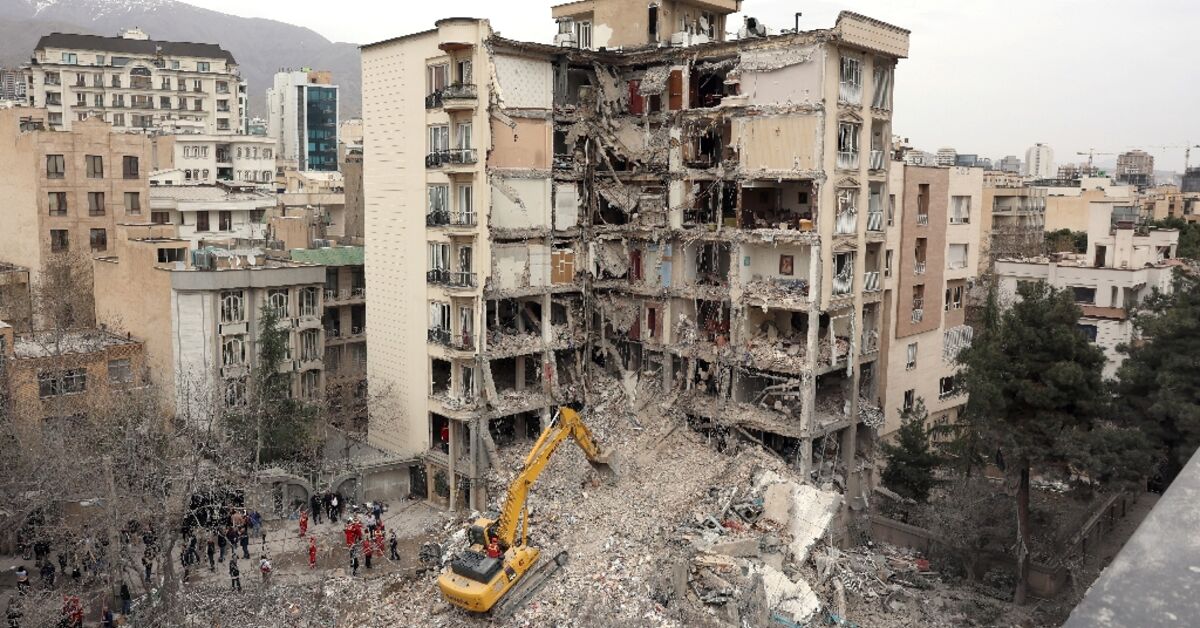
Iran has not updated its official death toll figures for weeks, while human rights groups outside the country are struggling with chronic communication problems, meaning the number of people killed during the war remains largely unknown.
The last time Iran's health ministry gave a full update about casualties was on March 8, the ninth day of the conflict, when it said around 1,200 civilians had been killed in US and Israeli airstrikes across the country.
Overseas human rights groups have long been considered one of the most reliable sources of information about life inside the heavily censored Islamic republic.
But with Iran's connections to the global internet cut off and phone lines down, they are struggling to reach their networks of contacts who are their eyes and ears on the ground.
The US-based Human Rights Activists News Agency (HRANA), which played an important role corroborating deaths during anti-government protests in January, estimates the civilian death toll at 1,407 people, including 214 children.
"I would say it's an absolute, absolute minimum, and that's simply because we don't have the capacity to be everywhere at one time, understanding the full extent of what's happening," HRANA deputy director Skylar Thompson told AFP.
"With the scale and the speed at which places are being targeted across the country, it's impossible to document it at the same pace," she added.
The Iranian Red Crescent is not providing casualty estimates, but its latest figures indicate 61,555 homes, 19,000 businesses, 275 medical centres, and nearly 500 schools have been damaged.
AFP journalists have been able to confirm that many civilian buildings in Tehran have been damaged, including apartment blocks caught in the blast wave of nearby missile or bomb strikes, but not beyond the city.
Reporters are unable to travel around the country without official authorisation.
- Connection problems -
Distrust of Iran's official figures is high among human rights groups, particularly after the bloody crackdown on anti-government protests in January.
Although Iran acknowledged around 3,000 deaths, mostly among security forces, researchers and campaigners outside Iran estimated that anywhere from 7,000 to 35,000 people were killed in the indiscriminate shooting.
"The Islamic republic has a history of not publishing or not collecting data," Awyar Shekhi from the Norway-based human rights group Hengaw told AFP.
The problem for Hengaw and others seeking to provide a credible alternative to the incomplete official data has been the almost-total shutdown of Iran's internet connections to the outside world since the start of the war on February 28.
"The connection is worse than it ever was before, so it's really difficult to get accurate data of how many people have been killed, and the information we get is so little," Shekhi added.
Both she and Thompson stressed that Iranian authorities have been threatening and arresting people who have illegally accessed the global internet to send information abroad, sometimes accusing them of spying.
Making telephone calls to Iran from abroad is also largely impossible.
- 'Focus on the civilian harm' -
The biggest loss of life for civilians in the war so far was the airstrike on an elementary school in Minab on the first day of the war that killed at least 165 people, according to an official toll.
A US Tomahawk cruise missile hit the school because of a targeting mistake, according to the preliminary findings of a US military investigation reported by The New York Times.
Hengaw also documented an airstrike on a flour factory in the city of western Naqadeh on March 7 that killed 11 workers and injured another 21.
"I believe that the US and Israel are using a quite aggressive interpretation of what is a military target," Thompson from HRANA added.
Unlike in January, during the anti-government protests, she said there had so far been relatively little attention in the Western media on the toll of ordinary Iranians.
"There's such a focus on the geopolitics of it all, I think it's really important to have a focus on the civilian harm," she added.
Elsewhere in the region, Lebanon's health ministry said Israeli strikes had killed 1,029 people in the country.
A total of 16 civilians have been killed by Iranian attacks in Israel and 17 civilians have been killed in Gulf countries, according to authorities and emergency services there.
Facts Only
Iran's health ministry last updated civilian casualty figures on March 8, reporting around 1,200 deaths from US and Israeli airstrikes.
Human rights groups, including HRANA, estimate at least 1,407 civilian deaths, including 214 children.
Iran's internet and phone connections have been cut off, hindering communication with sources inside the country.
The Iranian Red Crescent reports damage to 61,555 homes, 19,000 businesses, 275 medical centers, and nearly 500 schools.
AFP journalists confirmed damage to civilian buildings in Tehran but cannot travel freely without official authorization.
Human rights groups distrust Iran's official figures, citing past discrepancies, such as the January protests where external estimates ranged from 7,000 to 35,000 deaths.
Iranian authorities have threatened and arrested individuals accessing the global internet to send information abroad.
A US airstrike on an elementary school in Minab on February 28 killed at least 165 people, according to official figures.
Lebanon's health ministry reports 1,029 deaths from Israeli strikes.
Israeli and Gulf authorities report 16 and 17 civilian deaths, respectively, from Iranian attacks.
Executive Summary
Full Take
The strongest version of this narrative highlights the severe information asymmetry in conflict zones, where state censorship and infrastructure disruptions create a vacuum filled by unreliable official data and fragmented external estimates. The article rightly emphasizes the challenges faced by human rights groups in verifying casualties, a critical issue for accountability. However, the reliance on Western-based NGOs and the framing of US/Israeli actions as "targeting mistakes" without equivalent scrutiny of Iranian military operations may reflect an implicit bias. The pattern of distrust in Iranian official figures is well-documented, but the absence of comparable skepticism toward US military investigations (e.g., the Minab school strike) could reinforce a "good vs. evil" binary.
Patterns detected: ARC-0024 Ambiguity (lack of clarity on how external estimates are derived), ARC-0043 Motte-and-Bailey (focusing on civilian harm while downplaying geopolitical context).
Root cause: The narrative operates within a paradigm of "information warfare," where casualty figures become weapons in a broader legitimacy struggle. The unstated assumption is that Western sources (HRANA, US military) are inherently more credible than Iranian ones, despite their own limitations. This echoes Cold War-era propaganda dynamics, where civilian suffering is instrumentalized to score political points rather than addressed as a humanitarian crisis.
Implications: The erosion of trust in all institutions—governmental, military, and NGOs—undermines collective agency. Civilians bear the brunt of both physical violence and epistemological chaos, unable to access reliable information to make life-or-death decisions. Second-order consequences include the normalization of internet shutdowns as a tool of war and the further polarization of global audiences along pre-existing fault lines.
Bridge questions: How might casualty verification mechanisms be designed to operate independently of state and NGO biases? What would it look like to center civilian voices in conflict reporting rather than geopolitical narratives? Under what conditions would you trust a casualty figure from any party in this conflict?
Counterstrike scan: A coordinated influence campaign would amplify civilian suffering to delegitimize one side while ignoring or justifying the other's actions. The actual content does not fully match this pattern, as it acknowledges harm from multiple actors, but the selective emphasis on US/Israeli strikes over Iranian military operations could align with a playbook aimed at undermining Western credibility. The absence of Iranian civilian perspectives (beyond NGO estimates) is notable but not necessarily manipulative.
Sentinel — Human
The analyzed text is likely to be human-written, with characteristics such as erratic sentence length variance, a personal voice, and no apparent fabrication signals.