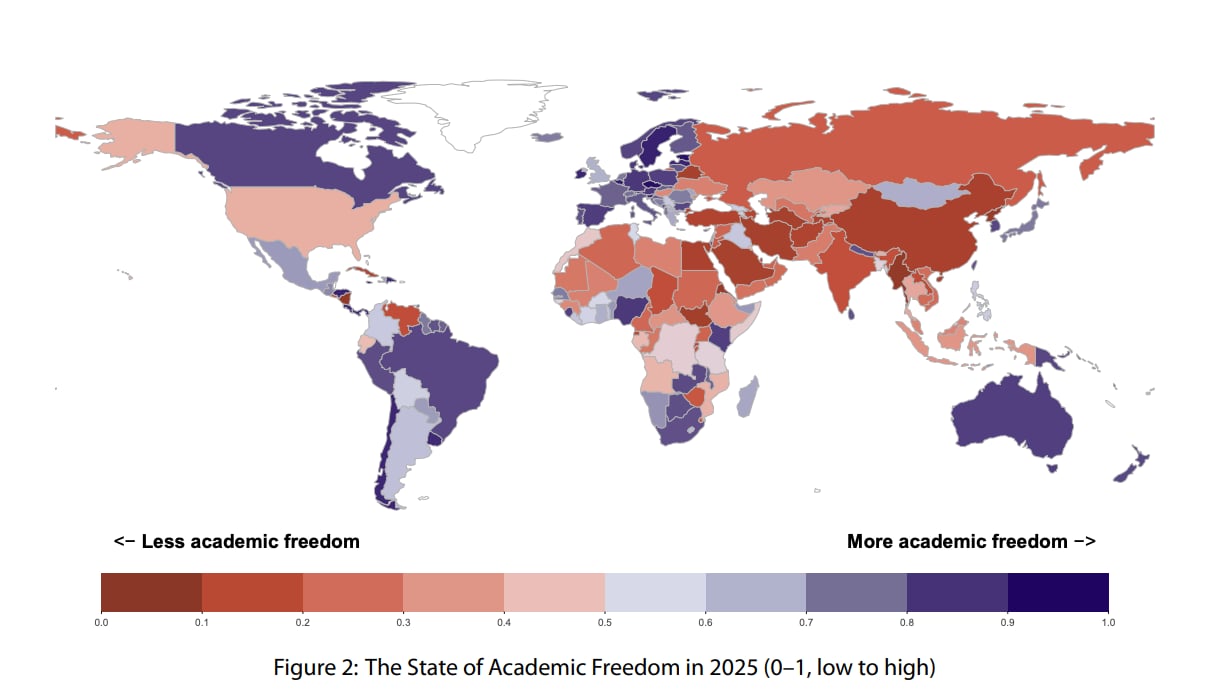
This week the Friedrich Alexander Universität Institute for Political Science and the V-Dem Institute released the 2026 update to their Academic Freedom Index. The United States shows a marked decline in just the past year to the bottom 30-40% of nations, with the report noting, “the decline in institutional autonomy in the United States stands out as a case of fast and steep deterioration.” This continues a conspicuous decline for the U.S. on this measure that began in 2019-2020.
The New York Times interviewed several professors to learn about their experiences teaching and conducting research amidst declining academic freedom. Christopher Kutz, a law professor at the University of California, Berkeley, told the Times, “I have to think very hard about whether it’s worth talking about something that’s obviously clearly relevant to the course.”
Many faculty, who disproportionately lean left, are restricting what they say in the classroom out of fear of political retaliation in a red-dominated climate of government intervention. Not long ago, however, it was right-of-center faculty who were disproportionately self-censoring. Some of these faculty now feel more free in aspects of their classroom expression in a climate where the dominance of left-wing identity politics is fading.
Jessica Trisko Darden, an associate professor of political science at Virginia Commonwealth University and HxA member, told the Times her classroom now feels more open for discussion without the pressure to center everything on identity. “My students are no longer circumscribed in their beliefs, opinions, analyses by identity categories that people are ascribing to them,” she explained.
This political dynamic has notably been playing out in the discipline of sociology. As I covered previously, the state of Florida has censored leftist viewpoints from their state-approved textbook for sociology. And many faculty are pushing back against the state censorship by “quietly defying” Florida’s new restrictions. “What I find most concerning is that we’re in this phase now where instead of telling us what not to teach, they’re telling us what to teach,” Zachary Levenson, sociologist at Florida International University, told The Guardian. “That feels especially terrifying and authoritarian.”
Several HxA members have been vocal in their support for reform of the discipline. Jukka Savolainen, a sociologist at Wayne State University, has called the government intervention in Florida “a wake-up call” for the discipline.
Instead of defending the ideologically corrupt status quo, we should listen to critics inside and outside the discipline… If this formerly exciting field of inquiry is to have a future, we must return to its roots. This will demand a collective commitment to impartial research and teaching. This shouldn’t be too much to ask. After all, it was a sociologist, Robert K. Merton (1910-2003), who formulated the enduring norms of science, which include organized skepticism and disinterestedness.
HxA member Ashley Rubin, a sociologist at University of Hawai'i at Mānoa, published an analysis of scholarship in American Journal of Sociology on her Substack this week “to explore whether and how the top articles in the field are homogenizing around ideologically preferred topic areas.” She finds that the identified trend of “woke” scholarship overall having peaked around 2021 has not replicated in this prominent disciplinary journal. Speaking with the Chronicle of Higher Education this week, she said, “if we don’t get our own house in order, we will see more of this government-led scrutiny or rules about what we can and cannot do.”
In other countries, Americans are experiencing broader academic freedom to pursue highly contentious work. Ghent University, located in Belgium, which is among the top 10% of institutions on the Academic Freedom Index, just appointed philosopher Nathan Cofnas to the position of postdoctoral fellow. His research, which focuses on the area of genetic variation among human groups, has drawn controversy in the form of a 300 signatory letter demanding explanation of his appointment, alleging his research violates the university’s code of ethics.
But many academics, including HxA president John Tomasi, have signed a counter-letter in support, arguing that “While we are not endorsing any specific claims Cofnas has made, we believe that academics must be able to put forward controversial or provocative claims without fear of losing their employment.”
Signatory Abhishek Saha, professor of mathematics at Queen Mary University of London and HxA member, explained that the demands to dismiss Cofnas “misunderstands both philosophy and academic freedom” and that “academic freedom exists precisely to protect contentious, controversial and offensive work.”
This gets at the heart of what we must do next. The uneven experience of academic freedom, increasingly along political lines, is a sign that we have failed to sustain genuine viewpoint diversity within our institutions. Without critical introspection and principled reform, outside actors will step in and make changes that sway with the political winds, causing turmoil for our institutions and diverting focus from what they should be doing: producing knowledge.
Related Articles
Your generosity supports our non-partisan efforts to advance the principles of open inquiry, viewpoint diversity, and constructive disagreement to improve higher education and academic research.
Facts Only
Friedrich Alexander Universität Institute for Political Science and V-Dem Institute released 2026 Academic Freedom Index update
United States shows marked decline in academic freedom, bottom 30-40% of nations
Decline in institutional autonomy in the United States began in 2019-2020 and accelerated
Christopher Kutz, law professor at University of California, Berkeley, speaks about self-censorship due to political retaliation
Jessica Trisko Darden, associate professor of political science at Virginia Commonwealth University, discusses open classroom discussion without identity politics pressure
Zachary Levenson, sociologist at Florida International University, voices concerns over government-led scrutiny and rules about teaching
Jukka Savolainen, sociologist at Wayne State University, calls Florida government intervention a wake-up call for the discipline
Ashley Rubin, sociologist at University of Hawai'i at Mānoa, analyzes scholarship in American Journal of Sociology for homogenizing ideologically preferred topic areas
Ghent University appoints philosopher Nathan Cofnas as postdoctoral fellow, despite controversy over his research on genetic variation among human groups
Signatories of counter-letter in support of Cofnas' appointment argue for academic freedom to protect contentious, controversial, and offensive work
Executive Summary
Full Take
This analysis will focus on the patterns of academic freedom and self-censorship discussed in the article.
**Steelman**: The article presents a balanced view of the declining academic freedom in the United States, citing examples of both left- and right-leaning faculty self-censorship due to political pressure. It also highlights international contrasts, such as the controversy surrounding a controversial philosopher's appointment at Ghent University in Belgium.
**Pattern Scan**:
Ambiguity (ARC-0024): The article does not provide clear definitions or distinctions of terms like "self-censorship," "political retaliation," and "political climate."
Systemic (ARC-0044): The article suggests a systemic issue of declining academic freedom in the United States, but does not explore potential root causes or historical patterns.
**Root Cause**: The article does not explicitly explore the root causes of the declining academic freedom in the United States. Potential factors could include increasing political polarization, changes in funding sources, or shifts in societal values.
**Implications**: The declining academic freedom in the United States may have significant implications for the country's higher education system, including a potential stifling of intellectual diversity and innovation.
**Bridge Questions**:
What are the root causes of the declining academic freedom in the United States?
How can academic institutions and policymakers promote and protect intellectual diversity and free expression?
What role do political, social, and economic factors play in shaping academic freedom?
**Counterstrike Scan**: The article does not present any clear signs of being part of a coordinated influence campaign. The discussion of academic freedom is a broad and ongoing topic, not tied to any specific current events or political narratives.