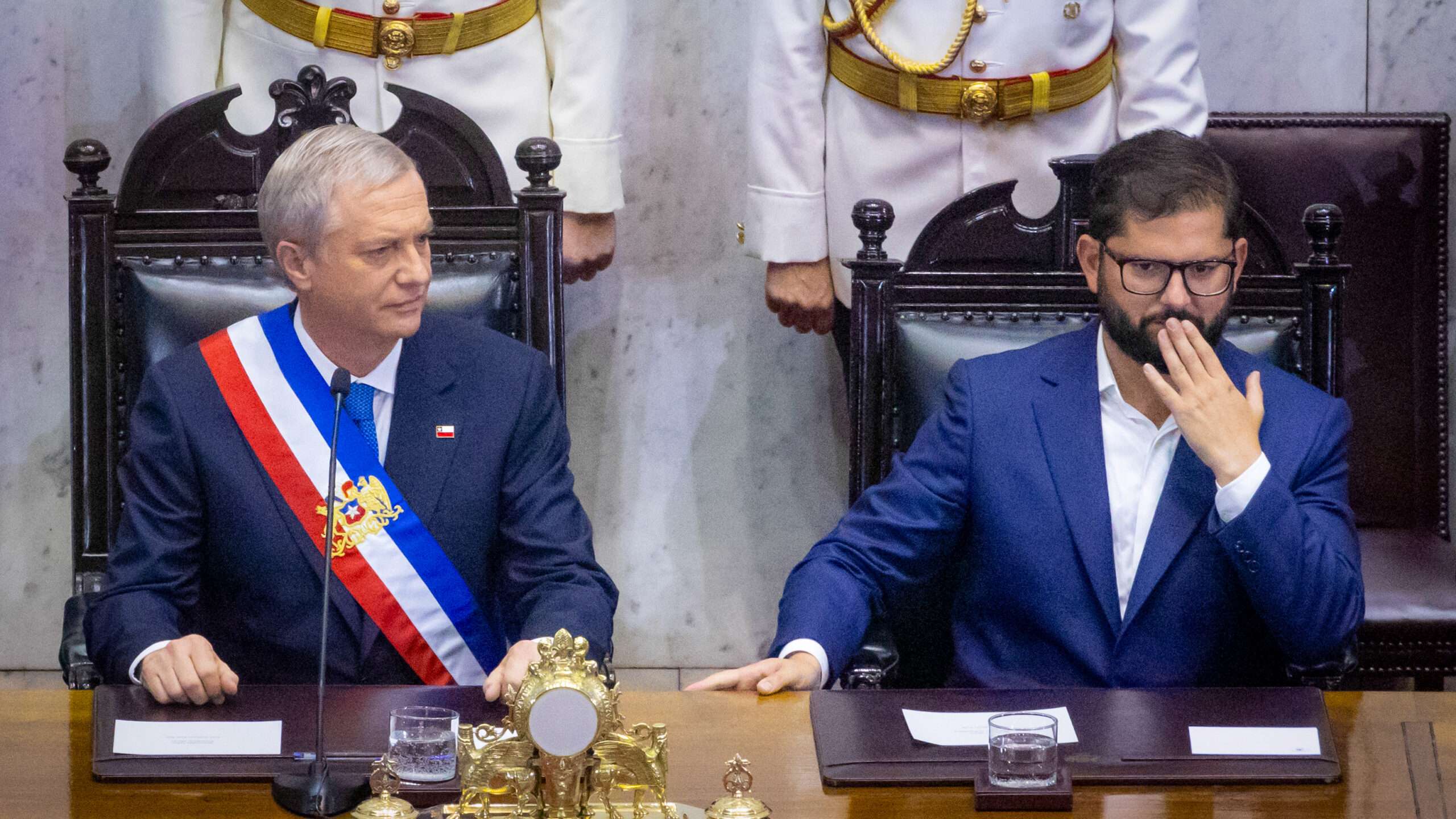
Outgoing President Gabriel Boric predicted that Chile would go from being neoliberalism’s “cradle” to its “grave.” His movement got buried instead.
Gabriel Boric, the former student radical who rode a wave of left-wing unrest into Chile's presidency in 2021, left office Wednesday, replaced by José Antonio Kast, a right-wing populist who secured a landslide victory last December. Boric's election was supposed to be a watershed moment for a country long held up as Latin America's free market success story; it appeared Chile was repudiating the liberal economic model that had defined it for decades. Yet the leftist project collapsed under its own weight, and the Chilean pendulum has since swung violently in the opposite direction. But Kast arrives with a different set of dangers.
The story begins in the 1970s, when Chile transitioned from socialism to free market capitalism during the murderous dictatorship of Augusto Pinochet. Under Pinochet's predecessor, the socialist President Salvador Allende, the inflation rate had reached over 600 percent, and the nation's economy had been on the verge of collapse. That origin left an indelible stain on what became one of the greatest economic success stories of the past half-century. Chile's free market reformers struck a Faustian bargain with the Pinochet regime: In exchange for looking the other way as thousands were tortured and disappeared, they were granted enormous latitude to slash regulations, cut tariffs, and privatize state-owned companies.
But voters eventually opted to continue Chile's laissez faire economic agenda. For 30 years following Chile's 1990 transition back to democracy, left-of-center governments doubled down on free market policies, and the nation prospered. From 1990 to 1998, the poverty rate was cut nearly in half, while extreme poverty plummeted from around 13 percent in 1990 to about 6 percent. By the early 2000s, Chile had become one of the region's wealthiest countries.
In 2014, President Michelle Bachelet began to erode Chile's pro-market agenda, but policies such as private pensions, low tariffs, and light-touch regulation remained in place. The country had become "a case study in institutional resilience," Chilean economist Víctor Espinosa tells Reason. The free market order had become an institutional framework too deeply embedded and too economically valuable to dismantle easily.
By the 2010s, Chile was still outperforming every other Latin American country, but income inequality and corruption scandals were fueling a left-wing resurgence. Central to that backlash was the pension system. When the system of individual savings accounts (AFPs) was launched, officials indicated that it would generate pensions equivalent to 70 percent of a worker's salary at retirement. This 70 percent replacement rate became an "implicit promise" ingrained in the public's mind.
But the promise didn't hold. For the median worker, the replacement rate was less than 35 percent. For those with spotty work histories and low contribution density, self-financed pensions could amount to as little as 4 percent of their salary. On average, pensions hovered around 25 percent of final years' wages. The mandatory savings rate of 10 percent was "obviously too low" compared to the OECD average of 19 percent, as economist Sebastián Edwards describes it in The Chile Project. Life expectancy in Chile increased by 11 years between 1981 and 2021, but the retirement age stayed fixed, meaning the same volume of savings had to stretch over a much longer retirement, inevitably shrinking monthly payouts. Workers were excluded from AFP boards, fueling a sense that the pension system was something being done to them, rather than for them.
Chile's economic model faced a crisis of legitimacy. The country was still richer and more stable than its neighbors, but many Chileans judged the system by its perceived failures, especially the sense that the gains of growth were distributed too unevenly. The pragmatic formula for prosperity looked to its critics like an aging consensus, the legacy of a dictatorship, that no longer commanded public loyalty.
In October 2019, nationwide protests culminated in widespread vandalism, arson, and sustained clashes with police. What began as a fare hike dispute evolved into a broader rejection of the political establishment and laissez faire economics. In the streets of Santiago, Chile's capital, opposition to "neoliberalism" was inseparable from the moral indictment of the post-Pinochet order. Protest slogans such as "it's not about 30 pesos, it's about 30 years" framed the unrest as a social rebellion against the three decades of transition-era consensus. To many demonstrators, Chile's market institutions were inseparable from the dictatorship that had first imposed them.
A former firebrand student leader, Boric, emerged as the millennial face of a radical new left in Chile. His Apruebo Dignidad coalition represented an uneasy alliance between Boric's own progressive Broad Front and the orthodox Communist Party. Boric framed the 2019 social unrest as a decisive break from the free market model pioneered by the Chicago Boys. "If Chile was the cradle of neoliberalism," he famously declared, "it will also be its grave." To the international left, his December 2021 victory looked like an opportunity to dismantle Latin America's free market experiment. By the time he took office, the movement to bury the Pinochet-era constitution was already underway.
Along with Boric's rise, there was the threat of a new constitution. To help restore order, President Sebastián Piñera had agreed to a referendum in which voters would decide whether to toss out the Pinochet-era constitution and start from a blank slate. Seventy-eight percent of voters came out in favor of launching a Constitutional Convention to begin the process.
The Constitutional Convention quickly turned into a farce. Two delegates attended sessions dressed as Pikachu and a blue dinosaur. Another delegate delivered a speech in the form of a folk song. The draft constitution that emerged comprised 388 articles, enumerating 103 social rights (more than any constitution on earth), including the right of glaciers not to be disturbed and a state obligation to promote the use of seeds historically used by Indigenous peoples. It declared Chile a "plurinational" state, created 11 separate justice systems, one for each officially recognized Indigenous people, and abolished the Senate.
And then voters reversed course. The draft constitution was rejected by a wide margin in a national referendum. A second attempt at a new constitution, drafted this time by a right-leaning convention, was also rejected in 2023. Chileans, it turned out, didn't want a radical remaking of the social order.
Boric did succeed in expanding the size and scope of the Chilean government. His government raised the minimum wage and expanded cash transfer programs. The most consequential reform came in the final year of his term when Congress passed a long-stalled pension reform that replaced Chile's predominantly individualized system, a flagship of the economic miracle. Instead, it created a mixed model that added mandatory employer contributions and gradually raised total contribution rates. Boric's signature tax reform, intended to finance a significant expansion of social services, was diluted. Promises of a broad social services upgrade gave way to incremental changes, hemmed in by budget constraints and a Congress that wouldn't play along.
Chilean economist Espinosa says Boric's agenda ultimately fell far short of expectations. "The distance between what was promised and what was implemented," Espinosa says, "is among the largest since the return to democracy." Boric's half-kept promises helped drive the pendulum in the opposite direction. The two failed constitutional processes, Espinosa argues, suggested that a social majority had come to see the problem not as the constitution itself, but as its use as an instrument for imposing a socialist project incompatible with growth and economic freedom.
What that rejection produced was a sharp lurch toward a different danger. Chileans were right to refuse a maximalist left-wing project that treated social frustration as an argument for dismantling economic freedom. But Boric's failure is not a vindication of the illiberal right. If the Chilean left tried to discredit the country's market order by portraying it as unjust, Kast risks discrediting it all over again by tying it to authoritarian nostalgia.
Kast, who takes office after a decisive presidential victory, is not a conventional conservative correction to Boric. He campaigned on fiscal austerity, reduced public spending, and incentives for investment, presenting himself as a defender of Chile's economic institutions. Yet he is also a right-wing populist with open admiration for Pinochet: He voted "yes" in the 1988 plebiscite to keep him in power, said in 2017 that Pinochet "would vote for me if he were alive," and has floated pardons for some former regime officers imprisoned for human rights abuses.
That nostalgia helps explain the hard-edged politics of order and exclusion that run through his agenda. Kast warned the roughly 340,000 undocumented immigrants to leave voluntarily before his inauguration, after which they would face prosecution or deportation. He has proposed fortifying Chile's northern border and creating an ICE-style enforcement agency to carry out mass deportations. He opposes abortion and same-sex marriage. He wants to emulate El Salvador's Nayib Bukele by deploying soldiers in gang strongholds and dramatically expanding the prison system.
Chile's free market miracle survived two attempts to rewrite the constitution and a president who promised to bury the framework that made the country prosperous. Its deepest strength was that, for decades, democratic Chile chose to preserve and adapt the institutions that generated growth. That democratic legitimacy is the model's greatest protection. Kast's danger is that he could once again fuse economic liberalism to nationalist reaction and Pinochet nostalgia. If that happens, the backlash Boric rode to power will return in a new form.
Facts Only
Gabriel Boric, a former student radical, was elected President of Chile in 2021, succeeding Sebastián Piñera.
Boric's presidency followed nationwide protests in 2019, initially sparked by a metro fare hike but expanding into broader opposition to inequality and neoliberal policies.
Chile's free-market reforms began under Augusto Pinochet's dictatorship in the 1970s, replacing socialist policies that had led to economic collapse.
From 1990 to 2021, Chile's poverty rate declined significantly, and it became one of Latin America's wealthiest nations.
In 2014, President Michelle Bachelet began eroding pro-market policies, but key elements like private pensions and low tariffs remained.
Chile's pension system, based on individual savings accounts (AFPs), failed to deliver promised replacement rates, with median workers receiving less than 35% of their final salary.
In October 2019, protests led to a referendum where 78% of voters approved drafting a new constitution to replace the Pinochet-era document.
The Constitutional Convention produced a 388-article draft with extensive social rights, including Indigenous justice systems and environmental protections, which was rejected in a 2022 referendum.
A second, right-leaning constitutional draft was also rejected in 2023.
Boric's government raised the minimum wage, expanded cash transfers, and reformed the pension system to include employer contributions.
José Antonio Kast, a right-wing populist, won the December 2023 presidential election with a landslide victory.
Kast has expressed admiration for Pinochet, voted to keep him in power in 1988, and proposed pardons for some former regime officers.
Kast's agenda includes fiscal austerity, mass deportations of undocumented immigrants, and emulating El Salvador's anti-gang policies.
Executive Summary
Full Take
The narrative of Chile's political pendulum swing presents a compelling case study in the fragility of economic consensus and the dangers of ideological overreach. At its strongest, the analysis highlights the resilience of Chile's free-market institutions, which survived both left-wing attempts to dismantle them and right-wing efforts to tie them to authoritarianism. The article effectively steelmans the argument that Chile's prosperity is deeply tied to its market-oriented policies, while acknowledging the legitimate grievances—such as pension shortfalls and inequality—that fueled the backlash against neoliberalism.
However, the piece also reveals subtle patterns of framing that warrant scrutiny. The portrayal of Boric's leftist project as a "collapse under its own weight" risks oversimplifying the structural constraints he faced, including congressional opposition and the inherent challenges of reforming entrenched systems. Meanwhile, Kast's authoritarian tendencies are presented as a "different set of dangers," but the article stops short of fully interrogating how his policies might exacerbate the very inequalities that fueled the 2019 protests. There's a tension between the celebration of Chile's economic miracle and the acknowledgment that its benefits have been unevenly distributed—a tension that neither Boric nor Kast has resolved.
The root cause of this instability lies in the unresolved legacy of Pinochet's dictatorship, where economic liberalism was imposed through violence, leaving a moral stain that neither the left nor the right has successfully addressed. The paradox is that Chile's prosperity is undeniable, yet its democratic legitimacy remains contested. Kast's rise suggests that the pendulum may swing toward illiberalism, risking a cycle where economic freedom becomes conflated with authoritarianism, further eroding public trust.
For human agency, the implications are stark: Chileans are caught between a left that overpromised and underdelivered and a right that may prioritize order over justice. The second-order consequences could include deeper polarization, institutional erosion, or even a resurgence of protest if Kast's policies fail to address underlying inequities.
Bridge questions: What would a truly inclusive economic model look like in Chile, one that preserves growth while addressing inequality? How can the country reconcile its market success with the authoritarian origins of its reforms? And what role do external actors—such as global markets or ideological movements—play in shaping Chile's internal struggles?
Counterstrike scan: If this narrative were part of a coordinated campaign, it might aim to discredit left-wing reform efforts while downplaying the risks of right-wing authoritarianism. The actual content, however, presents a balanced critique of both sides, avoiding overt manipulation. The focus on institutional resilience and the dangers of extremism aligns with a centrist perspective rather than a partisan attack.
Patterns detected: ARC-0024 Ambiguity (in the framing of Boric's failures), ARC-0043 Motte-and-Bailey (celebrating market resilience while acknowledging its flaws without resolving the tension).
Sentinel — Human
The article shows strong signs of human authorship, including a distinct narrative voice, varied sentence structure, and detailed, context-rich analysis. No significant indicators of AI generation or synthetic manipulation were detected.