From the December 1996 issue of Car and Driver.
I was traumatized by my first experience in 1973 with a Chevy Suburban. Dad was looking for a new station wagon that year. I savored thoughts of soon being carted around in a flashy Buick LeSabre Estate or Dodge Monaco wagon, but he had something different in mind and showed up one spring day with a colossal boxy Suburban. It was painted drab olive green, had no fake wood, and no styling as far as I could tell. Worse yet, he referred to it as a "truck." "What kind of kid rides around in a truck?" I thought. I was bitter.
But Dad's priorities were far more sensible than an eight-year-old's. The Suburban had more than 50 percent more cargo room than a full-size GM wagon. It was also 14 inches taller, offering a commanding view of the road. A full-size van offered these advantages, but my father was worried about its lack of crush space in the event of a head-on crash.
For Sale Near You
See all results for used 1996 Chevrolet Suburban for sale near 30306
Many other buyers have had similar thoughts. The Chevrolet/GMC Suburban concept hasn't changed much since 1973, when GM sold 36,604 of them. Since then, yearly sales have more than tripled. There are other reasons for these numbers. This large SUV can also tow as much as 10,000 pounds if you check the right option boxes. Chrysler's Caravan/Voyager minivans can tow only a third of that, and a Jeep Grand Cherokee can tow up to 6700 pounds. Suburbans also have excellent resale value. A typical five-year-old Suburban is worth more than 60 percent of its original cost. A typical 1991 Mercedes-Benz 300TE wagon commands only 44 percent of its new price.
This popularity survives despite the Suburban's abysmal 13-mpg EPA-city fuel economy with its standard V-8 engine. Minivans typically get from 17 to 19 mpg in that cycle. Smaller SUVs get from 14 to 16 mpg.
For decades, the Suburban had the market of large five-door sport-utilities essentially to itself. Ironically, it was GM that ended the vehicle's monopoly in 1995 by introducing a shortened Suburban—the Chevrolet Tahoe and the GMC Yukon—with more-carlike driving characteristics. And now Ford, with a new F-series truck chassis to work with, has gotten into the game with its new Expedition.
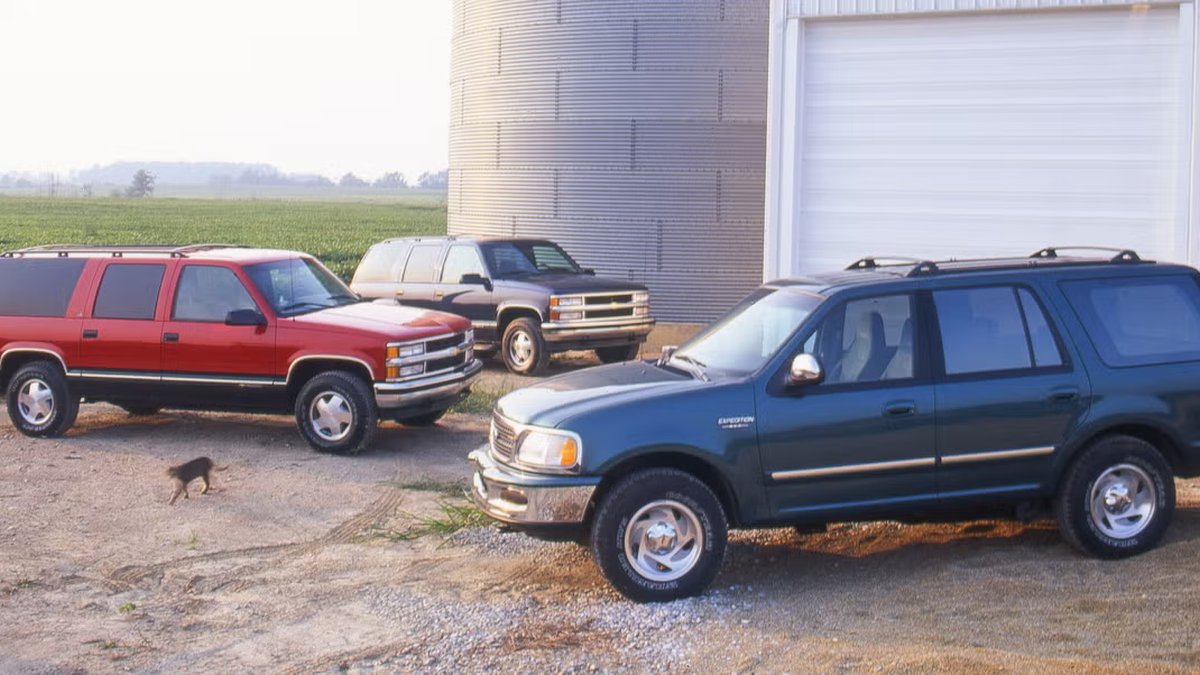
This segment of huge sport-utes begs for a comparison test, but between which vehicles? The Expedition's length, wheelbase, and maximum towing capacity reside between those of the Tahoe and Suburban, so we decided to bring both Chevys along, although we could only get our hands on 1996 models. The 1997 models have five more horsepower and five fewer pound-feet of torque, a passenger-side airbag, and steering changes to reduce effort at parking-lot speeds, but we didn't think those changes would significantly alter the outcome of our test. The three trucks were light-duty four-wheel-drive models, with as-tested prices between $32,000 and $36,000.
For Sale Near You
See all results for used 1996 Chevrolet Suburban for sale near 30306
We eschewed the delectably twisty roads where we normally test for the wide-open byways of Indiana and Ohio. We traveled to Winchester, Indiana, one of the many small farming towns across the Midwest with a speedway where you can watch a USAC midget race (which we did) and where you can hear the word "bijou" pronounced "bye-joe" without irony to a crowd that uttered not a single laugh.
These trucks should be capable of light-duty off-roading, too. We headed 300 miles north to Silver Lake, Michigan, where, in the towering sand dunes, we promptly peeled a tire off the rim of the Tahoe and rendered the four-wheel-drive system of the Expedition nonfunctional (as of this writing, Ford had not analyzed the problem on this preproduction prototype). Later, during track testing at the Chrysler proving grounds, we blew a rear-wheel brake cylinder on the Suburban, coating its right-rear wheel and tire with caustic brake fluid.
So much for "tough trucks." Snafus aside, here's how they fared.
3rd Place:Chevrolet Suburban K1500LS
Bulk could be the Chevy Suburban's middle name, because you're constantly reminded of it, especially by the comments of test drivers in the logbooks. "Man, does this thing feel big," exclaimed one editor.
"Damn, this is huge," wrote another. The Suburban's 47.8-foot turning circle is almost five feet bigger than the Tahoe's and more than seven feet bigger than the Expedition's. Parking spaces that the Tahoe and the Expedition could slide into easily required an extra back-and-forth maneuver for the Suburban.
The Suburban's standard 5.7-liter 250-horsepower V-8 engine is responsive, and its 0-to-60-mph acceleration time of 10.4 seconds is within the range set by the two other trucks. But numbness is the primary driving characteristic of the Suburban. You must step through an inch or so of mush in the brake pedal before sensing any stopping action, and the steering feels only vaguely connected, offering no road feel and requiring frequent small corrections.
Our Suburban arrived with a split front bench seat for three. The center position, with a low-rise backrest that folds forward to become a storage console, is not much more supportive than your average pedal-car seat, and the outboard positions lack lateral and thigh support. The Suburban's second seat split-folds forward. The rear-most seat is comfortable even for three passengers, thanks in part to a separate footwell. The Suburban can inhale 150 cubic feet of cargo with the second seat folded forward and the third seat removed (a one-minute job that doesn't require tools). That's 32 cubic feet more than the two other trucks have.
The Suburban rides well in most circumstances, as you might expect from a 5844-pound vehicle, although we did notice a stomach-heaving pitching over some roller coaster back roads. The $63 heavy-duty front springs probably didn't help the ride, but they might have assisted in the sand at Silver Lake: This big truck climbed and crested the 200-foot dunes with the least drama of the three trucks here, despite having relatively shallow approach and departure angles.
HIGHS: Hippodrome-sized interior room, a headstrong off-roader, enough seating for the entire Supreme Court.
LOWS: Numb, wandering steering; occasionally bouncy ride; unsupportive seats. Tough to park a hippodrome.
VERDICT: Unwieldy and more trucklike than the others, but it's still the ticket if you have a really big load.
This Suburban can certainly haul more stuff. For catering Baywatch cast parties on the beach, it may be a godsend. Barring those circumstances, we would prefer the quieter ride, more accurate steering, and more comfortable seats of the Tahoe, as well as its slightly less cumbersome length. Which brings us to our second-place finisher.
2nd Place: Chevrolet Tahoe LS
The five-door Tahoe is more than just a shortened Suburban. It's more than even a stretched three-door Tahoe, which is intended for rougher off-road duty. Chevy's goal with the five-door Tahoe was to reduce some of the Suburban's trucklike characteristics so it would appeal to those considering smaller sport-utes and minivans. Fourteen inches were removed from the wheelbase, 20.9 inches from its length, and 1.9 inches from its height (so even short folks have an easier time climbing in). A stiffer frame with new bushings and spring rates was intended to provide a better ride. Styling changes were apparently not on the to-do list. "If there's a boxier-looking truck on the road, it must belong to Ryder," noted one editor.
To our sensitive behinds, the Tahoe didn't seem to ride any better than the Suburban, but on its passenger-car tires (the Suburban has light-truck tires), it rode more quietly. Like the Suburban's, the Tahoe's steering is lifeless, but it doesn't require as much corrective action. Its turning circle is 4.9 feet narrower—an immediately apparent fact.
Only committed haulers will despair over the Tahoe's smaller cargo capacity. Our Tahoe as equipped could haul the same payload as our Suburban, just not the same bulk. Trailering capabilities were also similar, although a Tahoe can be equipped to haul 7000 pounds, versus the Suburban's 10,000. The third seat is not an option, though, on the Tahoe.
The Tahoe's engine feels like a 5.7-liter Suburban's that has just been freed from hauling about 450 pounds. Which, in fact, it is. This is the quickest truck of the three, going from 0 to 60 mph in 9.8 seconds. Its 6.0-second 50-to-70-mph passing time beats the others' by at least 0.7 second, which is a big advantage when driving two-lane roads. The Tahoe managed 16 mpg on our 900-mile trip. That's dismal fuel economy, but the best of this bunch, reversing the Expedition's 1-mpg lead in the EPA-city ratings.
Our Tahoe came with buckets separated by a console, but with their lack of support, they might as well have been benches. "I wonder if I might actually fall out of the seat," whined one driver. Like the Suburban, the rest of the Tahoe's interior is devoid of artistic flair, but it is ergonomically acceptable.
HIGHS: Lively engine, low step-up height, quiet ride.
LOWS: Numb steering, shipping-crate profile.
VERDICT: Suburban lite—more sensible and much less filling.
This Tahoe offers most of the Suburban's advantages while remaining more user-friendly. Its ride is quieter and its steering is better. There's not much driving precision in either Chevrolet, though, which leaves a hole for our first-place finisher to fill.
1st Place: Ford Expedition XLT
In the past when carmakers dished out high technology, light trucks got the table scraps. Not anymore. Manufacturers have been taking trucks more seriously as the demand for them has increased. Ford's new 1997 F-150 pickup sets benchmarks for carlike handling, ride, and refinement. The new Expedition, based on the same platform, promises to do the same.
"This is the most carlike of the three vehicles," insisted one editor. "Good suspension control, minimal body roll, accurate steering, good ride-and-handling trade-off," he continued. "Drives like a car after getting out of the Suburban," wrote another driver, "although ride does not seem as smooth and quiet as the Tahoe's."
The Expedition steers with precision and little body roll, but it could take some lessons from cars (or even the Chevy, for that matter) in emergency handling. In our lane-change test, its power steering would freeze up momentarily when we quickly turned the wheel from left to right, preventing us from changing direction as quickly as we wanted to. As a result, the Expedition could manage a speed through the cones no faster than the much larger Suburban.
The Expedition functions fairly well as a truck. As equipped, it can tow 7400 pounds, the most of these trucks (an 8000-pound rating is optional). The Ford's four-wheel-drive transfer case can be locked, or set to direct torque to the front wheels only when excessive rear-wheel slip is detected. In either mode, the Expedition seemed to have less traction than the Suburban and the Tahoe when climbing sand dunes (before its four-wheel drive ceased operating completely). But it could be that the Expedition's street tires are not as well suited for occasional off-road use.
Our test truck's 230-hp 5.4-liter SOHC V-8, a $565 option over the 215-hp 4.6-liter SOHC V-8, barely kept the Expedition running in the pack with the Tahoe and Suburban in acceleration tests. At least the Expedition slows down well. It comes with four-wheel disc brakes with ABS, as opposed to the Chevy's ABS setup with rear drums. Hit the brakes at 70 mph, and the Ford comes to a stop 216 feet later. It bests the Tahoe by nine feet, and the Suburban by 24, although heavy fade was evident in all three trucks.
Styling-wise, if the Suburban and the Tahoe were the World Trade Center, the Expedition would be the Chrysler Building: Its bold snout may be trendy, but it's also more memorable and it doesn't detract from the truck's functionality. We like it. Inside, the Expedition's flowing surfaces are a break from the Chevy's straightforward lines. The seats lacked only lateral support. Other complaints were limited. One editor whined about the sea-green interior color, and Phillips hated the parking-brake location. "I can't drive this without smashing my left ankle into it," said our five-foot-nine executive editor.
We carefully tally features, and the Expedition wins. A $34,418 sticker price includes such extras as a power driver's seat, rear air conditioning with roof vents, rear stereo controls, and a CD changer. That price also includes a load-leveling suspension with rear air springs.
HIGHS: Bold styling; light, carlike handling; features aplenty.
LOWS: Uncooperative steering during emergency maneuvers, obnoxious location of the parking-brake pedal (especially for shorter drivers).
VERDICT: Ford mates car with light truck and delivers big sport-ute without the clumsiness.
We may not be wild over big, clumsy sport-utes, but as car guys, we'll take the most precise and refined one we can get. The Expedition stands out not by its test numbers, but by its better-balanced combination of driving characteristics, hauling abilities, and yes, even styling. That makes the new Expedition the winner in this test.
Specifications
Specifications
1996 Chevrolet Suburban K1500LS
Vehicle Type: front-engine, rear/4-wheel-drive, 6-passenger, 4-door wagon
PRICE
Base/As Tested: $26,988/$35,740
ENGINE
pushrod 16-valve V-8, iron block and heads, port fuel injection
Displacement: 350 in3, 5733 cm3
Power: 250 hp @ 4600 rpm
Torque: 335 lb-ft @ 2800 rpm
TRANSMISSION
4-speed automatic
CHASSIS
Suspension, F/R: control arms/live axle
Brakes, F/R: vented disc/drum
Tires: Firestone Steeltex A/T M+S
LT245/75R-16
DIMENSIONS
Wheelbase: 131.5 in
Length: 220.0 in
Width: 76.7 in
Height: 72.1 in
Passenger Volume, F/R: 62/54 ft3
Cargo Volume, Seats Up/Folded: 48/150 ft3
Curb Weight: 5844 lb
C/D TEST RESULTS
60 mph: 10.4 sec
1/4-Mile: 17.7 sec @ 79 mph
90 mph: 25.0 sec
Rolling Start, 5–60 mph: 10.5 sec
Top Gear, 30–50 mph: 4.9 sec
Top Gear, 50–70 mph: 6.7 sec
Top Speed (gov ltd): 97 mph
Braking, 70–0 mph: 240 ft
Roadholding, 300-ft Skidpad: 0.71 g
Interior Sound
Idle: 56 dBA
Full Throttle: 83 dBA
70-mph Cruising: 78 dBA
C/D FUEL ECONOMY
Observed: 15 mpg
EPA FUEL ECONOMY
City/Highway: 13/17 mpg
--
1996 Chevrolet Tahoe LS
Vehicle Type: front-engine, rear/4-wheel-drive, 5-passenger, 4-door wagon
PRICE
Base/As Tested: $31,079/$32,857
ENGINE
pushrod 16-valve V-8, iron block and heads, port fuel injection
Displacement: 350 in3, 5733 cm3
Power: 250 hp @ 4600 rpm
Torque: 335 lb-ft @ 2800 rpm
TRANSMISSION
4-speed automatic
CHASSIS
Suspension, F/R: struts/live axle
Brakes, F/R: vented disc/drum
Tires: BFGoodrich Radial Long Trail T/A M+S
P245/75SR-16
DIMENSIONS
Wheelbase: 117.5 in
Length: 199.1 in
Width: 76.4 in
Height: 70.2 in
Passenger Volume, F/M/R: 62/54 ft3
Cargo Volume, Seats Up/Folded: 67/118 ft3
Curb Weight: 5394 lb
C/D TEST RESULTS
60 mph: 9.8 sec
1/4-Mile: 17.4 sec @ 80 mph
90 mph: 23.6 sec
Rolling Start, 5–60 mph: 9.9 sec
Top Gear, 30–50 mph: 4.5 sec
Top Gear, 50–70 mph: 6.0 sec
Top Speed (gov ltd): 98 mph
Braking, 70–0 mph: 225 ft
Roadholding, 300-ft Skidpad: 0.67 g
Interior Sound
Idle: 51 dBA
Full Throttle: 75 dBA
70-mph Cruising: 69 dBA
C/D FUEL ECONOMY
Observed: 16 mpg
EPA FUEL ECONOMY
City/Highway: 13/17 mpg
--
1997 Ford Expedition XLT
Vehicle Type: front-engine, rear/4-wheel-drive, 5-passenger, 4-door wagon
PRICE
Base/As Tested: $30,510/$34,418
ENGINE
SOHC 16-valve V-8, iron block and aluminum heads, port fuel injection
Displacement: 330 in3, 5403 cm3
Power: 230 hp @ 4250 rpm
Torque: 325 lb-ft @ 3000 rpm
TRANSMISSION
4-speed automatic
CHASSIS
Suspension, F/R: control arms/live axle
Brakes, F/R: vented disc/disc
Tires: Goodyear Wrangler RT/S M+S
P265/70SR-17
DIMENSIONS
Wheelbase: 119.0 in
Length: 204.6 in
Width: 78.6 in
Height: 76.4 in
Passenger Volume, F/R: 60/58 ft3
Cargo Volume, Seat Up/Folded: 63/118 ft3
Curb Weight: 5392 lb
C/D TEST RESULTS
60 mph: 10.6 sec
1/4-Mile: 18.0 sec @ 79 mph
90 mph: 24.8 sec
Rolling Start, 5–60 mph: 10.4 sec
Top Gear, 30–50 mph: 4.4 sec
Top Gear, 50–70 mph: 6.8 sec
Top Speed (gov ltd): 106 mph
Braking, 70–0 mph: 216 ft
Roadholding, 300-ft Skidpad: 0.66 g
Interior Sound
Idle: 59 dBA
Full Throttle: 71 dBA
70-mph Cruising: 69 dBA
C/D FUEL ECONOMY
Observed: 15 mpg
EPA FUEL ECONOMY
City/Highway: 14/18 mpg