June 29, 2026 | Policy Brief
Sanctioning DR Congo’s Blood Gold Is Smart, but Not Enough
June 29, 2026 | Policy Brief
Sanctioning DR Congo’s Blood Gold Is Smart, but Not Enough
The east of the Democratic Republic of Congo (DRC) is now at the center of the U.S.-China critical mineral conflict.
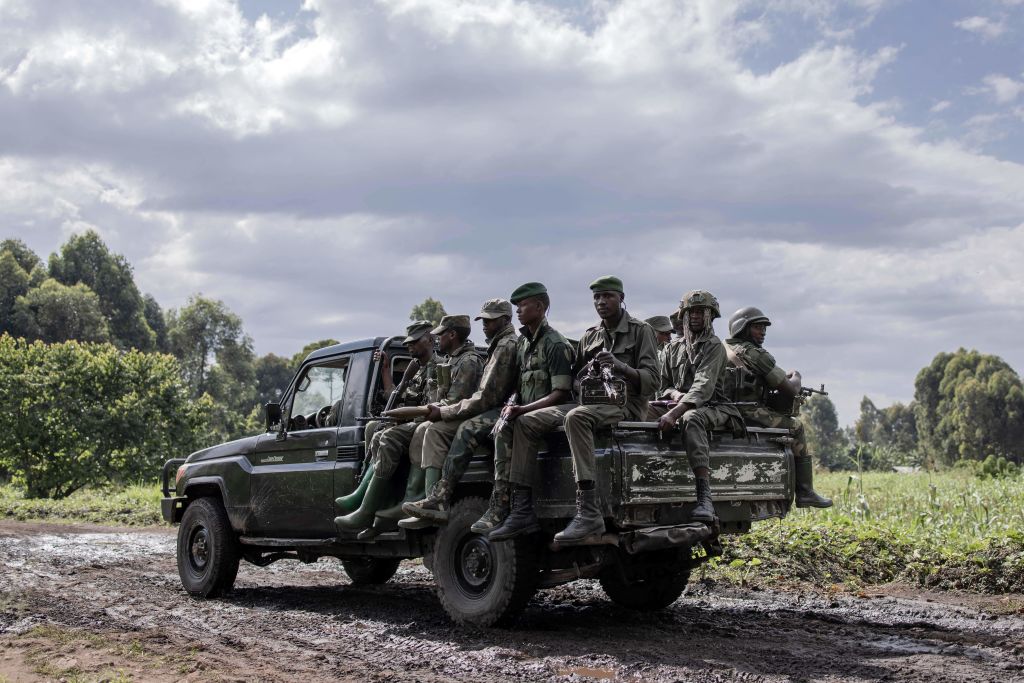
On June 25, the U.S. Treasury sanctioned a network based in the Rwandan capital of Kigali moving gold from eastern DRC on behalf of the Rwandan-backed M23 militia. The designation supports the Washington Accords, a Trump-brokered peace and investment framework designed to stem mineral smuggling and develop eastern Congo’s mining sector, thereby offering an alternative to China’s dominant role.
The June 25 sanctions are a necessary step that build on multiple previous rounds of designations targeting the Rwandan Defense Force (RDF) and entities linked to illegal mineral extraction and smuggling. Yet six months after the Washington Accords were signed, conditions in eastern DRC are deteriorating rapidly. Armed conflict is escalating, mass graves have been discovered, millions remain displaced, and the Ebola virus is spreading. Meanwhile, China’s chokehold on the DRC’s mineral supply chains remains intact.
M23 Feeds China’s Supply Chain
Eastern DRC holds roughly 60 percent of the world’s coltan reserves and 70 percent of the world’s cobalt — minerals essential to electric vehicle batteries, semiconductors, and advanced weapons systems. China has come to depend almost exclusively on the DRC for its raw cobalt imports and now controls roughly 70 percent of global cobalt refining capacity. Armed groups — especially the M23 militia — have fought for more than three decades over eastern DRC’s mineral resources and control of smuggling routes, fueling the devastating conflict.
Gold follows a similar pipeline. RDF soldiers escort gold from M23-controlled mines across the Ruzizi border into Kigali, where the Gasabo Gold Refinery processes and exports it to international markets. Gold prices, though falling from record highs earlier this year, remain strong, increasing profits for M23 that flow directly into the militia’s armed operations in the region.
The Washington Accords’ Investment Vision Is Stalling
The Washington Accords sought to counter China by building a licit mineral pipeline to the United States. Six months on, the investment vision is not materializing. U.S. development finance tools — the International Development Finance Corporation, the Export-Import Bank, and the Millennium Challenge Corporation — have been hamstrung by staffing cuts and deteriorating security conditions on the ground. Meanwhile, China’s CMOC — the world’s largest cobalt miner, which operates entirely out of the DRC — recorded a production record in 2025.
U.S. Pressure on Rwanda Has Limits
The RDF is one of Africa’s most capable militaries. The United States relies on it across multiple security challenges on the continent. In Mozambique, for instance, the RDF is the primary security guarantor for two major liquefied natural gas projects: ExxonMobil’s $30 billion Rovuma LNG and TotalEnergies’ $20 billion. Both depend on Rwandan troops to hold off ISIS-affiliated insurgents in Cabo Delgado. The mission is so critical that Washington exempted RDF operations in Mozambique from its own sanctions.
Washington also needs Rwanda’s cooperation to contain Ebola in eastern Congo. M23’s seizure of Goma in January 2025 closed the region’s main airport, blocking humanitarian access as the virus spreads. Containing the outbreak requires RDF cooperation to open airports and move aid — further limiting how hard Washington can push.
Pressure on Rwanda will not, by itself, deliver the Washington Accords. The United States needs positive economic tools to match its sanctions.
To Make the Accords Work, Washington Needs a Fuller Toolkit
The U.S. strategy in the DRC needs reinforcement on two fronts.
First, Washington should surge health assistance to eastern DRC. The Ebola outbreak is not a peripheral humanitarian concern — it is a threat to the Washington Accords and American efforts to break China’s coercive mineral diplomacy. Allowing it to spread unchecked erodes the governance conditions that licit investment demands, opens space for Russian and Chinese influence operations, and signals to African partners that Washington abandons its commitments under pressure.
Second, the DFC, the Export-Import Bank, the MCC, the State Department, and the Foreign Commercial Service should operate under a unified investment strategy in the DRC — sequencing U.S. financing tools, coordinating with private-sector partners seeking critical mineral offtake, and presenting DRC authorities with a credible alternative to Chinese dominance. Making licit mineral development more attractive than the smuggling pipeline requires Washington to show genuine positive progress on the ground, not just sanctions.
Dan Swift is a senior research analyst for economics, finance, and trade for the Center on Economic and Financial Power (CEFP) at the Foundation for Defense of Democracies (FDD), where Susan Soh is a research associate. For more analysis from the authors and FDD, please subscribe HERE. Follow FDD on X @FDD and @FDD_CEFP. FDD is a Washington, DC-based, nonpartisan research institute focusing on national security and foreign policy.
Sentinel — Human
Sentinel analysis incomplete — partial response from fallback model.