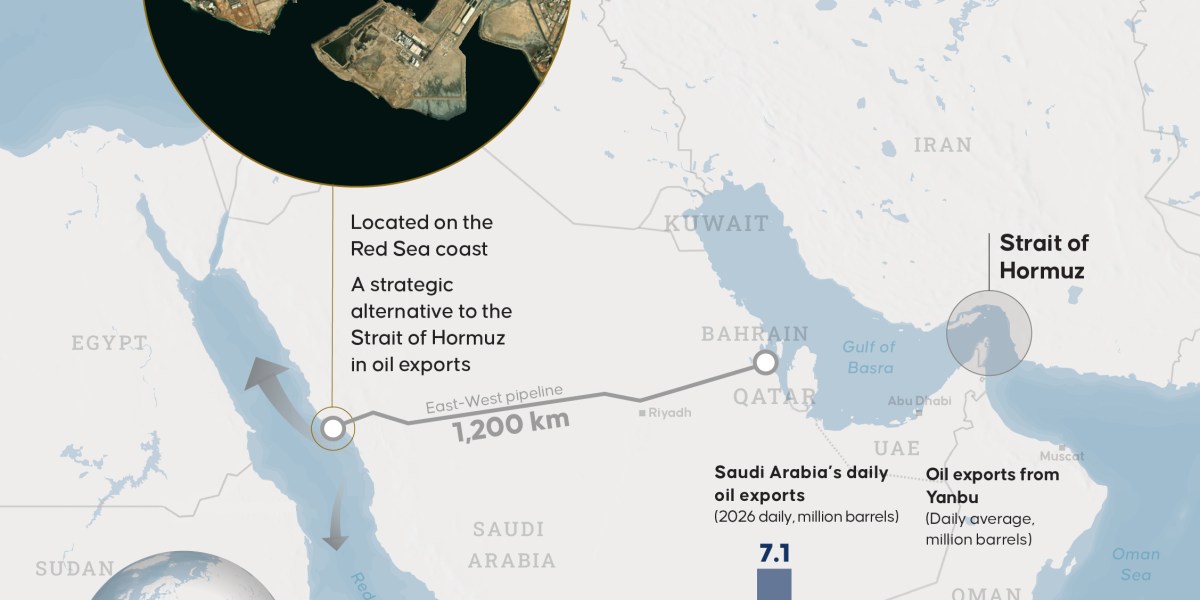
Saudi Arabia’s crucial East-West pipeline that circumvents the Strait of Hormuz is pumping oil at its full capacity of 7 million barrels a day, according to a person familiar with the matter.
The technical milestone is the culmination of the kingdom’s longstanding contingency plan for keeping its oil flowing after the effective closure of their main export route. Flotillas of tankers have been redirected to the Red Sea port of Yanbu to collect the oil, providing an important lifeline for global supply.
Crude exports via Yanbu have now reached about 5 million barrels a day and the kingdom is also exporting 700,000 to 900,000 barrels a day of refined products, according to the person familiar with the Saudi oil industry. Of the 7 million barrels a day that go through the pipeline, 2 million are destined for Saudi refineries.
The Yanbu route only partly offsets the hit to supply from shutting Hormuz, through which about 15 million barrels a day of crude shipments passed before the war. But the bypass is one reason oil prices haven’t reached the crisis-level highs of previous supply shocks.
With Yemen’s Houthis now saying they are entering the war, the concern for the oil market will be that the Red Sea becomes a new front in the conflict. While the Houthis have not given any indication they would attack tankers going through the Red Sea and Bab El-Mandeb strait, they have previously threatened shipping in the area with drones and missiles.
Read More: Saudi Arabia Taps Key Pipeline the World Didn’t Know It Needed
Saudi Arabia, which has a historical role as the world’s oil supplier of last resort and nurtures a reputation for reliability, had prepared for decades for the worst-case scenario of Hormuz closing. It put its contingency plan to work within hours of the first US and Israeli strikes on Iran, and has been ramping up east-west shipments ever since.
Running the breadth of the Arabian Peninsula from the massive oil fields in the east of the country to the industrial port city of Yanbu, the pipeline is more than 1,000 kilometers (620 miles) long. It’s a by-product of a previous conflict — the 1980s Iran-Iraq war — which saw attacks on ships in the Strait, but nothing like the unprecedented near-closure the current conflict has caused.
Facts Only
Actor: Saudi Arabia, Yemen’s Houthis
Action: Pumping oil at full capacity through East-West pipeline, redirecting tankers to Yanbu port, threatening shipping with drones and missiles
Event: Ongoing geopolitical tensions, potential closure of Strait of Hormuz
Timeline: Current situation, decades of preparation by Saudi Arabia
Location: Arabian Peninsula (East-West pipeline), Yanbu port, Red Sea, Strait of Hormuz
Executive Summary
Full Take
Saudi Arabia's increased use of the East-West pipeline and the subsequent rerouting of tankers to Yanbu port can be seen as a strategic response to geopolitical tensions that could potentially lead to the closure of the Strait of Hormuz. This move not only highlights Saudi Arabia's historical role as a reliable oil supplier but also underscores its preparedness for such scenarios, which has been built up over several decades. However, concerns remain about the Red Sea becoming a new front in the conflict, potentially disrupting global oil supply. It is crucial to monitor this situation closely and consider potential ripple effects on energy markets and geopolitical dynamics.
Patterns detected: ARC-0024 Ambiguity (The potential for further conflict and its impact on shipping are mentioned but not fully explored or quantified).
Questioning assumptions: What long-term strategies could be put in place to ensure stable oil supply and mitigate geopolitical risks? How can international cooperation address these issues, and what role can diplomacy play in preventing future conflicts in the region?