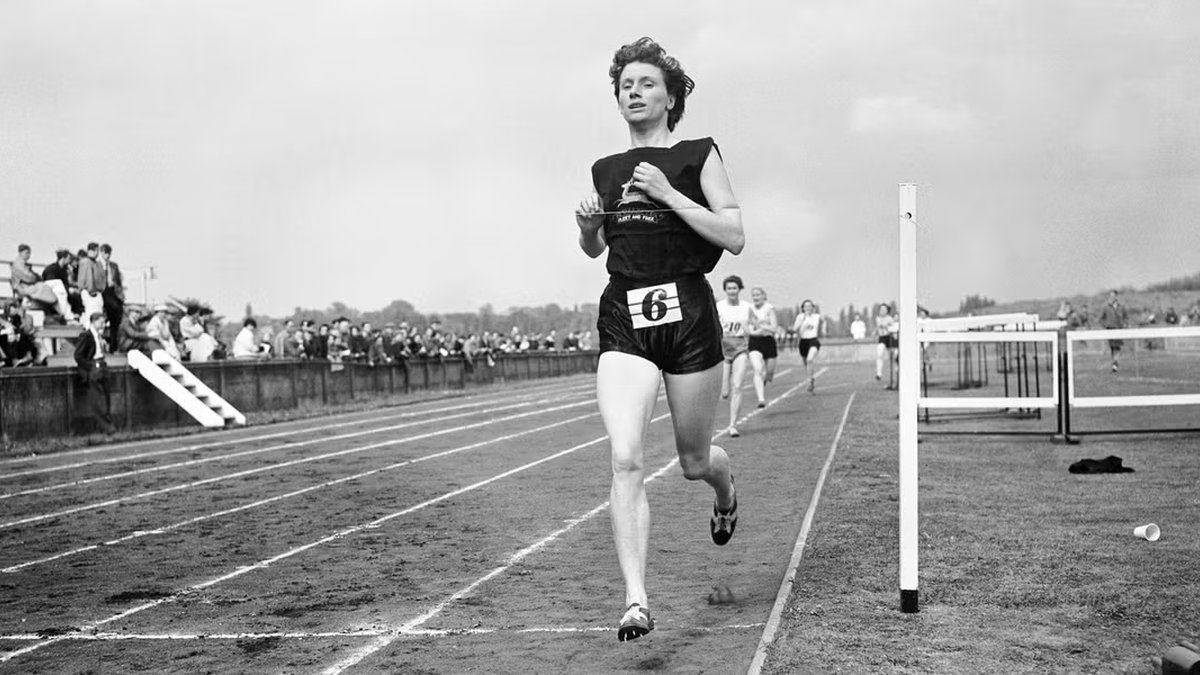
In May 1954, two British runners achieved never-before-seen records of speed.
First, on May 6, Roger Bannister became the first person to run a mile under four minutes (3:59.4, to be specific), at Iffley Road Track in Oxford, England. Although his record was broken just 46 days later by John Landy, Bannister received worldwide acclaim and was made the inaugural Sports Illustrated Sportsperson of the Year in 1954. He was knighted in 1975. He was frequently remembered and honored for his achievement throughout his life, including with a 1988 television miniseries, a 2005 film dramatizing his record, and a 2016 TV documentary about his life.
A few weeks later, on May 29, Diane Leather became the first recorded woman to run a mile in under five minutes. “Diane Leather, a good-looking laboratory analyst, ran a mile in 4 minutes 59.6 seconds today, the fastest ever for a woman,” went The New York Times's coverage. “A 5-minute mile in women’s track and field has been looked upon as the sport’s greatest goal. There is no world record for the distance, as a mile is not authorized for women in International Amateur Athletic Federation regulations.” Not only was the overall coverage minimal, but Leather's achievement never even went into the record books.
According to her biography page from England's Athletics Museum, Leather grew up playing lacrosse, netball, and hockey and didn't start running until 1952, when she was a chemistry student at the Birmingham College of Technology inspired by watching the Helsinki Olympics. She joined a local running club, the Birchfield Harriers, and was soon setting records that went mostly unacknowledged by the larger world.
When Leather broke her own record in September 1955, The New York Times reported the news in passing, in an article titled “Germar Is Victor in London Sprint” that starts by sharing the wins and losses of male runners in an international track and field meet at White City Stadium before finally, in the sixth paragraph, addressing her achievement: “England’s Diane Leather ran the mile in 4:45, the fastest ever by a woman. A crowd of 25,000 cheered her home in the floodlit stadium. Miss Leather’s time bettered her previous world best performance of 4:50.8, recorded at the same track last May. There is no recognized world record for the mile in women's events.”
Leather passed away in 2018, at the age of 85, and according to her obituary in the Times, her record wasn't acknowledged by the IAAF because during the 1928 Amsterdam Olympics, the press claimed that six women collapsed from exhaustion at the first Olympic women's 800-meter event. (World Athletics later reported it was only one.) The sexist backlash that followed declared that women were too fragile to run such long distances competitively, and the event was discontinued until the 1960 Rome Olympics, coincidentally the same Olympics Leather competed in before she retired.
While she has received more acknowledgment in recent years, Leather's amazing world best, which helped set the stage for future record holders like Faith Kipyegon, was met with minimal fanfare. She wasn't on any magazine covers and she certainly didn't become a dame. She wasn't even inducted into the England Athletics Hall of Fame until 2013. Instead, she led a relatively quiet life, working as a chemist earlier in her career before going back to school for social work. She worked at a nonprofit agency called Cruse Bereavement Care for many years, and had four children with her husband, Peter Charles.
The gender inequality in running—and in athletics more generally—that caused Leather's record-setting runs to receive such little recognition remains pervasive, though strides have been made since the 1950s.
But for Leather herself, the recognition was never the point. “There is no way I was resentful or angry that my achievement wasn't given the publicity Roger Bannister's was,” she told a local newspaper in 2004. “It was something I accepted. I was just thrilled because I was on the Pathe News at the time.” She also commented on the generational difference in running culture, explaining, “We used to see it as something we did in our spare time, after a day at work. Now it is so professional and intensely competitive.”
Still, Leather's enduring competitive spirit helped build the foundation for women running today. If she wasn’t given her flowers in her day and age, it’s even more reason to honor her legacy today.
Katja Vujić is a freelance writer based in Brooklyn whose work has appeared in Runner’s World, The Cut, Allure, Architectural Digest, The Boston Globe Magazine, and more. You can find more of her work on her website.