Listen to this essay
26 minute listen
Every historian knows that most of the past is lost to us. We just don’t know what most people in the past thought or did, and neither are their names known to us. How much knowledge do we have, in fact? Is it 10 per cent, or 1 per cent, or 0.1 per cent? Perhaps less often acknowledged is the fact that we don’t have even 10 per cent (or 1 per cent, or 0.1 per cent) of everything there once was, across the board. Instead, we might have 10 per cent of some realms of history and 0.1 per cent – or more likely 0 per cent – of others.
This disparity of surviving historical evidence privileges the elite, and is particularly the case with regard to art, or what scholars like to call ‘material culture’, and everyday language just calls ‘stuff’. By and large, what survives from the past is the stuff of wealthy people.
I confronted this problem of ‘survivorship bias’ of historical evidence more than 10 years ago, in 2014, when I was co-curating an exhibition at the British Museum about the China of the early Ming period. The vast Ming dynasty ruled from 1368 to 1644, and the director of the museum was insistent that we show the lives of ‘ordinary people’ at the time. We tried. We looked long and hard for an example of the kinds of agricultural tools that must have once existed in their tens of tens of millions. Nowhere could we find one, not a spade nor a plough (never mind the straw raincoats or shoes of the people who wielded them). By comparison, finding the gold and bejewelled hairpins of aristocratic ladies, even the things used by emperors and empresses at the top of the social pyramid, was relatively easy.
In its day, Ming China was the largest state on the planet, probably one of the most populous in history. With some 150 million subjects in the 16th century (specialists argue over the numbers, and the shaky statistics they are based on), it had a population larger than the whole of Europe combined. Ming China was also larger than any contemporary European state, only the great empires of the Mughals in India or the Ottomans in the Middle East, North Africa and the Balkans rivalled its size. It had numerous cities with populations far in excess of any European capitals.
Like most empires in history, the Ming came into being in warfare and violence and confusion. Its founder, an extraordinary man named Zhu Yuanzhang (1328-98), was born at a time when China was ruled – from the city that is now Beijing – by the Mongols, the descendants of the great world conqueror Genghis (Chinggis) Khan (c1155-1227), and of his grandson Kublai (Khubilai) Khan (1215-94). When Zhu was a child, he entered a Buddhist monastery after the death of his impoverished peasant parents. At the time, the Mongol grip on power was weakening, undermined by uprisings and by the violent feuds among members of the ruling family.
In 1352, Zhu left the monastery and embraced life as a fighting man, rising through the ranks of warlord armies until he was a significant commander in his own right. Eventually, he became one of several contenders trying to seize supreme power from the Mongols. After decades of devastating warfare, this extraordinary figure from the lowest stratum of Chinese society came out on top, establishing the Ming dynasty in 1368 and driving the Mongol ruling house from their capital back into the northern steppes from which they had come.
The Ming founder used the many marriages to consolidate alliances with his generals
Zhu vociferously condemned the Mongols as uncivilised outsiders. (‘Stinking of mutton’ was a common put-down.) He also adopted many aspects of Mongol statecraft in the creation of the new polity. He placed his capital in the most economically advanced and prosperous part of China, the valley of the Yangtze River, in the great city now called Nanjing. Zhu now stood at the head not only of a vast empire but of a very large imperial family. China had always been a polygynous society, in which powerful men had the right to a number of partners, but the Ming founder took this to almost unprecedented lengths. In addition to a principal consort, who alone bore the title of empress, he also had some 20 consorts and concubines. The English word makes this sound less legitimate or respectable than it actually was in China. These consorts bore him 26 acknowledged sons, 24 of whom lived to adulthood, and 16 daughters who lived long enough to be married. There was probably also a number of children of both sexes who died in infancy and don’t make it into the historical record.
In such a patriarchal society, any child of the emperor was legitimate, regardless of their mother’s status. So the issue of the rights of illegitimate children that so troubled medieval European ruling houses did not arise. The Ming founder used the many marriages to consolidate alliances with his generals, and with the elite civilian advisers who would govern the dynasty with him. When his sons were old enough, they were sent away from the imperial court to command armies of their own ‘as a hedge and fence’ to the capital. Several of Zhu’s sons accumulated their own distinguished records as war leaders, as fighting continued to ensure the definitive defeat of the Mongols, and to subdue still-existing other contenders for the throne.
When Zhu Yuanzhang died in 1398, aged 69, the throne passed to his grandson, the eldest son of his eldest son Zhu Biao (1355-92), who had died six years earlier. This second emperor of the Ming, Zhu Yunwen (1377-1402), had been formed under very different circumstances than his ferocious grandfather, circumstances that stressed the arts of peace over those of war. The existence of a cohort of powerful uncles made the position of the new Jianwen-era emperor precarious. It was his attempt to trim their power that led the eldest – and the most militarily effective – of Zhu Yuanzhang’s surviving sons to mount a challenge to his nephew’s grip on the imperial position. The ensuing civil war lasted for years and involved enormous armies.
Everything in the Ming was on a large scale. It split the imperial family itself into supporters of the reigning emperor in Nanjing, and those of his uncle Zhu Di (1360-1424). Zhu Di’s wife was, for example, the sister of the general commanding the imperial forces, and there were many such scenarios in which close relatives found themselves fighting on opposite sides of a struggle that lasted so long largely because the two sides were evenly matched, rather like the Wars of the Roses in England. Ultimately, it was Zhu Di who prevailed when, in 1402, his forces stormed the capital city of Nanjing as his nephew vanished in the burning of the imperial palace. The ensuing bloodbath over which he presided exterminated the families of the defeated emperor’s closest advisors. All subsequent Ming emperors, down to the end of the dynasty, were descended from Zhu Di, who is now conventionally known in history writing as the Yongle emperor, after the grimly ironic title given to the years of his rule (yongle means ‘perpetual happiness’). His reign, in which the capital was moved north to his own power base in modern Beijing, was proclaimed as a ‘second founding’, a fresh start, for the dynasty.
Specialists in Ming history argue about the extent to which the state touched the lives of ordinary people, the millions and millions of peasants who lived in China’s immense countryside and engaged in basic subsistence agriculture, prey at any moment to natural calamities. The total number of officials (‘mandarins’) in the empire was only 25,000, and many of these were concentrated in the empire’s capital. So it’s hard to imagine that – at a ratio of 6,000 to one – most peasants in the countryside had ever set eyes on a mandarin. The Chinese proverb ‘Heaven is high, and the emperor is far away’ conveys an image of state power as remote from the lives of the unrecorded majority. Did they even know they were living in the ‘Ming dynasty’?
For the family at the centre of it all, the imperial family itself, things were surely very different. We must know every detail of their lives, must we not? I’m not so sure. Writing a history of that imperial family has caused me to think again about what we know about Ming China and crucially, how we know it. The enormous written record that comes down from the Ming raises important questions about how we know the past, questions relevant to some of our current concerns about verification and authenticity. What historians working on all sorts of times and places come to realise is that historical sources may well tell us more about the period in which they were written, and about the concerns and agendas of the historians’ own period, than they do about their subject. The Ming was no exception to this principle.
Keep in mind that the Ming shi isn’t contemporary, or even close, to the events and the people it describes
The first port of call for any historian of the Ming is likely to be a massive work of 28 paperback volumes called simply Ming shi or ‘The Ming History’. It is the very last of what scholars call the ‘standard dynastic histories’, a form of historical writing first seen in China more than 2,000 years ago, in Shi ji or ‘The Records of the Grand Historian’. That book had been written by just one man, the ‘Grand Historian’ Sima Qian (c145-c87 BCE), while all subsequent dynastic histories were written by a team. In the case of ‘The Ming History’, completed in 1736, that team worked for the Manchu emperors of the subsequent Qing, China’s last ruling dynasty. They stuck to a time-honoured format, in which the whole was composed of three parts: first, a year-by-year chronicle of events in the reigns of successive emperors; second, a series of essays on important topics like the dynasty’s economy, or the way the military was organised; third – and this is by far the largest part – a great quantity of short biographies of people who lived in the period.
With the exception of a small number of biographies of imperial women – the wives and daughters of emperors – these are all biographies of men. When reading the Ming shi, it is important to keep in mind that it isn’t contemporary, or even close, to the events and the people it describes. It was finished more than 350 years after the founding of the Ming in 1368, and nearly 100 years after the dynasty came to a violent end and the succeeding Manchu Qing dynasty came to power. The men who assembled this vast historical work were all conscientious, and they produced something that should be considered one of the great works of Chinese literature, as well as a great piece of historical writing. But they were not witnesses to the events, not even close.
Much bigger, even, than ‘The Ming History’ is a huge body of work known as Ming shi lu, or ‘The Veritable Records’ of the Ming. After each reign, a committee of historians would produce an official record of the rule of the emperor who had just passed away, literally on a day-by-day basis, drawing on sources produced at that time, but then committing these sources to the flames in a ritual burning that meant ‘The Veritable Record’, emperor by emperor, stood as an essentially unchallengeable account. Each ‘veritable record’ was approved by the reigning sovereign – in most cases the son of the previous one. So, by definition, no Ming emperor ever read ‘The Veritable Record’ of his own reign, the basic material on which he would be judged by history. Originally, these were designed to be strictly controlled and restricted works, available only within the highest reaches of imperial government. They were not printed. But by the late 16th and early 17th century, the end of the Ming period, copies of this work, still in manuscript, began to circulate among the educated elite of China. A set of ‘The Veritable Records’ became a prized addition to a rich man’s library. There’s a Chinese proverb that says ‘The writing brush of the historian is like iron,’ which refers not only to the inflexible integrity expected of the historical writer, but also to the unchangeable nature of the historical record – it can’t be challenged. That, in any case, was the theory. Unsurprisingly, it turns out to be much more complicated than that.
The personal name of the emperor (like the ‘Yuanzhang’ part of ‘Zhu Yuanzhang’) was absolutely taboo, and could not be used by ordinary people. In his own lifetime, an emperor was referred to simply as shang, ‘highness’ or huang shang, ‘imperial highness’. The years in which he ruled were given a ‘reign title’ with a meaning often drawn from the Chinese classics, like Hongwu (‘great martial power’) or Jianwen (‘establishment of civil merit’), or Yongle (‘perpetual happiness’). This wasn’t the name of the emperor, although by convention nowadays people often write about the Ming founder as ‘the Hongwu emperor’, for example. It was the period of the reign title that structured the Chinese system of counting the passing years. What we today call 1403 CE, for example, was in the Ming the ‘Yongle first year’, 1404 being ‘Yongle second year’, and so on.
After his death, an emperor was given a ‘temple name’, which is how he would also be called in historical writing. We suppose this temple name is how people referred to deceased emperors in everyday speech, as well as being the name under which he would be worshipped as an ancestor in the rituals that lay at the heart of the imperial cult. Chinese people at the time believed ancestors to have power in the world of the living (you did not stop being a member of the imperial family just by being dead), and to be important channels of communication with the impersonal but omnipotent power of Heaven. Thus on his death, the Ming founder became Taizu (‘grand progenitor’); this was a title that had been ascribed to many previous dynastic founders throughout Chinese history. So the ‘veritable record’ of his reign would be Taizu shi lu, ‘The Veritable Record of the Grand Progenitor’.
‘The Veritable Record’ subverts its own claims to authority as a text with a frankly outrageous assertion
Given the violent events that had ensued on the Grand Progenitor’s death, the overthrow of his grandson, the usurped accession to the imperial throne of his son Zhu Di, it is perhaps not that surprising that it took three attempts and some 16 years before the Yongle emperor was finally satisfied, in 1418, with the account of what had taken place. This is the only version we have now, the earlier ones were all destroyed. There must have been many people, particularly in and around the extended imperial family, who understood full well that this officially approved history diverged in a number of ways from their own experience of the preceding decades. For example, Taizu shi lu contains an elaborate genealogy of the Ming founder that makes him a direct descendant of Zhuanxu (2513-2435 BCE), a grandson of the Yellow Emperor (2698-2598 BCE), considered a god, sage and revered founder of the Chinese race.
It is not so much that Zhuanxu and the Yellow Emperor are what we would now call ‘mythical’. Plenty of people must have remembered Zhu Yuanzhang’s frequent insistence that he came from very humble and undistinguished stock, that he had (with the favour of Heaven) clawed himself up from nothing to the throne. He was proud of this, and drew attention to it often. So this very first page of ‘The Veritable Record’ subverts its own claims to authority as a text with a frankly outrageous assertion. Or maybe it is the power to make outrageous assertions about history and have them publicly accepted that is the mark of true authority (whether they are privately believed is another matter).
Even more extreme, and even more pertinent, is the way in which the reign of the overthrown nephew, the four years of Jianwen (‘establishment of civil merit’), were now to be simply erased from history, with the Hongwu era acquiring an extension of four more years to cover the missing period of time, so that instead of ending (with the death of the founder) in Hongwu 31st year, it went on to Hongwu 35th year. As it happens, one of the very few surviving contracts for the purchase of land that we have from the early Ming period is dated ‘Jianwen 2nd year’. One has to wonder what the two relatively humble parties to this transaction thought when the year in which they had sealed the deal suddenly ceased to exist. However, the Jianwen era did not vanish from educated consciousness. Indeed, as the Ming dynasty went on, there were more and more calls for some sort of recognition, not just of the Jianwen era’s existence, but of the violent wrongs done to the ‘martyrs’ (as they were now seen) who had died at the hands of the vengeful Yongle emperor when he seized power. In the end, the dynasty had to give in, so perhaps the iron writing brush of the historian had a certain malleability in it, after all.
In most cases, ‘The Veritable Record’ of an individual Ming emperor was written when his son ruled, and the final text was approved – at least formally – by that son. This meant that the Ming Chinese virtue of xiao, or ‘filial piety’, a very important obligation, limited the amount of criticism directed at the deceased, and his qualities (or lack of them) as ruler. So it is likely that a ruler will appear as basically competent and effective. By and large, the Ming escaped the most negative effects of father/son conflict because of the poor record of Ming emperors in staying alive long enough for such collisions to manifest themselves. It’s not quite clear why so many Ming emperors died relatively young. It isn’t a case of inbreeding, like the Habsburg dynasty of Europe, who amassed a fearful raft of hereditary diseases by marrying their cousins or uncles (occasionally these were the same person). Ming empresses and emperor’s consorts invariably brought fresh genetic material into the dynasty, as none of them came from the same families over time.
Other kinds of writing from the Ming period show that plenty of upper-class people outside the imperial family, with good diets and access to medical care, lived to what even today would be called ripe old ages, into their 70s and 80s. Even in the Ming period, to die before the age of 40 was looked on as unfortunate and sad. Yet this is what many Ming emperors did. The Ming founder made it to almost 70 (impressive enough, if you consider his hard start in life, and the number of battles he had fought). The Yongle emperor made it to 64. But these were the only two Ming emperors out of 16 to see their 60th birthday. The Yongle emperor’s son died aged 46, and his two successors in their mid-30s.
What proved much more destabilising than child emperors were adolescent emperors
The relatively short life expectancy of Ming emperors means that their successors often acceded to power when they were remarkably young. Unlike what happened in some other parts of the world, the accession of a small child does not seem to have destabilised the Ming. Although all decisions were formally made by ‘the emperor’, in practice, it was the emperor’s mother – as in 1435, when the new emperor was an eight-year-old child, and again in 1572, when the new ruler was just nine – who constituted the principal source of authority, together with the highest-ranking officials.
What proved much more destabilising than child emperors were adolescent emperors, here the Ming dynasty perhaps suffered from a run of bad luck. However, there was no concept of ‘adolescence’ in the Ming period. You were either a child or an adult, the latter status being marked by your availability to be married (usually at 15, but sometimes earlier). In the half century or so between 1465 and 1522, four emperors acceded to power at the ages respectively of 16, 17, 13, and 13 again. If we consider that these adolescent boys were given theoretically limitless powers, with unrestricted access to sexual partners (and alcohol), we might be less surprised that some Ming reigns seem to have gone badly.
The official history of the Ming, as contained in ‘The Veritable Records’ and later ‘The Ming History’, is so copious it creates an illusion of knowing everything, every action, every detail. But, in fact, there are plenty of omissions. These are never more gaping or glaring than in the case of the lives of women. We don’t even know the personal names of most Ming empresses. They certainly had them, but it was part of a woman’s status and respectability in the Ming that such personal details were unknown to outsiders like male court historians.
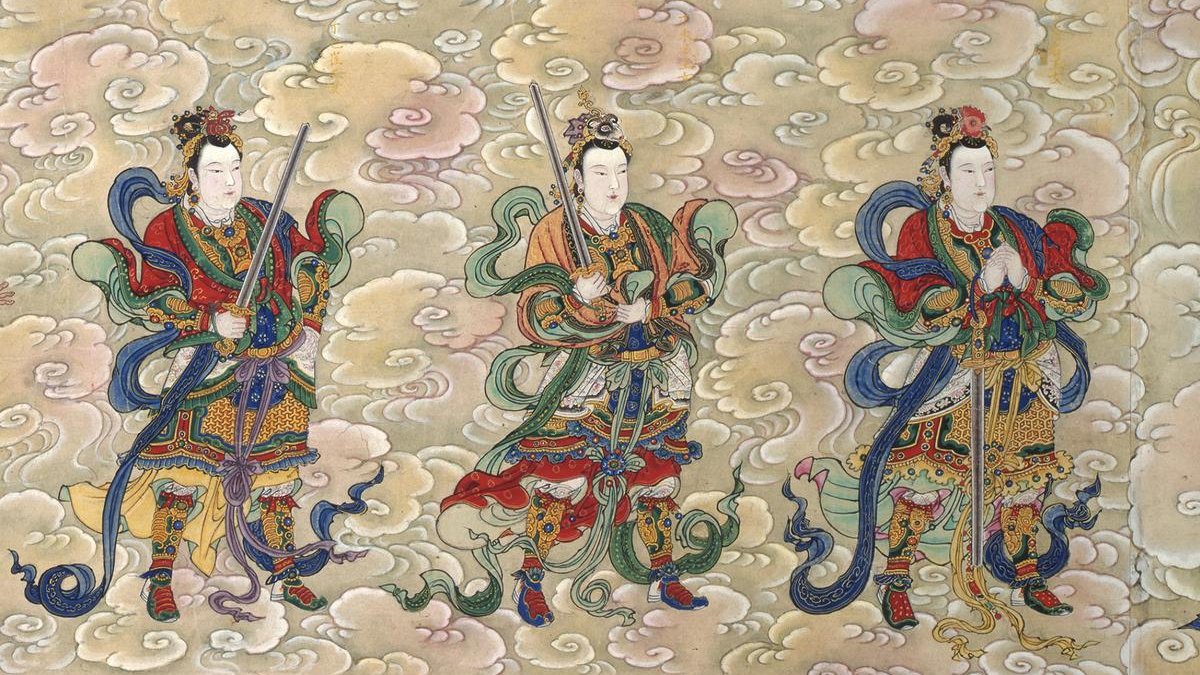
Just one example gives us a sense, a troubling sense, of how much we don’t know. There is a scroll painting now in the San Diego Museum of Art that shows, in intricate and meticulous detail, a ceremony held in 1493 under the auspices of one of the most senior figures of the indigenous Chinese religion we now call Daoism. It is a ritual designed to give an empress surnamed Zhang (she was to be the mother of the Zhengde emperor) the power to summon and control a whole raft of terrifying deities with names like ‘Director of Fate’ and ‘Administrator of the Thunder Ministry’. The ‘Ordination Scroll of Empress Zhang’ is an invaluable piece of evidence for the religious life of the imperial family, and for the roles in religious life of women of the dynasty. But it’s unique. Nothing else like the Empress Zhang ordination scroll survives, nor any other surviving document even comes close to giving us this degree of insight into the ‘private’ religious lives of imperial women.
To further help us put into perspective the scale of what we do and what we don’t know about Ming China, nothing among the millions of Chinese characters in all the texts that come down to us from the Ming dynasty even mentions the ordination of Empress Zhang. If the scroll had not fortuitously survived, we would have no idea that it had happened, indeed we would never be in a state of imagining it could have happened – it would be another ‘unknown unknown’. What else don’t we know about? It’s a reminder to anybody today that there are limits on our knowledge of the past, and that humility, as well as iron rigour, needs to be part of the historian’s reflexes.
No piece of evidence, whether it is a text or an artefact, presents itself to us with absolute innocence
Where there are gaps in knowledge, there are often attempts made to fill in those gaps. As the Ming dynasty went on, writers outside the imperial family got bolder and bolder in writing down stories about that family’s doings, which fascinated audiences just as the lifestyles and marital troubles of ‘the royals’ have continued to fascinate to this day. And, sometimes, they just made up stuff. By the time ‘The Ming History’ was completed in 1736, all sorts of juicy details about imperial private life, down to what kinds of dreams the emperors dreamed, had come to have the status of ‘historical fact’. And for audiences in China, these ‘historical facts’ continue to provide entertainment and diversion. Just as lots of people in Britain who are not professional historians know that King Henry VIII had six wives, so lots of people in China know that the fifth Ming emperor had two successive empresses, divorcing the initial one of these in what was the first (but not the last) imperial breakup of the Ming. This scandalous tale is at the heart of the hugely popular 62-hour Chinese television epic Da Ming fenghua (‘Ming Dynasty’), broadcast in 2019-20. In this drama, Empress Hu and Empress Sun, who supplants her, are secretly sisters, which is highly implausible, to say the least, in academic historical terms, even if it makes for compelling drama.
The professional historians with their iron writing brushes are not the only ones now who get to tell the stories. This makes it all the more necessary to consider, and to discuss openly, not just what we know about the past, but also how we know about the past. No piece of evidence, whether it is a text or an artefact, presents itself to us with absolute innocence. An exhibition can have an immediacy, bringing us into the very presence of the past, in a way that written texts perhaps find it harder to do. But exhibitions and museums can show only what survives, when in reality the things that don’t survive (but that once existed in much greater quantities) might be the more significant aspect of the past.
Writings – especially from a context like Ming China where they come down to us in such enormous quantities – might seem to fill those gaps, but writing has its silences and its exclusions too. Most historical writing, now and in the past, is written from a particular standpoint. In the case of issues widely accepted as controversial, like (to take one current example) the British Empire and its legacies, it is usually pretty easy to work out what that standpoint is. For works written in a remoter past, or in less familiar contexts, the standpoints can be harder to grasp. To try and investigate them is assuredly not to say that there is no such thing as ‘historical truth’; it is to insist on the realities, as well as the complexities, of the past.