By Gary Ng, CEO and co-founder of viAct
There is a major shift occurring at some of the most hazardous workplaces on the planet: oil refineries, large construction projects, and underground mines, as new and improving technologies are being used for the initial line of defence.
Technologies, like Artificial Intelligence (AI), robotics, and IoT wearables, especially smartwatches, have replaced the hard hat and safety supervisor as the last line of defence against workplace hazards by providing a first layer of protection against them.
Over the past few years, world has witnessed a rapid increase in both quantity and variety of robotic and automated systems being deployed to monitor, detect, and respond to workplace hazards in real-time, and there has probably never been a more opportune time for these technologies to evolve from being part of pilot programmes to permanent fixtures of the industrial workplace.
Autonomous robotics and smartwatches: The new safety stack
For years, manual inspection, periodic audits and stretched-thin human supervisors have provided the basis for establishing safety in high-risk industries. Pressurised pipelines managed by oil and gas facilities, construction sites with thousands of workers routinely exposed to extreme heat, and mining operations conducting blasting and excavating operations underground all share one vulnerability in common: the gap between when a hazard occurs and when a human identifies it.
Two converging technologies are reducing this gap. Autonomous robotics, including drones, and mobile inspection units are extending the area of safety monitoring significantly beyond what human supervisors could physically cover.
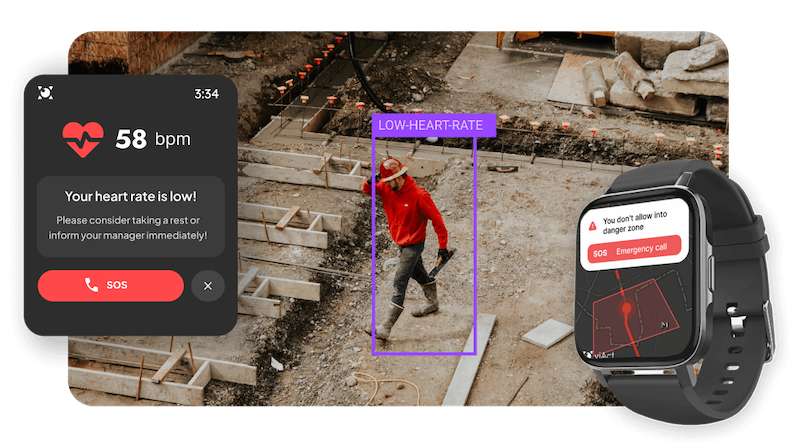
Simultaneously, AIoT-enabled smartwatches, are changing what happens in seconds after a hazard is detected. This is how it works: the AI CCTV identifies a safety violation, like PPE non-compliance or danger zone intrusion, identifies the worker involved, and sends real-time alert, via haptic vibration, directly to the concerned worker.
The worker corrects the behaviour and shares proof of their corrective action, thus creating an auditable trail with date, time and locations of the whole process. What typically took 24 to 48 hours under the previous manual system now occurs in less than five minutes.
This closed-loop model with AI CCTV used as the brain and the smartwatch as the last mile, is now being deployed across various oil and gas facilities, large construction jobsites, and mining sites worldwide, where the amount of industrial work and the intensity of operating conditions have made the case for “always-on AI safety” impossible to ignore.
Where are robotics and AI making the biggest difference?
In all the high-risk industries, the baseline capabilities such as PPE detection, danger zone intrusion and confined space monitoring are considered as the minimum layers of AI safety that operators are expected to have in place. Beyond these, each industry is driving AI adoption around their specific challenges.
For example, in the oil and gas sector, one of the critical applications centres around lone worker monitoring in remote and offshore environments, where a smartwatch detecting and alerting worker malaise can mean the difference between a rescue and a fatality.
Similarly, in a construction site, AI CCTV monitoring combined with biometric data from smartwatches for heat stress management enables early intervention before situations become critical.
Likewise, in mining, blast zone clearance monitoring is one of the priorities where haptic alerts from the smartwatch cut through noise and darkness, ensuring every worker is accounted for before detonation.
Real-world deployments are already translating these capabilities into measurable safety outcomes on the ground. One such deployment, currently underway in the Middle East, offers a particularly compelling example of what this integrated model can deliver.
A real-world success story: viAct begins Middle East trials of AI CCTV integrated with smartwatches for real-time industrial safety
viAct, an HSE-focused AI company operating across the GCC, has begun implementing its integrated closed-loop technology model with several of its current clients throughout the region, like Aramco, Neom, Sajco, Adnoc Gas, Saudi Telecom Company, ACWA Power, SABIC, and Oxagon Industrial Complex – all utilizing this integrated approach in the oil & gas, construction, and manufacturing in Saudi Arabia and the UAE particularly.
The outcomes from the existing deployments provide evidence to support this next phase of expansion. On a construction site in Saudi Arabia, for managing large numbers of workers under extreme desert conditions, viAct combined its AI video analytics solutions with its IoT smart watches. This connected worker-safety technology provided real-time heat stress alerts, resulting in a 63 percent reduction in on-site medical incidents.
In addition, 95 percent compliance rates were achieved with automatic logging of hydration breaks and PPE compliance. These results directly reflect the kind of measurable, ground-level impact this integrated closed-loop technology model is capable of delivering at scale.
What comes next for AI-driven industrial safety?
With increasing global regulatory pressure and increased demand from project owners for easily verifiable safety compliance data, the use of AI and robotics in many high-risk industries will rapidly accelerate for the duration of this decade.
Governments throughout the Middle East, Southeast Asia, and beyond are increasing their occupational safety mandates, which means that the burden of proof has shifted from post-incident reporting to continuous and documented compliance that is being done in real-time.
The companies that are getting ahead of the game right now, by incorporating computer vision and AIoT-enabled smartwatches, into their safety programs, will likely set the standard that other companies must eventually meet. The closed-loop safety model has transitioned from a competitive advantage for first-movers to an expected minimum requirement across the global oil and gas, construction, and mining industries.
About the author: Gary Ng, CEO and co-founder of viAct, comes with a background of building engineering who turned into AIpreneur with inception of viAct in 2016. He has 10+ years of experience in implementing technological innovations in construction industry. Before viAct, he was the managing director of 3D fashiontech EFI Optitex. Also rewarded as the best regional senior executive in Nasdaq listed technology enterprise Stratasys. With his ultimate strength of analytical thinking and strategic decision making, Gary was also the advisory board member for SXSV in his early career. Gary believes in the concept of transferring knowledge from experienced to youngsters and is a renowned academic professional. Currently he is a visiting faculty professional at The Hong Kong Polytechnic University. Gray is also an active public speaker & preacher of AI driven sustainability in workplaces.
Facts Only
Gary Ng is the CEO and co-founder of viAct, an AI company focused on health, safety, and environment (HSE) solutions.
viAct operates in the GCC region, working with clients like Aramco, Neom, Adnoc Gas, and SABIC.
AI, robotics, and IoT wearables, including smartwatches, are replacing traditional safety measures in oil refineries, construction sites, and mines.
Autonomous drones and mobile inspection units extend safety monitoring beyond human capabilities.
AI-powered CCTV detects safety violations, such as PPE non-compliance or danger zone intrusions, and sends real-time alerts to workers via smartwatches.
Workers correct violations and log actions, creating an auditable trail.
In oil and gas, smartwatches monitor lone workers in remote or offshore environments.
In construction, AI CCTV and smartwatches manage heat stress by tracking biometric data.
In mining, smartwatches provide haptic alerts for blast zone clearance.
viAct’s deployments in Saudi Arabia and the UAE include projects with Aramco, Neom, and ACWA Power.
A construction site in Saudi Arabia using viAct’s technology saw a 63% reduction in medical incidents and 95% compliance with hydration breaks and PPE.
Global regulatory pressure is increasing the demand for real-time safety compliance data.
The closed-loop safety model is becoming a standard requirement in oil and gas, construction, and mining industries.
Executive Summary
Full Take
The narrative presents a compelling case for AI-driven safety in high-risk industries, emphasizing measurable improvements in compliance and incident reduction. The strongest version of this argument highlights real-world deployments, such as viAct’s projects in the Middle East, where integrated AI and IoT systems have demonstrably enhanced worker safety. The technology’s ability to close the gap between hazard detection and response—from hours to minutes—is a significant advancement over traditional methods. However, the discussion leans heavily on success stories without addressing potential limitations, such as system failures, false positives, or worker resistance to surveillance. The focus on compliance metrics and regulatory pressure may overshadow broader questions about worker autonomy and the ethical implications of constant monitoring.
Patterns detected: ARC-0024 Ambiguity (lack of discussion on potential downsides or failures of the technology), ARC-0043 Motte-and-Bailey (emphasizing "safety" as the motte while the bailey includes broader adoption of surveillance tech).
The paradigm driving this narrative is the belief that technology can eliminate human error and systemic risks in hazardous workplaces. This assumes that AI and IoT systems are infallible and that workers will universally benefit from increased monitoring. Historically, similar shifts toward automation in safety-critical industries have raised concerns about deskilling, over-reliance on technology, and the erosion of human judgment. The second-order consequences could include reduced trust between workers and management if surveillance is perceived as punitive rather than protective.
Key questions to consider: How do workers perceive the balance between safety and privacy in these systems? What safeguards exist to prevent misuse of the data collected? Could over-reliance on AI lead to complacency in human oversight?
If this narrative were part of a coordinated influence campaign, the playbook might involve highlighting only the successes of AI safety systems while downplaying risks, using regulatory pressure as a justification for widespread adoption, and framing opposition as resistance to progress. The actual content aligns with this pattern to some extent, as it emphasizes benefits without critically examining potential drawbacks. However, it does not appear to be a deliberate manipulation, as the claims are supported by real-world examples and industry trends.
Sentinel — Human
This text shows signs consistent with being written by a human. The author provides personal insights and a unique writing style that is not typically found in machine-generated content.