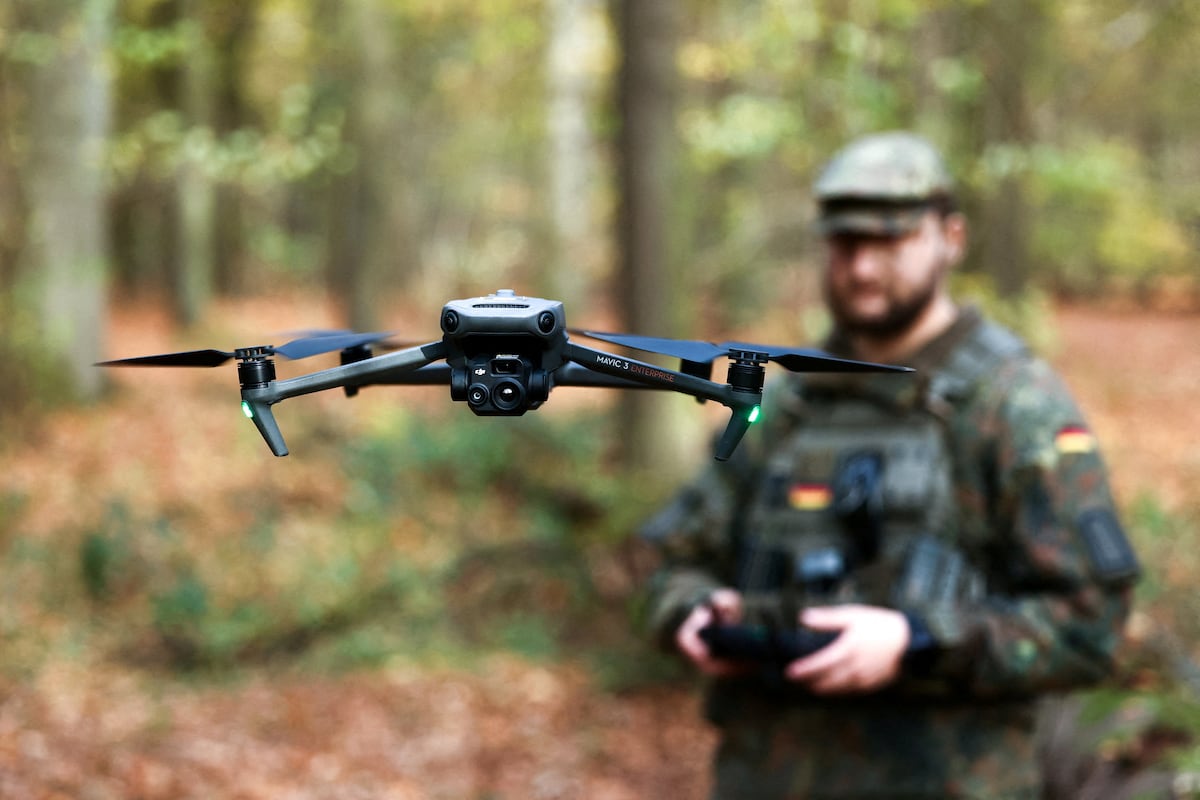
BERLIN — The German army is working to accelerate wartime decision-making through artificial intelligence tools capable of analyzing battlefield data more rapidly than humans, drawing lessons from Ukrainian and other forces, its commander told Reuters.
Lt. Gen. Christian Freuding, who became army chief last October after years of overseeing Germany’s arms supplies to Kyiv, shared his insights from visits to Ukrainian command posts where drones and modern sensors have drastically increased the volume of battlefield data.
“The Ukrainians exploit data which they have collected over four years of war. Based on this data, the AI can deduce how the enemy has acted in similar situations in the past - and recommend countermeasures,” he said.
He noted that tasks now requiring hundreds of personnel and days to complete could be sped up significantly through AI, adding that conventional methods alone would never be enough to “break the adversary’s decision-making cycle.”
Freuding suggested utilizing data from Ukraine and from German military exercises when training analytical tools, ensuring alignment with Germany’s operational principles.
Addressing ethical concerns, he emphasized that AI would serve only as an advisory tool to facilitate human decision-making.
“The task of taking analytical and balanced decisions will always remain with the human, with the soldier,” he said, adding that while a specific AI product is yet to be selected, the technology’s deployment is a priority.
Freuding underscored the importance of aligning Germany’s AI systems with NATO’s evolving standards. He did not rule out a European-developed system, but said American solutions might offer practical advantages due to their advanced deployment.
“Personally, I think it’s important that we get something up and running quickly. Of course, issues like data sovereignty and security need to be taken into account,” he added.
The U.S. Army is fielding the AI tool Maven, made by the Silicon Valley company Palantir, to process battlefield data, including imagery and video, to improve situational awareness and speed up decision-making.
Facts Only
Lt. Gen. Christian Freuding became the German army’s commander in October 2023.
Freuding previously oversaw Germany’s arms supplies to Ukraine.
The German army is developing AI tools to accelerate wartime decision-making.
Ukrainian forces use drones and sensors to collect battlefield data, which AI analyzes to predict enemy actions.
Freuding observed Ukrainian command posts where AI recommends countermeasures based on historical data.
AI could reduce tasks requiring hundreds of personnel and days of work to significantly shorter timeframes.
Freuding stated that human decision-making will remain central, with AI serving as an advisory tool.
Germany plans to use data from Ukraine and its own military exercises to train AI systems.
The AI systems must align with Germany’s operational principles and NATO standards.
Freuding did not rule out European-developed AI but noted potential advantages of American systems like Maven.
The U.S. Army uses Maven, developed by Palantir, to process battlefield imagery and video for situational awareness.
Freuding emphasized the need for quick deployment while considering data sovereignty and security.
Executive Summary
Full Take
The strongest version of this narrative presents AI as a force multiplier for Western militaries, enabling faster, data-driven decisions while maintaining human oversight. It credits Ukraine’s wartime innovations as a model for NATO allies, framing AI adoption as a necessary evolution to counter adversaries’ decision-making cycles. The emphasis on human control and ethical constraints serves as a reassuring counterbalance to concerns about autonomous warfare.
However, the narrative leans on a few unstated assumptions: that AI’s predictive power will translate seamlessly across different conflict contexts, that data from Ukraine is universally applicable, and that the risks of over-reliance on AI can be mitigated by human oversight alone. The mention of American systems like Maven subtly reinforces the idea that U.S. technological dominance is inevitable, potentially sidelining European sovereignty concerns. The framing also avoids deeper questions about the escalatory risks of AI in warfare—whether speeding up decision-making could reduce strategic patience or increase the likelihood of miscalculation.
Root cause: This reflects a broader paradigm shift in modern warfare, where data superiority is increasingly seen as a decisive advantage. The unstated assumption is that AI can compress the OODA loop (observe, orient, decide, act) without introducing new vulnerabilities—such as adversarial AI manipulation or overconfidence in algorithmic recommendations.
Implications: For human agency, the tension lies in whether AI augments or erodes command judgment. The costs may include reduced deliberation time, while the benefits accrue to militaries that can deploy AI fastest. Second-order consequences could include an AI arms race, where lagging nations feel compelled to adopt untested systems to keep pace.
Bridge questions: How might AI’s recommendations interact with the fog of war, where incomplete or deceptive data is common? What safeguards would prevent AI from reinforcing cognitive biases in commanders? If AI systems from different NATO members are interoperable, who bears responsibility for failures?
Counterstrike scan: A coordinated influence campaign pushing this narrative might emphasize urgency ("falling behind adversaries"), downplay risks ("human oversight is enough"), and frame dissent as technophobia. The actual content does not fully match this pattern—it acknowledges ethical concerns and avoids hyperbole—but the focus on speed and American solutions could align with a broader push for NATO-wide AI adoption.
Patterns detected: none
Sentinel — Human
This text appears to be written by a human journalist based on its irregular sentence length variance, personal voice, and lack of mechanical structure or template patterns.