The Battle Over Futures That Never Expire
“Incumbents are always going to fear the future, right?” — Michael Selig, Chairman, Commodity Futures Trading Commission, June 2026
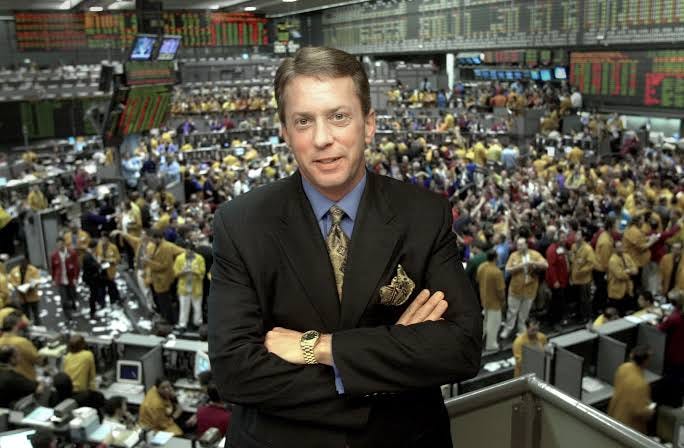
Growing up on the South Side of Chicago in a neighborhood of firefighters and cops, Terry Duffy knew little about hog butchering and even less about trading. But a regular at a bar he tended in Lake Geneva, Wisconsin, saw something in him and offered him a runner’s job at the Chicago Mercantile Exchange.
“I said I don’t even know what the hell the Chicago Mercantile Exchange is [but] it’s 1980, it’s raining ugly outside, there were no jobs to be had back then. I thought to myself, I’ll take a look at this. I got a job for $56 a week, and when I heard the bell go off for the first time I thought someone had bombed the exchange.”
Duffy started out in the lean hog pit, shuttling orders for pork futures between the phone clerks and the pit traders on the floor of the exchange. A year later he founded his own firm, TDA Trading, and bought a seat on the exchange. Seats had come down from a peak valuation of $380,000 but still cost more than Duffy could afford, so he persuaded his mother to mortgage the family home to help fund it. Shortly afterwards, he lost it all.
“I was in the pit and I misheard an order and I did the opposite of what I thought I was supposed to do and I lost – originally between $75,000 and $100,000” he said. “I turned the loss into $150,000 trying to make it better.”
It took Duffy three years to claw his way back, trading during the day and working bar jobs at night, his debt guaranteed by the trader who had scouted him. He went on to thrive on the floor, standing on the top stair of the pit in his red trading jacket, filling orders and schmoozing with customers. When CME introduced electronic trading in 1992, he was among the first to embrace it. In 1995, he joined the board and in 2002 became chairman, overseeing the restructuring that took CME public as the first US exchange to do so.
Under his leadership, CME grew into a powerhouse. It cemented a near-monopoly in US short-term interest rate derivatives and secured a dominant share in equity derivatives, anchored by its highly liquid E-mini and Micro futures contracts on the S&P 500. It still trades lean hog futures, though agricultural commodities now make up only 7% of daily trading volume. In all, it transacts 28.1 million contracts a day, up from 2.2 million contracts in 2002, earning a fee of around $0.65 on each contract. Margins, which have expanded from 34% to 66% under Duffy, rank among the highest in the S&P 500. Its market cap – $115 billion at its peak a few months ago – has risen 8,000% since the IPO.
But it hasn’t all been smooth. Duffy has had to negotiate shifting regulation, new technologies and the threat of challengers. Recently, a new challenge has emerged via prediction market platforms such as Kalshi. We’ve talked about them before. Beyond their success in sports betting, they see a bigger prize in financial assets. “The vision of Kalshi has always been: we want to build the next-generation exchange,” co-founder Tarek Mansour said this month. And that means going after CME. “Kalshi’s regulated prediction-market exchange combines Wall Street-grade reliability with Silicon Valley speed to create a next-generation CME for the 21st century,” the company trumpets.
It comes at a time Duffy is thinking about retirement. Last week, he announced that he will relinquish the CEO role he has held since 2016 to become executive chairman. But he won’t go quietly. The same week he unveiled his succession plans, he filed suit against his primary regulator, the Commodity Futures Trading Commission and its chairman Michael Selig over their decision to grant Kalshi permission to launch perpetual futures, a product that some view as disruptive.
“I’m always up for a good battle,” says Duffy. “I’ve never shied away from one, and I won’t shy away from this.”
To understand what Duffy stands to lose – and whether he can win – read on.
Sentinel — Human
This text exhibits strong markers of human authorship, characterized by specific personal anecdotes, nuanced emotional pacing, and the detailed embedding of complex biographical and financial history.