Americans have a reputation for being bad at world geography, and the current U.S. administration is no exception, particularly when it comes to correctly identifying what is – and is not – part of the United States of America.
President Donald Trump’s April 2025 executive order “unleashing America’s offshore critical minerals” provides an example. It purports to “unleash” seabed minerals both within and far outside U.S. jurisdiction.
The minerals on the U.S. seabed are America’s. The minerals on the international seabed are not “America’s.” The administration plans to authorize companies to mine in international areas, nonetheless.
I have studied the international agreements and customary rules governing the oceans since the Law of the Sea Convention entered into force in 1994. The Trump administration’s attempt to unilaterally exploit the seabed resources of the global commons will severely undermine part of the rules-based international order that the U.S. built and of which it has been the main beneficiary.
The scramble for critical minerals
The U.S. has been trying to secure access to critical minerals that are essential for modern technology. These materials include nickel, manganese and cobalt for large batteries and copper for the power grid. All can be found on land, but some can also be found at the bottom of the sea.
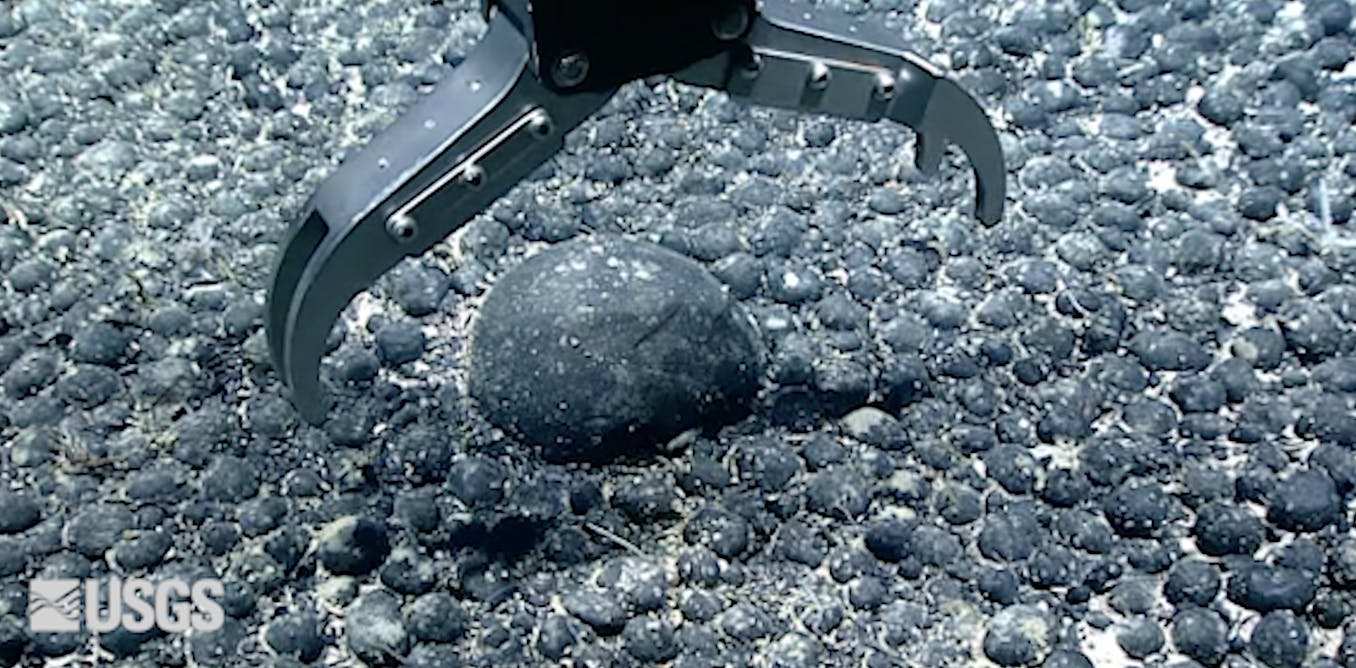
Of particular interest are polymetallic nodules – agglomerations, typically smaller than a potato, containing manganese and other metals and found in the silt of the deep ocean floor. An Australian mining executive described these nodules as “an EV battery in a rock.”
The Clarion Clipperton Zone, in the middle of the Pacific Ocean, contains one of the highest concentrations of polymetallic nodules. But whose nodules are they?
My ocean
In September 1945, President Harry Truman claimed for America a large part of the seabed extending from its shores, areas that, before Truman’s claim, were shared by the international community.
In reaction, countries around the world spent the next five decades hammering out a system to limit how much of the seabed that coastal countries could claim, and establishing rules that would govern the remaining shared areas of the oceans.
The resulting arrangement, finalized in 1994, gives countries that border the ocean authority over the resources in the water and seabed within 200 nautical miles (370 kilometers) of their coasts, known as “exclusive economic zones,” and, for some countries, additional areas of seabed beyond that limit.
add kilometer number in the caption
The United States enjoys one of the world’s largest exclusive economic zones today. It includes an area totaling over 4 million square miles (10 million square kilometers) – larger than all 50 U.S. states combined – and an additional nearly 400 million square miles (1 million square kilometers) of seabed extending even farther offshore.
In those areas, the United States controls the exploitation and management of living and nonliving natural resources, including seabed minerals.
Our ocean
But exclusive economic zones were only one part of what the Law of the Sea Convention negotiators called a “package deal.”
The other part of the deal retains the remaining areas – approximately half of the planet’s seabed – for the international community. It’s known as “the Area,” and its resources are considered the common heritage of mankind. To prevent a free-for-all, no single country can authorize mining in the Area. Instead it is managed by the International Seabed Authority for the benefit of humankind as a whole. To date, the ISA has executed 31 contracts with countries and companies to explore the mineral resources in the Area.
One hundred and seventy-one countries have joined the convention so far. However, the United States, despite being one of its primary architects, is the only industrialized nation remaining outside the treaty.
Nonetheless, the U.S. has long considered the treaty to reflect rules of customary international law. Where the Area is concerned, the U.S. respected the terms of the package deal – until now.
‘America’s’ offshore critical minerals
Trump’s offshore mining order relies on a U.S. statute enacted in 1980 as an interim measure pending completion of negotiations related to the Area. It authorized the National Oceanic and Atmospheric Administration to license exploration and permit commercial recovery of polymetallic nodules on the seabed in areas outside U.S. jurisdiction.
When that 1980 statute was enacted, there was a spurt of commercial interest. The U.S. issued four exploration licenses. Two were relinquished in the 1990s. In the 30-plus years since the international community finalized the package deal, even the company holding the two remaining NOAA licenses – Lockheed Martin – has considered them largely worthless unless the U.S. ratifies the Law of the Sea Convention.
That changed in April 2025 when Trump, citing the 1980 U.S. law, ordered the NOAA to “expedite the process for reviewing and issuing seabed mineral exploration licenses and commercial recovery permits in areas beyond national jurisdiction.”
A few days later, Canadian mining firm The Metals Company submitted an application via its wholly-owned subsidiary TMC USA to mine polymetallic nodules in the Area under U.S. unilateral authority. TMC USA touted its application for mining areas in the nodule-rich Clarion Clipperton Zone – in the middle of the Area – as a “world first”.
The International Seabed Authority condemned the move and reminded countries that “unilateral exploitation of resources that belong to no single State but to all of humanity is prohibited.”
Is that legal?
So, does the Trump administration’s plan violate U.S. international obligations?
The answer is maybe.
The U.S. is not a party to the Law of the Sea Convention, so it is not bound by the treaty. But scholars disagree on whether U.S. unilateral mining would violate obligations arising from rules of customary international law.
The United States is not the only player in this game. If any of the 171 countries that have subscribed to the treaty were to participate in or allow their citizens to participate in U.S.-authorized mining activity in the Area, they would violate their treaty obligations. Any other convention partner could bring them before the International Tribunal for the Law of the Sea in Hamburg, Germany.
Canada, home of TMC, could find itself in that position. So could many nations whose citizens or companies have worked with TMC. If those partners continued their work with TMC USA under U.S. authorization, their home countries could be exposed to legal action.
The Area is not a domestic source
In announcing an expedited seabed mining application process in January 2026, NOAA Administrator Neil Jacobs mischaracterized polymetallic nodules in the Area as “a domestic source of critical minerals for the United States.”
To be clear, the United States has critical minerals on its land territory and within its area of exclusive seabed jurisdiction. It is beginning to explore those resources with an eye to possible future mining. These are domestic American sources of critical minerals – they are “America’s.” The minerals in the Area are not.
Yes, America needs critical minerals, but it should not undermine the system of international ocean governance – a system it engineered and from which it benefits perhaps more than any other nation – to get them.
Facts Only
President Donald Trump issued an executive order in April 2025 to expedite seabed mineral exploration and mining in areas beyond U.S. jurisdiction.
The order relies on a 1980 U.S. statute, the Deep Seabed Hard Mineral Resources Act, which authorizes NOAA to license such activities.
The Clarion Clipperton Zone, located in the Pacific Ocean, contains high concentrations of polymetallic nodules rich in critical minerals like manganese, nickel, and cobalt.
The International Seabed Authority (ISA) manages the "Area," which covers approximately half of the planet’s seabed, under the 1994 Law of the Sea Convention.
The ISA has condemned the U.S. move, stating that unilateral exploitation of the Area’s resources violates international agreements.
The U.S. is not a party to the Law of the Sea Convention but has historically respected its provisions regarding the Area.
Canadian mining firm The Metals Company submitted an application in April 2025 to mine polymetallic nodules under U.S. authorization.
The U.S. exclusive economic zone covers over 4 million square miles (10 million square kilometers), larger than all 50 states combined.
The ISA has issued 31 exploration contracts for the Area to date, involving multiple countries and companies.
Legal scholars disagree on whether U.S. unilateral mining violates customary international law.
Countries that are parties to the Law of the Sea Convention could face legal action if they participate in U.S.-authorized mining in the Area.
NOAA Administrator Neil Jacobs described polymetallic nodules in the Area as a "domestic source of critical minerals" in January 2026.
Executive Summary
The U.S. administration under President Donald Trump has taken steps to authorize mining of seabed minerals in international waters, a move that challenges established international agreements. The 1980 Deep Seabed Hard Mineral Resources Act allows the U.S. to license exploration and mining in areas beyond its jurisdiction, and in April 2025, Trump issued an executive order to expedite this process. The Clarion Clipperton Zone, a mineral-rich area in the Pacific Ocean, is a key target, with Canadian firm The Metals Company applying for a U.S.-backed mining permit. However, the International Seabed Authority (ISA) has condemned this unilateral action, arguing that such resources belong to humanity as a whole under the 1994 Law of the Sea Convention. While the U.S. is not a party to the treaty, it has historically respected its provisions. Legal scholars debate whether the U.S. move violates customary international law, and other nations risk legal consequences if they participate in U.S.-authorized mining. The situation highlights tensions between national resource needs and global governance frameworks.
The U.S. has one of the world’s largest exclusive economic zones, granting it control over vast seabed resources within 200 nautical miles of its coast. However, the Trump administration’s push to exploit minerals in international waters—designated as the "common heritage of mankind"—risks undermining the rules-based order the U.S. helped create. Critics argue that while critical minerals are essential for technology and energy, bypassing international agreements could set a dangerous precedent. The outcome remains uncertain, with potential legal and diplomatic repercussions for the U.S. and its partners.
Full Take
The strongest version of this narrative highlights a legitimate tension: the U.S. needs critical minerals for technological and energy security, but its unilateral approach risks eroding the international legal framework it helped establish. The article credibly outlines the historical context of the Law of the Sea Convention and the U.S.’s paradoxical role as both architect and outsider. It also fairly presents the ISA’s condemnation and the potential legal risks for other nations. However, the framing leans toward portraying the U.S. action as a clear violation of global norms, which may oversimplify the legal ambiguity around customary international law.
Pattern scan: The narrative employs a subtle form of **ARC-0024 Ambiguity** by presenting the U.S. move as inherently destabilizing without fully exploring alternative interpretations of customary law or the strategic rationale behind the decision. There’s also a hint of **ARC-0043 Motte-and-Bailey**—the "rules-based order" is treated as an unassailable motte, while the bailey (U.S. exceptions to that order) is framed as hypocrisy. The emotional tone is restrained but leans toward alarm about the erosion of international norms.
Root cause: The paradigm here is the clash between national sovereignty and global governance. The unstated assumption is that the U.S. should prioritize multilateral agreements over unilateral resource extraction, even when those agreements constrain its strategic interests. This echoes historical patterns of great powers testing the limits of international systems they once championed—think of the U.S. and the Kyoto Protocol or the International Criminal Court.
Implications: If the U.S. proceeds, it could embolden other nations to bypass the ISA, fragmenting ocean governance. The second-order consequences include potential retaliation in other domains (e.g., trade, security) and a weakening of the U.S.’s moral authority in global forums. The beneficiaries would be mining corporations and nations with advanced deep-sea technology, while the costs—environmental, legal, and diplomatic—would be borne collectively.
Bridge questions: What if the ISA’s regulatory framework is too slow to meet the urgent demand for critical minerals? Could unilateral actions by the U.S. force a much-needed reform of the convention? And if the U.S. ratifies the treaty, would that resolve the tension, or is the issue deeper—about who controls the "global commons" in an era of resource scarcity?
Counterstrike scan: A coordinated influence campaign would amplify the narrative of U.S. hypocrisy, framing it as part of a broader pattern of disregard for international law (e.g., climate agreements, trade disputes). It might also downplay the strategic necessity of critical minerals or the ISA’s bureaucratic inefficiencies. The actual content aligns partially with this playbook but stops short of overt manipulation—it presents a legitimate critique while acknowledging legal ambiguity. No red flags for bad faith, but the framing invites skepticism about whether the "rules-based order" is being weaponized for political ends.
Patterns detected: ARC-0024 Ambiguity, ARC-0043 Motte-and-Bailey
Sentinel — Human
The article shows strong signs of human authorship, including a distinct voice, personal expertise, and nuanced legal analysis, with minimal stylometric or coherence red flags.