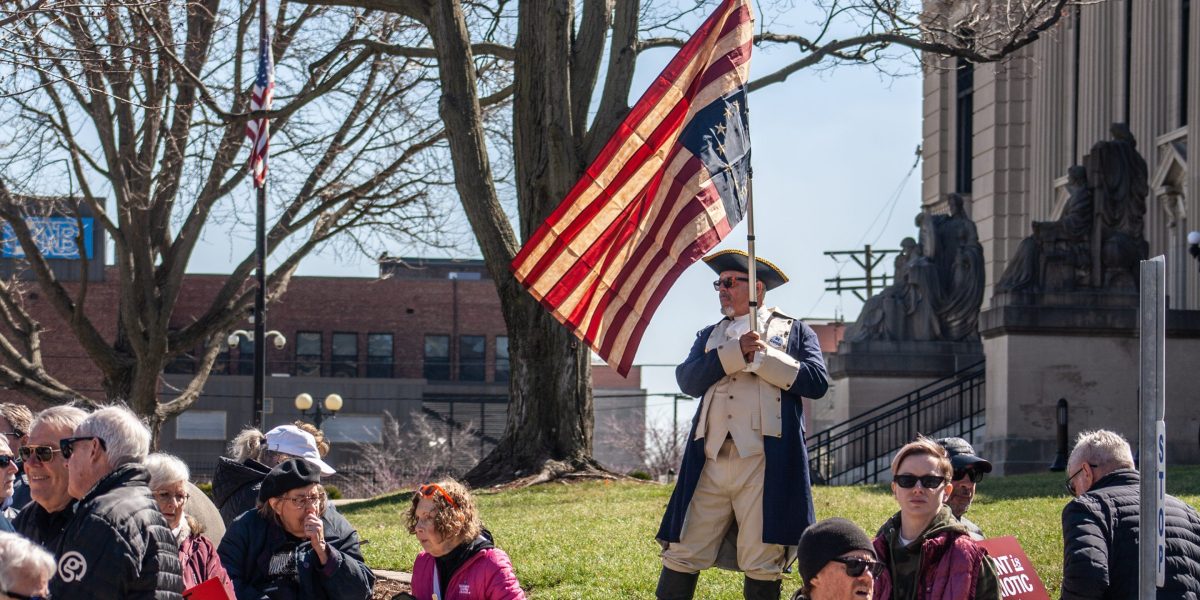
Large crowds protested Saturday against the war in Iran and President Donald Trump’s actions in “No Kings” rallies across the U.S. and in Europe. Minnesota took center stage, with thousands of people standing shoulder-to-shoulder to celebrate resistance to Trump’s aggressive immigration enforcement.
Minnesota’s flagship event on the Capitol lawn in St. Paul drew Bruce Springsteen as its headliner. He and other speakers praised the state’s people for taking to the streets over the winter in opposition to a surge of U.S. Customs and Immigration Enforcement agents.
Springsteen performed “Streets of Minneapolis,” the song he wrote in response to the fatal shootings of Renee Good and Alex Pretti by federal agents. Springsteen lamented Good and Pretti’s deaths but said the state’s pushback against ICE has given the rest of the country hope.
“Your strength and your commitment told us that this was still America,” he said. “And this reactionary nightmare, and these invasions of American cities, will not stand.”
People rallied from New York City, with almost 8.5 million residents in a solidly blue state, to Driggs, a town of fewer than 2,000 people in eastern Idaho, a state Trump carried with 66% of the vote in 2024.
Biggest crowds yet expected
U.S. organizers have estimated that the first two rounds of No Kings rallies drew more than 5 million people in June and 7 million in October.This week they told reporters they expected 9 million participants Saturday, though it was too early to tell whether those expectations were met.
Organizers said more than 3,100 events — 500 more than in October — were registered, in all 50 states.
In Topeka, Kansas, a rally outside the Statehouse had people impersonating a frog king and Trump as a baby. Wendy Wyatt drove with “Cats Against Trump” sign from Lawrence, 20 miles (32 kilometers) to the east, and planned to drive back to her hometown for a later rally there.
Wyatt said “there are so many things” about the Trump administration that upset her, but “this is very hopeful to me.”
GOP officials dismissive of protests
White House spokesperson Abigail Jackson characterized them as the product of “leftist funding networks” with little real public support.
The “only people who care about these Trump Derangement Therapy Sessions are the reporters who are paid to cover them,” Jackson said in a statement.
The National Republican Congressional Committee was also sharply critical.
“These Hate America Rallies are where the far-left’s most violent, deranged fantasies get a microphone,” NRCC spokesperson Maureen O’Toole said.
Protesters have a long list of causes
Trump’s immigration enforcement push, particularly in Minnesota, was just one item on a long list of protester grievances that also included the war in Iran and the rollback of transgender rights. Speakers at the Minnesota rally decried billionaires’ economic power.
In Washington, hundreds marched past the Lincoln Memorial and into the National Mall, holding signs that read “Put down the crown, clown” and “Regime change begins at home.” Demonstrators rang bells, played drums and chanted “No kings.”
Bill Jarcho was there from Seattle, joined by six people dressed as insects wearing tactical vests that said, “LICE” — spoofing ICE, as part of what he called a “mock and awe” tour.
“What we provide is mockery to the king,” Jarcho said. “It’s about taking authoritarianism and making fun of it, which they hate.”
About 40,000 people marched in San Diego, police there said.
In New York, Donna Lieberman, executive director of the New York Civil Liberties Union, said during a news conference that Trump and his supporters want people to be afraid to protest.
“They want us to be afraid that there’s nothing we can do to stop them,” she said. “But you know what? They are wrong — dead wrong.”
Organizers said two-thirds of RSVPs for the rallies came from outside of major urban centers. That included communities in conservative-leaning states like Idaho, Wyoming, Montana, Utah, South Dakota and Louisiana, as well in electorally competitive suburbs in Pennsylvania, Georgia and Arizona.
Main event at the Minnesota Capitol
Organizers designated the rally there as the national flagship event.
Before Springsteen took the stage, organizers played a video in which actor Robert DeNiro said he wakes up every morning depressed because of Trump but was happier Saturday because millions of people were protesting. He also congratulated Minnesotans for running ICE out of town.
The bill also included singer Joan Baez, actor Jane Fonda, Vermont U.S. Sen. Bernie Sanders and a long list of activists, labor leaders and elected officials.
Protesters held up a massive sign on the Capitol steps that read, “We had whistles, they had guns. The revolution starts in Minneapolis.”
“Donald Trump may pretend that he’s not listening, but he can’t ignore the millions in the streets today,” said Randi Weingarten, president of the American Federation of Teachers.
Rallies outside the US
Demonstrations were also planned in more than a dozen other countries, from Europe to Latin America to Australia, Ezra Levin, a co-executive director of Indivisible, a group spearheading the events, said in an interview. In countries with constitutional monarchies, people call the protests “No Tyrants,” he said.
In Rome, thousands marched with defiant chants aimed at Premier Giorgia Meloni, whose conservative government saw its referendum for streamlining Italy’s judiciary fail badly this week amid criticism that it was a threat to the courts’ independence. Protesters also waved banners protesting Israeli and US attacks on Iran, calling for “A world free from wars.”
In London, people protesting the war held banners with slogans such as “Stop the far right” and “Stand up to Racism.”
And in Paris, several hundred people, mostly Americans living in France, along with labor unions and human rights organizations, gathered at the Bastille.
“I protest all of Trump’s illegal, immoral, reckless, and feckless, endless wars,” rally organizer Ada Shen said.
Facts Only
Large crowds protested on Saturday against the war in Iran and President Donald Trump’s actions in "No Kings" rallies across the U.S. and Europe.
Minnesota’s rally at the Capitol lawn in St. Paul was the flagship event, headlined by Bruce Springsteen.
Springsteen performed "Streets of Minneapolis," a song written in response to the fatal shootings of Renee Good and Alex Pretti by federal agents.
Organizers estimated 9 million participants across 3,100 events, with rallies in all 50 states and over a dozen countries.
In Topeka, Kansas, protesters included a performance mocking Trump as a baby and a frog king.
White House spokesperson Abigail Jackson dismissed the protests as "leftist funding networks" with little public support.
The National Republican Congressional Committee criticized the rallies as "Hate America Rallies" where "far-left’s most violent, deranged fantasies get a microphone."
Protesters in Washington, D.C., marched past the Lincoln Memorial with signs like "Put down the crown, clown" and chanted "No kings."
In San Diego, about 40,000 people marched, according to police estimates.
International rallies occurred in Rome, London, and Paris, with protesters targeting local and global political issues.
The Minnesota rally featured speakers including Joan Baez, Jane Fonda, and Senator Bernie Sanders.
A video message from Robert De Niro congratulated Minnesotans for resisting ICE.
Executive Summary
Large-scale protests under the "No Kings" banner took place across the U.S. and Europe on Saturday, with Minnesota's rally at the Capitol in St. Paul serving as the flagship event. Headlined by Bruce Springsteen, the protests focused on opposition to President Donald Trump’s immigration enforcement policies, the war in Iran, and other grievances, including transgender rights and economic inequality. Organizers estimated participation could reach 9 million people across 3,100 events, though final numbers were not yet confirmed. The rallies drew diverse crowds, from urban centers like New York City to small towns in conservative states like Idaho. Republican officials dismissed the protests as leftist-funded and lacking genuine public support, while protesters emphasized their resistance to authoritarianism and hope for change. International demonstrations also occurred in cities like Rome, London, and Paris, with participants criticizing far-right policies and war.
The protests featured creative expressions of dissent, including satirical performances and signs mocking Trump and ICE. Speakers like Bernie Sanders and Joan Baez joined activists in Minnesota, where a video message from Robert De Niro praised the state’s resistance to ICE. While organizers framed the events as a show of grassroots opposition, critics from the GOP characterized them as divisive and extreme. The scale and geographic diversity of the rallies suggested broad, though not universally supported, discontent with Trump’s policies and broader political trends.
Full Take
The "No Kings" protests represent a coordinated, large-scale expression of opposition to Trump’s policies, framed as a defense of democratic values against perceived authoritarianism. The strongest version of this narrative is that it reflects genuine grassroots mobilization, with diverse participation across geographic and political lines, suggesting broad discontent with the administration’s actions on immigration, war, and social issues. The inclusion of high-profile figures like Springsteen and Sanders lends cultural and political weight to the movement, while the international rallies indicate a transnational alignment of progressive causes.
However, the narrative also exhibits patterns of emotional exploitation and distortion. The framing of the protests as a moral crusade against "kings" and "tyrants" leans into moral panic and weaponized anger, particularly in the satirical mockery of Trump and ICE. The GOP’s dismissal of the protests as "leftist-funded" and "Hate America Rallies" reflects a classic motte-and-bailey tactic, where critics attack the most extreme elements of the movement while ignoring its broader concerns. The article’s focus on the scale of the protests and the celebrity involvement may also serve as an appeal to popularity, potentially overshadowing the substantive policy debates at hand.
The root cause of this narrative is a clash between competing visions of democracy: one that sees Trump’s policies as an existential threat to liberal values, and another that views the protests as an overreaction by a radicalized left. Historically, this echoes past movements where mass protests have been both a tool of civic engagement and a target of political polarization. The implications for human agency are significant—protesters assert their right to dissent, while critics question the legitimacy of their grievances. The second-order consequences could include further entrenchment of political divisions or, conversely, a renewed push for policy changes.
Bridge questions: How might the protests’ messaging evolve if they fail to achieve immediate policy changes? What perspectives from conservative or moderate participants are missing from this narrative? Would evidence of tangible policy shifts alter the perception of these protests as effective or merely performative?
Counterstrike scan: If this were a coordinated influence campaign, the playbook would involve amplifying emotional triggers (e.g., "No Kings" rhetoric), leveraging celebrity endorsements for credibility, and framing opposition as extremist to polarize audiences. The actual content aligns with this pattern to some degree, particularly in its use of provocative language and dismissal of counterarguments. However, the inclusion of diverse voices and policy-specific grievances suggests a more organic movement than a manufactured one. The most concerning element is the potential for the protests to be weaponized by either side to deepen divisions rather than foster dialogue.
Patterns detected: ARC-0043 Motte-and-Bailey (GOP dismissal), ARC-0024 Ambiguity (scale of participation), ARC-0018 Emotional Exploitation (mockery and moral framing)
Sentinel — Human
This analysis suggests that the article is likely human-written, with no indications of AI-assisted manipulation or coordinated synthetic production. The text displays human-like sentence length variance, an idiosyncratic emphasis, a personal voice, and stylistic fingerprint.