NASA is bringing together the international partners in the Artemis program next week to discuss the program’s new architecture. NASA differentiates Artemis from the Apollo program by emphasizing that this time international partners will be an integral part. But recent changes are raising questions about their role, especially the future of the international Gateway lunar space station.
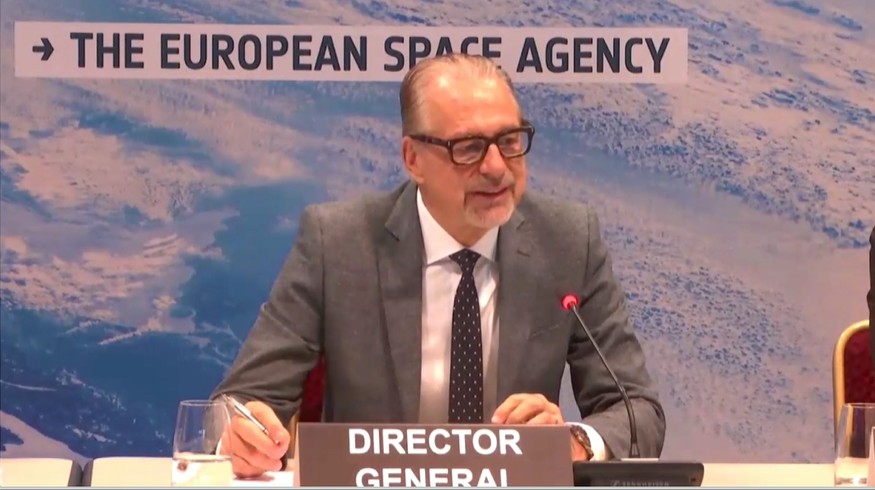
ESA Director General Josef Aschbacher revealed next week’s gathering during a press conference this morning following the quarterly meeting of ESA’s Ministerial Council.
After noting he had his first “very constructive, very positive and very interesting” meeting with NASA Administrator Jared Isaacman on February 11, he added that he is looking forward to learning about the new plans.
“NASA will see a very united Europe appearing in Washington and obviously in all the interactions afterwards. I think this is a very welcome opportunity. We will have yet to see what the proposal is, so therefore I cannot comment on something that is not known. But we will be sure that we are well prepared. And as new elements will come to the table, we will certainly reflect among our member states and prepare our actions, proposals and ways forward, always very swiftly, very proactively and I look forward to the meetings next week.” — Josef Aschbacher, ESA Director General
ESA, the Canadian Space Agency (CSA), and the Japan Aerospace Exploration Agency (JAXA) are critical members of the Artemis program, building on decades-long partnerships with the United States including the International Space Station. The United Arab Emirates (UAE) recently joined as well.
Gateway is not the only Artemis contribution from the international partners, but is the one that brings everyone together.
For Gateway, NASA is providing the initial elements: a Habitation and Logistics Module (HALO) and a Power and Propulsion Element (PPE). Northrop Grumman is the prime contractor for HALO, and Lanteris Space Systems (formerly Maxar) for the PPE.
ESA is building Gateway’s International Habitation Module, iHAB, in cooperation with JAXA. It’s also building the ESPRIT module for communications, refueling, and windows so the crew can look out to the Earth and the Moon like the Cupola on the ISS.
Separately, ESA provides the Service Module for Orion that contains the propulsion system and other critical elements. The first three European Service Modules (ESMs) for Artemis I, II and III were obtained through an arrangement to compensate NASA for operational expenses on the ISS. A second set of three for Artemis IV, V, and VI were later procured. Built by Airbus, four ESMs have been delivered and the other two are in production. As part of their cooperation, NASA agreed to send three ESA astronauts to Gateway.
Canada was the first international partner to sign on to Gateway, agreeing in February 2019 to build a third version of the Canadarm robotic arm. The first Canadarm was part of the Space Shuttle program and Canadarm2 is an integral part of the ISS.
Canadian astronaut Jeremy Hansen is a member of the Artemis II crew that is getting ready to fly around the Moon for the first time since the Apollo era as soon as April 1.
JAXA is working with ESA on iHAB, plus building a Pressurized Lunar Rover for astronauts to use on the lunar surface. NASA is contracting with U.S. companies for Lunar Terrain Vehicles, but astronauts must remain in their spacesuits when aboard LTVs. In a pressurized rover, they can live inside the vehicle for extended periods of time, donning spacesuits only when they need to go outside. The United States agreed to land two Japanese astronauts on the Moon, including the first non-American as part of the Artemis program, in exchange.
The United Arab Emirates is the fourth partner in Gateway, building the airlock. At one time NASA hoped Russia would do that to keep the ISS partnership intact, but after Russia’s invasion of Ukraine that wasn’t possible and the UAE stepped in.
President Trump’s FY2026 budget request called for canceling Gateway, but Sen. Ted Cruz (R-Texas) added $2.6 billion in the One, Big Beautiful Bill Act (OBBBA) last summer to fully fund it. Nonetheless, questions are swirling about Gateway’s future with the major changes to Artemis Isaacman announced on February 27. He and other NASA officials have been circumspect in answering questions about Gateway since then.
Asked about it yesterday, Lori Glaze, Acting Associate Administrator for Exploration Systems Development, told the Lunar and Planetary Science Conference they are continuing to work on Gateway pursuant to the OBBBA, also called the Working Families Tax Credit Act, but the focus now is getting to the lunar surface.
“We are currently working under the Working Families Tax Credit Act, which provides funding for Gateway for several years. So we are continuing activities on Gateway. You’ve heard the Administrator, the announcement that came out a couple of weeks ago. What he said was, we are going to accelerate the activities and he wants to focus on the lunar surface, but he didn’t address the rest of the program at that time. So we are continuing with Gateway and continuing to work with our partners.” — Lori Glaze
NASA has been endeavoring to return astronauts to the Moon for decades at varying levels of effort. President George W. Bush made a lunar return a priority in 2004, but President Obama eschewed the Moon, choosing to focus on getting astronauts to Mars instead. In December 2017, President Trump restored the Moon as a pathway to Mars, with commercial and international partners an important component.
The concept of a “gateway” in lunar orbit evolved over those years. Gateway is much smaller than the ISS and not intended to be permanently occupied. Crews could stay there for about three months to conduct scientific research. A primary function is to serve as a transfer point between Earth and the lunar surface. The Space Launch System (SLS) and Orion will put astronauts into lunar orbit where they will meet up with the Human Landing Systems (HLSs) being built by SpaceX and Blue Origin. SpaceX’s Starship HLS and Orion will directly dock in lunar orbit for the first lunar landing, but after that connect through the Gateway. The question is how much of that architecture is included in NASA’s revised plan. Critics insist Gateway is unnecessary.
Another question for ESA is whether NASA still plans to use ESM-6 for the Artemis program. Trump’s budget proposal also called for terminating the SLS/Orion system after Artemis III and replacing it with commercial alternatives like SpaceX’s Starship or Blue Origin’s New Glenn. Cruz added $4.1 billion in the OBBBA for Artemis IV and V, however.
Isaacman’s new plan is that Artemis III will be an earth-orbiting test flight instead of a lunar landing, and Artemis IV and V will be landings, but the fate of SLS/Orion after that is unclear. If Artemis V is the final flight of SLS/Orion, ESM-6 won’t be needed. At today’s ESA press conference, Daniel Neuenschwander, Director of Human and Robotic Exploration, said ESM-6 remains assigned to Artemis as of now.
User Comments
SpacePolicyOnline.com has the right (but not the obligation) to monitor the comments and to remove any materials it deems inappropriate. We do not post comments that include links to other websites since we have no control over that content nor can we verify the security of such links.
Facts Only
NASA is convening international partners in the Artemis program next week to discuss changes to the program’s architecture.
The European Space Agency (ESA), Canadian Space Agency (CSA), Japan Aerospace Exploration Agency (JAXA), and United Arab Emirates (UAE) are key partners in Artemis.
ESA is building the International Habitation Module (iHAB) and the ESPRIT module for Gateway, as well as the European Service Module (ESM) for Orion.
Canada is providing a robotic arm for Gateway and has astronaut Jeremy Hansen on the Artemis II crew.
JAXA is collaborating with ESA on iHAB and developing a pressurized lunar rover for surface missions.
The UAE is constructing the Gateway airlock.
NASA’s initial Gateway contributions include the Habitation and Logistics Module (HALO) and Power and Propulsion Element (PPE).
President Trump’s FY2026 budget proposed canceling Gateway and replacing SLS/Orion with commercial alternatives after Artemis III.
The One, Big Beautiful Bill Act (OBBBA) added $2.6 billion for Gateway and $4.1 billion for Artemis IV and V.
NASA Administrator Jared Isaacman announced changes on February 27, including making Artemis III an Earth-orbit test flight and prioritizing lunar landings for Artemis IV and V.
ESA Director General Josef Aschbacher met with Isaacman on February 11 and expressed readiness for next week’s discussions.
NASA’s Lori Glaze confirmed continued work on Gateway under current funding but emphasized a focus on lunar surface missions.
The fate of SLS/Orion after Artemis V and the use of ESM-6 remain uncertain.
Executive Summary
NASA is convening its international partners in the Artemis program next week to discuss significant changes to the program’s architecture, particularly regarding the Gateway lunar space station. The European Space Agency (ESA), Canadian Space Agency (CSA), Japan Aerospace Exploration Agency (JAXA), and the United Arab Emirates (UAE) are key contributors, with ESA providing critical modules like the International Habitation Module (iHAB) and the European Service Module (ESM) for Orion. Canada is supplying a robotic arm, while JAXA is collaborating on iHAB and developing a pressurized lunar rover. The UAE is constructing the Gateway’s airlock. Recent budget proposals and policy shifts, including President Trump’s FY2026 request to cancel Gateway and replace SLS/Orion with commercial alternatives, have raised uncertainties about the program’s future. NASA Administrator Jared Isaacman’s recent announcement of changes to Artemis III, IV, and V—shifting focus toward lunar landings—has left questions about Gateway’s role and the long-term use of SLS/Orion. Despite funding secured through the One, Big Beautiful Bill Act (OBBBA), NASA officials remain cautious about detailing the revised architecture, emphasizing continued work on Gateway while prioritizing lunar surface missions.
The international partners, particularly ESA, have expressed unity and readiness to adapt, though specifics of NASA’s new plans remain unclear. ESA Director General Josef Aschbacher highlighted Europe’s preparedness to engage constructively, while NASA’s Lori Glaze confirmed ongoing Gateway activities under current funding. However, the broader implications of these changes—such as the potential termination of SLS/Orion after Artemis V and the fate of ESM-6—remain unresolved. The situation reflects the tension between NASA’s evolving priorities, congressional funding decisions, and the expectations of long-standing international collaborators.
Full Take
The strongest version of this narrative highlights NASA’s strategic pivot toward lunar landings while maintaining international partnerships, framed as a necessary evolution to meet ambitious timelines. The article credits NASA with transparency in convening partners and acknowledges the constructive tone from ESA and others, suggesting a collaborative approach to uncertainty. However, the pattern scan reveals potential **ARC-0024 Ambiguity**—NASA’s vague statements about Gateway’s future and the role of SLS/Orion create a fog of uncertainty, allowing flexibility but also leaving partners in limbo. The repeated emphasis on "continued work" without clarity on long-term commitments could be a form of **ARC-0043 Motte-and-Bailey**, where the "motte" (current funding) is defended while the "bailey" (future architecture) remains undefined.
The root cause of this tension lies in the clash between political priorities, budgetary constraints, and the technical realities of space exploration. The historical pattern echoes past shifts in U.S. space policy—from Bush’s Moon-Mars initiative to Obama’s Mars focus and Trump’s lunar return—where changing administrations disrupt long-term planning. The implications for human agency are significant: international partners like ESA and JAXA have invested heavily in Artemis, and abrupt changes could erode trust or force costly adaptations. The UAE’s recent inclusion as a Gateway partner adds another layer of geopolitical complexity, particularly given the original hope that Russia would fill that role.
Bridge questions: What would a truly equitable international partnership look like in Artemis, beyond hardware contributions? How might commercial alternatives to SLS/Orion reshape the power dynamics between NASA and its partners? What safeguards could prevent future policy whiplash from derailing long-term lunar exploration?
Counterstrike scan: A coordinated influence campaign would exploit the ambiguity around Gateway to sow division—amplifying critiques of its necessity while downplaying international contributions to undermine trust. The actual content does not match this pattern; instead, it presents a balanced account of uncertainties and partner perspectives, suggesting healthy journalistic scrutiny rather than manipulation.
Sentinel — Human
The article exhibits strong human signals, including nuanced phrasing, specific attributions, and contextual depth, with minimal stylometric or coherence red flags.