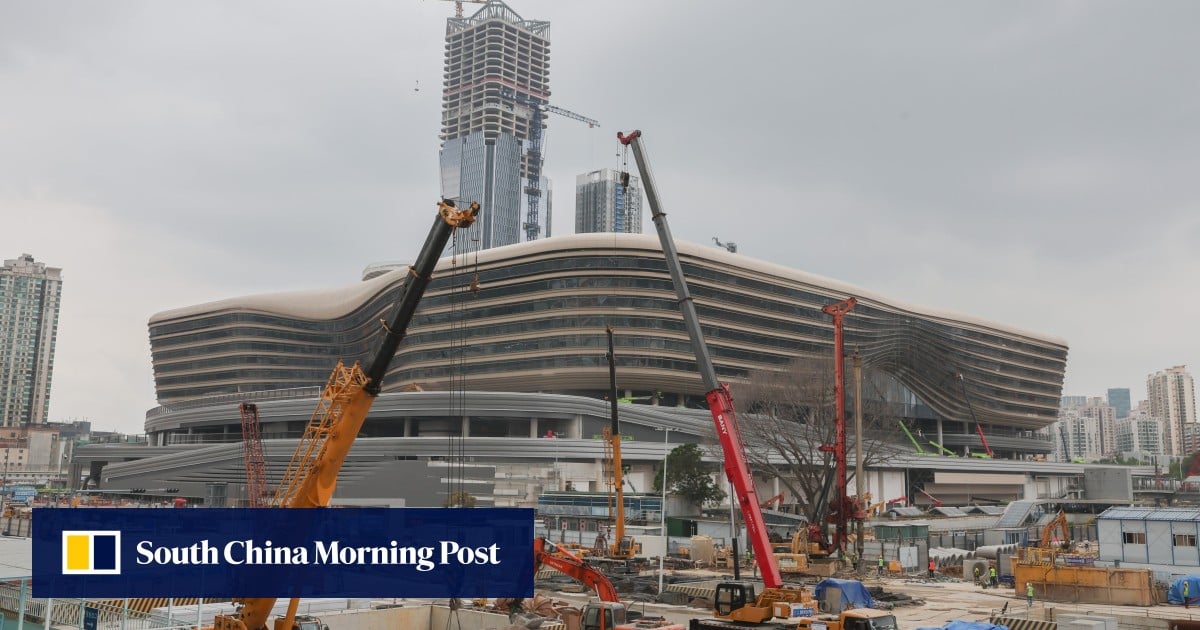
Hong Kong authorities plan to find a nearby site for parking and provide shuttle buses to the checkpoint building
Hong Kong lawmakers have expressed concern over the lack of a car park at the upgraded Huanggang border crossing, saying that providing a shuttle bus service for tour groups or motorists to reach the checkpoint building will not be convenient.
Secretary for Security Chris Tang Ping-keung said on Friday that the revamped building – which is on the mainland Chinese side of the border in Shenzhen – would not have a public car park or bays for coaches. The Transport and Logistics Bureau would decide the exact location of a car park near the crossing, he added.
“In our plan, we will find a spot that’s very close to the crossing, with the location to be confirmed, such as the San Tin traffic intersection, for residents to park and then take a shuttle bus for a few minutes to reach the Huanggang crossing,” Tang told a Legislative Council security panel meeting.
Lawmaker Dominic Lee Tsz-king said a short shuttle bus ride, even if there were frequent services, would still be inconvenient as it would add at least five to 10 minutes to the journey.
“Compared with a completely seamless passage, it’s a long way behind,” Lee said.
Lawmakers called for a public car park similar to the one at the Heung Yuen Wai crossing, where drivers can book a parking spot 30 minutes to seven days before entry.
Facts Only
Actor: Hong Kong authorities, Transport and Logistics Bureau, lawmakers (Dominic Lee Tsz-king)
Event: Lack of parking at Huanggang border checkpoint, plans to provide shuttle buses
Timeline: Current situation (unspecified future for the implementation of the plan)
Location: Huanggang border crossing in Shenzhen, Heung Yuen Wai crossing (both in China)
Executive Summary
Full Take
As Hong Kong authorities upgrade the Huanggang border crossing, a lack of parking facilities has become a concern for local lawmakers. The proposed solution involves providing shuttle buses for residents to reach the checkpoint building from a nearby car park location. However, this alternative is viewed as inconvenient due to additional travel time, prompting calls for a more accessible public car park system similar to the one at Heung Yuen Wai crossing.
Patterns detected: ARC-0024 Ambiguity (the article does not specify how frequent the shuttle bus services will be or if there are any restrictions on booking parking spots at Heung Yuen Wai)
The lack of parking facilities and the proposed solution at Huanggang border crossing raise questions about the prioritization of convenience for travelers. Is a shorter journey at the cost of added complexity an acceptable compromise? What factors influence the decision-making process regarding infrastructure development in cross-border areas? These are important considerations that merit further examination.
A potential coordinated influence campaign might involve emphasizing the inconvenience caused by the lack of parking facilities and promoting alternative solutions without providing clear details, aiming to provoke public outrage and demand for change. However, it is essential to assess each situation individually and avoid jumping to conclusions about manipulative intent.