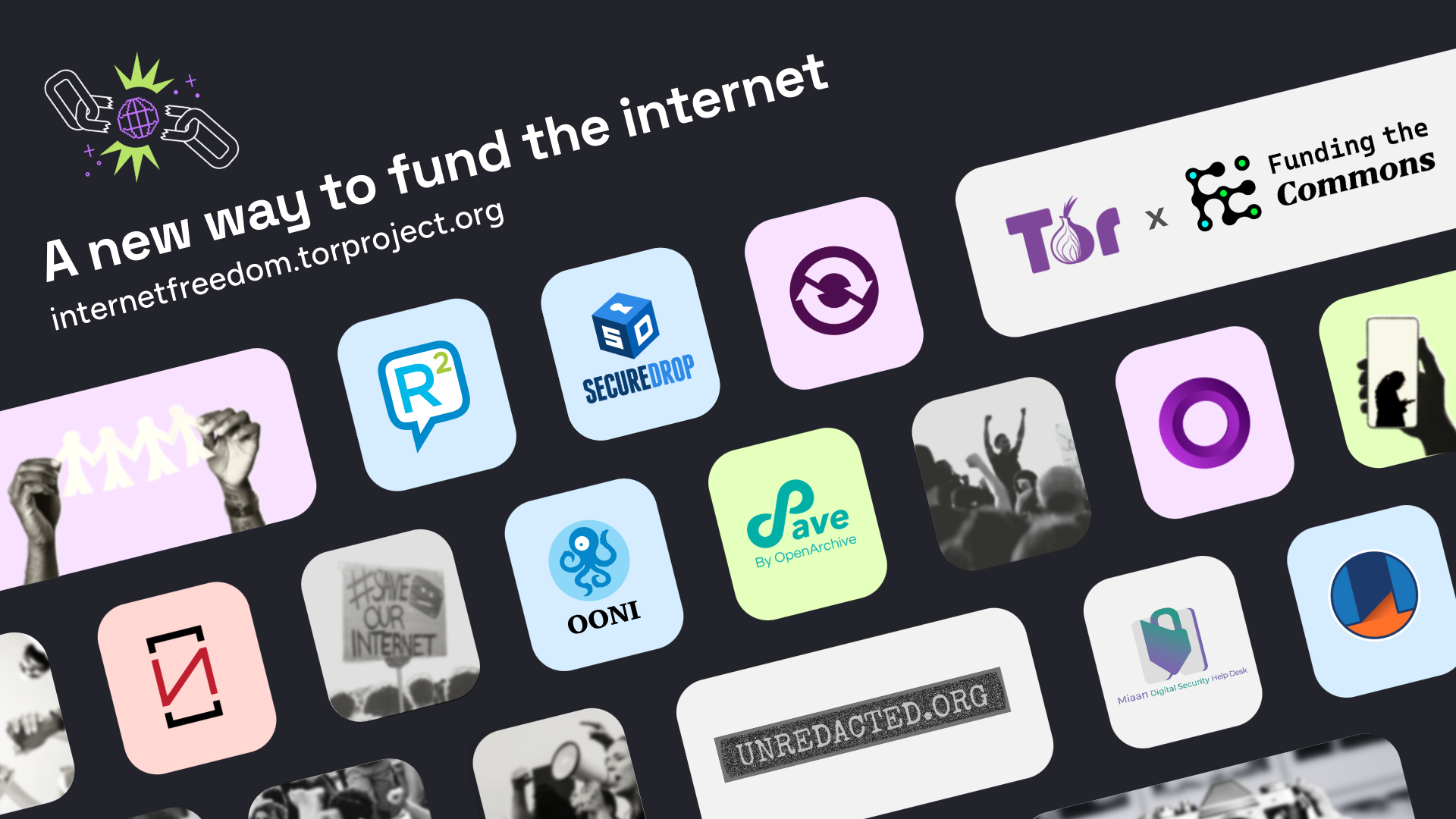
A coalition of privacy, internet freedom, cryptocurrency and open-source ecosystems, led by the Tor Project and Funding the Commons, today announced a new participatory funding campaign designed to support critical digital infrastructure at a moment of systemic funding instability.
Launching today at internetfreedom.torproject.org and as an Onion Service, the campaign is the first-ever Web3-native crowdfunding initiative dedicated to the internet freedom ecosystem. The campaign accepts contributions in Bitcoin (BTC), Ethereum (ETH), Zcash (ZEC), Monero (XMR), and Golem (GLM), and benefits 10 nonprofit projects working across privacy, censorship circumvention, secure communications, and public-interest digital infrastructure. An initial $115,000 USD matching pool supported by Cake Wallet, Zcash Community Grants, Logos, and Octant -- with additional ecosystem participation expected throughout the campaign -- will amplify donations made through June 18th, 2026, using a participatory matching model designed to reward broad community participation.
Internet freedom in peril
Internet freedom has declined for 15 consecutive years. As censorship and surveillance become increasingly sophisticated and pervasive, many of the tools people rely on to communicate and organize safely, access information freely, and protect their privacy are facing financial pressure and funding cuts. Some organizations were forced to reduce staffing, scale back technical infrastructure, delay development work, and stop support for the communities that depend on them. This strain threatens the long-term sustainability of critical public-interest infrastructure.
Today, the Tor Project and Funding the Commons, are launching a new experiment: a community-driven crowdfunding campaign exploring how internet freedom services and infrastructure can be funded more sustainably, transparently, and collectively. The campaign benefits organizations and tools supporting secure journalism, private communications, anti-censorship technologies, and privacy-preserving infrastructure used by millions of people worldwide.
SecureDrop: Secure whistleblower submission system used by journalists and newsrooms
OpenArchive: Privacy-first archiving tools for human rights defenders and journalists
OnionShare: Open-source tool for secure, anonymous file sharing and hosting
Ricochet Refresh: Metadata-resistant instant messaging over Tor
Onion Browser: Tor-powered web browser for iOS
Open Observatory of Network Interference (OONI): Global observatory documenting internet censorship and shutdowns
Paskoocheh, by ASL19: Anti-censorship technology and digital security support
Unredacted: Infrastructure supporting censorship circumvention and resilient communications
Digital Security Help Desk, by Miaan Group: Internet freedom technologies supporting users in Iran
Osservatorio Nessuno: Protecting activists, journalists, and civil society organizations with tech support and traceless software
Tor cannot be resilient alone. Its resilience depends on the resilience of the ecosystem around it, especially smaller projects that may not have the same access to institutional funding or donor networks. This campaign is one way to bring more people into the shared responsibility of sustaining public-interest technology.
A participatory funding model
The campaign uses a participatory matching fund model called quadratic funding designed to amplify the impact of many small contributions. Rather than prioritizing only large donations, the model increases support for projects backed by broader community participation, giving more people a meaningful voice in how funds are distributed. In practice, a project supported by many smaller contributors may receive more matching funds than one supported by only a few large donors.
The campaign's matching pool is supported by a coalition of organizations aligned around privacy, open infrastructure, and public goods funding, including: Cake Wallet, Zcash Community Grants, Logos, and Octant. Contributions can be made using ETH, BTC, ZEC, XMR, and GLM.
"Privacy and internet freedom drive everything we build at Cake Wallet. We are proud to support Tor and the broader internet freedom ecosystem through this campaign, helping keep essential privacy tools accessible to everyone. Beyond supporting the mission, we are also users, advocates, and builders who have helped bring Tor's protections to over two million users worldwide." - Vik Sharma, CEO, Cake Wallet
"Tor and Zcash protect complementary layers of privacy: Tor protects network privacy, while Zcash protects financial privacy. By supporting this campaign, Zcash Community Grants (ZCG) is helping sustain critical public-interest infrastructure for people who rely on privacy and internet freedom." - ZCG's members
Internet freedom tools are digital public infrastructure, and they face many of the same funding challenges as other public goods: they are widely relied on, difficult to monetize ethically, and often invisible until they are under threat. Funding the Commons has spent years working with builders, funders, researchers, and public institutions to test new ways of sustaining public goods.
Partnering with Funding the Commons gives us a way to bring internet freedom organizations into a broader conversation about how public-interest infrastructure is funded, and to test a model that can be reused, improved, and expanded over time:
"Quadratic funding is one of web3's answers to how critical infrastructure gets funded: Institutional money follows community signals, not the other way around," said David Casey, Director of Funding the Commons. "Any donation moves the match pool, no matter the size, putting weight behind the projects Tor users rely on every day."
The campaign launches today at: internetfreedom.torproject.org and http://swvbwbtmajvfrnz4wztx6ovshilm23ntigi73fz5wczj3aqdquq5icad.onion and accepts donations through June 18th, 2026.
Comments
We encourage respectful, on-topic comments. Comments that violate our Code of Conduct will be deleted. Off-topic comments may be deleted at the discretion of the moderators. Please do not comment as a way to receive support or to report bugs on a post unrelated to a release. If you are looking for support, please see our FAQ, user support forum or ways to get in touch with us.
Facts Only
* A funding campaign was announced by the Tor Project and Funding the Commons.
* The campaign is a Web3-native crowdfunding initiative launched at internetfreedom.torproject.org.
* Contributions are accepted in Bitcoin (BTC), Ethereum (ETH), Zcash (ZEC), Monero (XMR), and Golem (GLM).
* The campaign aims to support 10 nonprofit projects in privacy, censorship circumvention, and public-interest digital infrastructure.
* An initial $115,000 USD matching pool is supported by Cake Wallet, Zcash Community Grants, Logos, and Octant.
* The funding model is a participatory matching model called quadratic funding.
* The campaign seeks to address funding pressures facing tools relied upon by millions for secure communication and privacy.
* Supported projects include SecureDrop, OpenArchive, OnionShare, Ricochet Refresh, Onion Browser, Open Observatory of Network Interference (OONI), Paskoocheh, Unredacted, Digital Security Help Desk, and Osservatorio Nessuno.
* The campaign runs through June 18th, 2026.
Executive Summary
Full Take
Sentinel — Human
The text reads as a highly specific, human-authored call to action that effectively marries complex financial mechanisms with a clear ideological mission.