American farmers could see commodity sales to Iran under the negotiations going on between the U.S., Iran and mediators that just wrapped up in Switzerland.
White House Requests $11 Billion in Farmer Aid
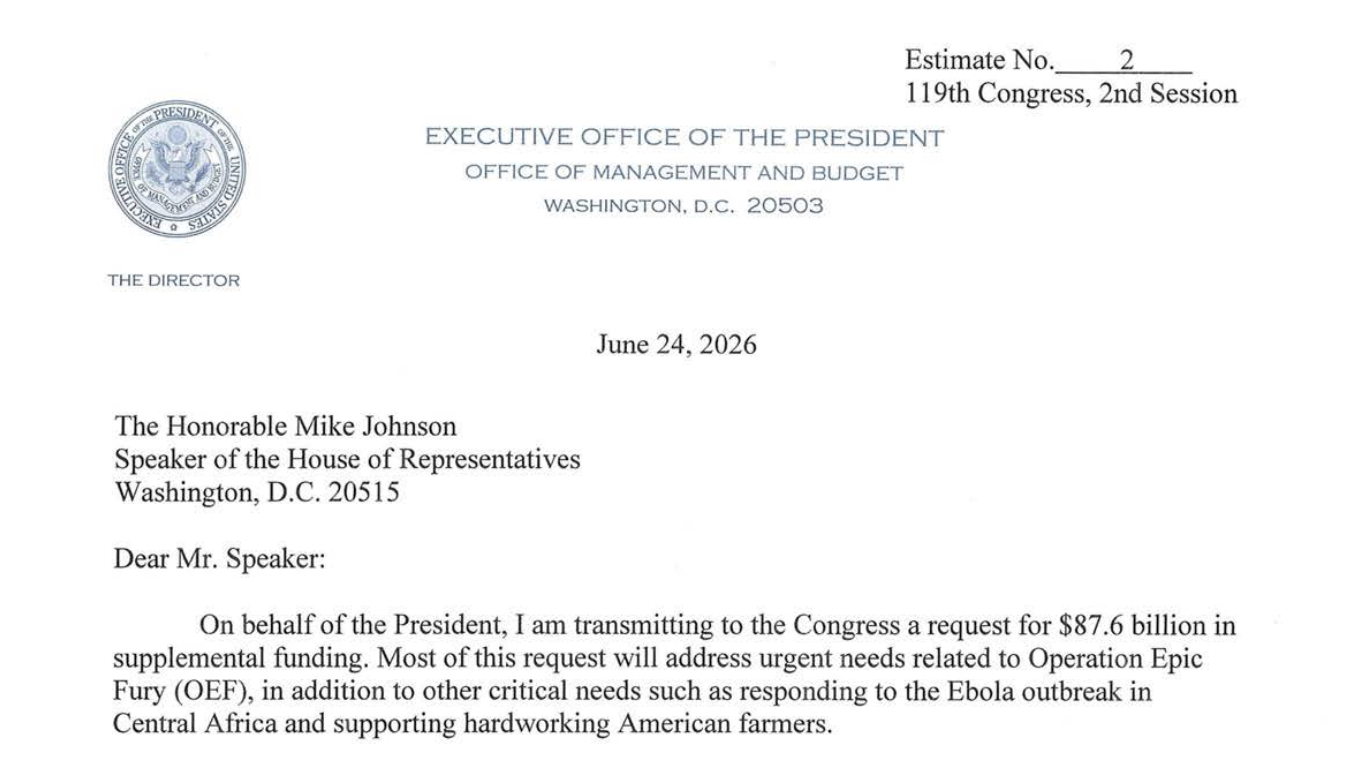
Progressive Farmer’s Jake Zajkowski and Chris Clayton reported that “the White House on Wednesday asked Congress to pass a supplemental funding package that includes a request for $11.1 billion for farmers and calls for Congress to pass year-round E15.”
“The White House Office of Management and Budget (OMB) sent a request for $87.6 billion in supplemental funding to House Speaker Mike Johnson, R-La. The lion’s share of that request — $67.1 billion — was for the War Department,” Zajkowski and Clayton reported. “In the letter, though, President Donald Trump and his staff requested $10 billion in ‘temporary economic assistance for row and specialty crops planted in crop year 2026.’ An additional $1.1 billion was requested specifically for farmers in Florida ‘to rebound from devastating losses that were the result of crippling storms this past winter.'”
Reuters’ Leah Douglas reported that “the new funding would add to $12 billion in aid the administration has already disbursed to farmers this year, as the industry sags under high production costs and low crop prices, made worse by Trump’s current trade policies and the war with Iran. Farm and industry groups have said that money was key to helping farmers prepare for spring planting, but insufficient to make them whole.”
“If the White House request is approved, the administration would be forecast to send about $55.4 billion in direct payments to farmers this year, according to U.S. Department of Agriculture data,” Douglas reported. “That would comprise roughly 33% of total farm income in 2026, the highest level in direct payments since 2001, according to Wesley Davis, a partner at Meridian Agribusiness Advisors, an agricultural economics consultancy.”
Lawmakers Had Been Eyeing $17 Billion in Farmer Aid
E&E News’ Meredith Lee Hill and Grace Yarrow reported yesterday that “farm-state Senate Republicans and White House officials are discussing the possibility of attaching billions of dollars in aid for farmers hit by President Donald Trump’s tariffs to an Iran war funding package, ramping up a monthslong push from lawmakers as the administration tries to land a war funding package, according to multiple people familiar with the matter.”
“GOP lawmakers, including Sen. John Hoeven of North Dakota and Senate Agriculture Chair John Boozman of Arkansas, are pushing to add $17.2 billion in farmer assistance to the potential package, according to four people involved in the talks who, like others in this report, were granted anonymity to discuss private conversations,” Lee Hill and Yarrow reported.
White House Also Calls on Congress to Approve Year-Round E15 Sales
Reuters’ Jarrett Renshaw reported that “President Donald Trump’s White House asked Congress on Wednesday to pass a law allowing year-round sales of gasoline containing higher volumes of ethanol, reviving a long-sought priority of the biofuels industry.”
“While Trump has long backed year-round sales of gasoline blended with 15% ethanol, the decision marks the first formal push by his White House to enact the policy and signals a willingness to challenge U.S. refiners that have opposed the measure over concerns it could raise costs and complicate fuel distribution,” Renshaw reported. “… In (the) supplemental bill released on Wednesday, the White House Office of Management and Budget asked Congress to address the ‘urgent and needed fix that codifies the permanent, year-round sale of E-15.'”
🚨OMB’s EXACT language re: #E15: “The Administration requests a fix that codifies the permanent, year-round sale of E-15, an urgent and needed policy change that would expand consumer choice, support domestic fuel production, and provide additional flexibility in fuel markets.” pic.twitter.com/uPrxmtL4Tf
— Corey Lavinsky (@biofuelslaw) June 24, 2026
Agri-Pulse’s Kim Chipman and Lydia Johnson reported that “an E15 bill passed by the House last month isn’t likely to be taken up by the Senate due to a controversial provision related to the exemption of oil refineries from national biofuel-blending rules. Instead, Senate Majority Leader John Thune, R-S.D., has said he aims to move a stand-alone E15 bill onto the chamber floor for a vote, though it’s not yet clear what such a measure would entail.”
“Pro-biofuel lawmakers have said they’re in favor of any legislative vehicle for E15 that can realistically get a bill through Congress,” Chipman and Johnson reported. “Expansion of domestic renewable fuel markets is seen as crucial to ensure long-term demand for corn and soybean farmers.”
Facts Only
* The White House asked Congress for a supplemental funding package requesting $11.1 billion for farmers and year-round E15 sales.
* The Office of Management and Budget (OMB) sent a request for $87.6 billion in supplemental funding to the House Speaker.
* $67.1 billion of the OMB request was requested for the War Department.
* The White House requested $10 billion in temporary economic assistance for row and specialty crops planted in 2026.
* $1.1 billion was requested specifically for Florida farmers to rebound from winter storm losses.
* The administration sought a fix that codifies the permanent, year-round sale of E-15 fuel.
* Farm and industry groups stated that existing aid was insufficient to make farmers whole.
* Lawmakers are discussing attaching billions in farmer aid for tariff-related losses to Iran war funding packages.
* Senate Majority Leader John Thune is aiming to move a stand-alone E15 bill to the Senate floor.
Executive Summary
Full Take
Sentinel — Human
This content functions as standard news reporting, effectively aggregating claims from multiple named sources regarding U.S. policy and economic forecasts without exhibiting strong signs of machine generation.