Legal intern Raj Gambhir was the principal author of this post.
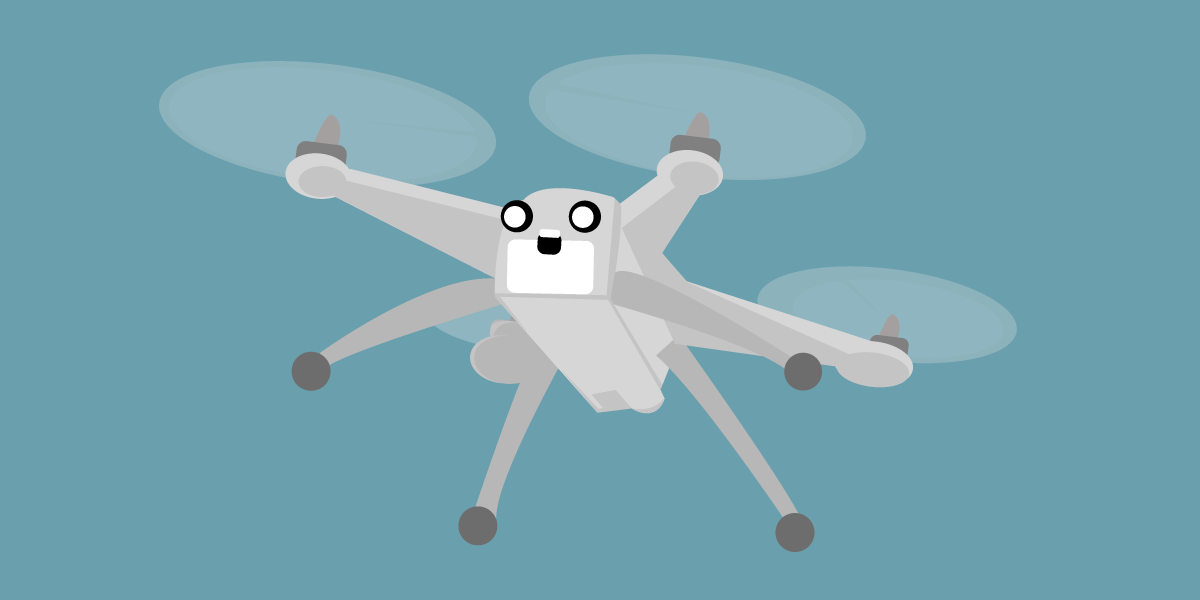
The Trump administration has restricted the First Amendment right to record law enforcement by issuing an unprecedented nationwide flight restriction preventing private drone operators, including professional and citizen journalists, from flying drones within half a mile of any ICE or CBP vehicle.
In January, EFF and media organizations including The New York Times and The Washington Post responded to this blatant infringement of the First Amendment by demanding that the FAA lift this flight restriction. Over two months later, we’re still waiting for the FAA to respond to our letter.
The First Amendment guarantees the right to record law enforcement. As we have seen with the extrajudicial killings of George Floyd, Renée Good, and Alex Pretti, capturing law enforcement on camera can drive accountability and raise awareness of police misconduct.
A 21-Month Long “Temporary” Flight Restriction?
The FAA regularly issues temporary flight restrictions (TFRs) to prevent people from flying into designated airspace. TFRs are usually issued during natural disasters, or to protect major sporting events and government officials like the president, and in most cases last mere hours.
Not so with the restriction numbered FDC 6/4375, which started on January 16, 2026. This TFR lasts for 21 months—until October 29, 2027—and covers the entire nation. It prevents any person from flying any unmanned aircraft (i.e., a drone) within 3000 feet, measured horizontally, of any of the “facilities and mobile assets,” including “ground vehicle convoys and their associated escorts,” of the Departments of Defense, Energy, Justice, and Homeland Security. Violators can be subject to criminal and civil penalties, and risk having their drones seized or destroyed.
In practical terms, this TFR means that anyone flying their drone within a half mile of an ICE or CBP agent’s car (a DHS “mobile asset”) is liable to face criminal charges and have their drone shot down. The practical unfairness of this TFR is underscored by the fact that immigration agents often use unmarked rental cars, use cars without license plates, or switch the license plates of their cars to carry out their operations. Nor do they provide prior warning of those operations.
The TFR is an Unconstitutional Infringement of Free Speech
While the FAA asserts that the TFR is grounded in its lawful authority, the flight restriction not only violates multiple constitutional rights, but also the agency’s own regulations.
First Amendment violation. As we highlighted in the letter, nearly every federal appeals court has recognized the First Amendment right of Americans to record law enforcement officers performing their official duties. By subjecting drone operators to criminal and civil penalties, along with the potential destruction or seizure of their drone, the TFR punishes—without the required justifications—lawful recording of law enforcement officers, including immigration agents.
Fifth Amendment violation. The Fifth Amendment guarantees the right to due process, which includes being given fair notice before being deprived of liberty or property by the government. Under the flight restriction, advanced notice isn’t even possible. As discussed above, drone operators can’t know whether they are within 3000 horizontal feet of unmarked DHS vehicles. Yet the TFR allows the government to capture or even shoot down a drone if it flies within the TFR radius, and to impose criminal and civil penalties on the operator.
Violations of FAA regulations. In issuing a TFR, the FAA’s own regulations require the agency to “specify[] the hazard or condition requiring” the restriction. Furthermore, the FAA must provide accredited news representatives with a point of contact to obtain permission to fly drones within the restricted area. The FAA has satisfied neither of these requirements in issuing its nationwide ban on drones getting near government vehicles.
EFF Demands Rescission of the TFR
We don’t believe it’s a coincidence that the TFR was put in place in January 2026, at the height of the Minneapolis anti-ICE protests, shortly after the killing of Renée Good and shortly before the shooting of Alex Pretti. After both of those tragedies, civilian recordings played a vital role in contradicting the government’s false account of the events.
By punishing civilians for recording federal law enforcement officers, the TFR helps to shield ICE and other immigration agents from scrutiny and accountability. It also discourages the exercise of a key First Amendment right. EFF has long advocated for the right to record the police, and exercising that right today is more important than ever.
Finally, while recording law enforcement is protected by the First Amendment, be aware that officers may retaliate against you for exercising this right. Please refer to our guidance on safely recording law enforcement activities.
Facts Only
The Trump administration issued a nationwide flight restriction (TFR) preventing private drone operators from flying within 3,000 feet of ICE or CBP vehicles.
The restriction, labeled FDC 6/4375, began on January 16, 2026, and is scheduled to last until October 29, 2027.
The TFR applies to unmanned aircraft near facilities and vehicles of the Departments of Defense, Energy, Justice, and Homeland Security.
Violators may face criminal and civil penalties, including drone seizure or destruction.
The EFF and media organizations, including *The New York Times* and *The Washington Post*, sent a letter to the FAA in January demanding the restriction be lifted.
The FAA has not responded to the letter as of the time of the article.
The TFR covers "ground vehicle convoys and their associated escorts" of the listed agencies.
Immigration agents often use unmarked vehicles or switch license plates, complicating compliance with the restriction.
The EFF argues the TFR violates the First Amendment right to record law enforcement and the Fifth Amendment right to due process.
The FAA’s regulations require specifying the hazard justifying a TFR and providing a point of contact for accredited news representatives, which the agency did not do.
The TFR was implemented during a period of heightened protests against ICE, following the killings of Renée Good and Alex Pretti.
Civilian recordings of law enforcement have contradicted official accounts in past incidents.
Executive Summary
Full Take
The strongest version of this narrative highlights a legitimate concern: the TFR appears to be an overbroad restriction that disproportionately limits press freedom and public oversight of law enforcement. The EFF’s argument that the restriction violates constitutional rights is well-supported by legal precedent recognizing the right to record police. The timing—amid protests and high-profile incidents of police violence—raises valid questions about whether the restriction is designed to shield agencies from scrutiny rather than address a genuine security threat. The lack of transparency in enforcement (e.g., unmarked vehicles) and the FAA’s failure to follow its own regulatory procedures further undermine the restriction’s legitimacy.
However, the narrative leans heavily on emotional framing around police accountability, which could be seen as an appeal to moral outrage (ARC-0012). While the right to record is constitutionally protected, the article does not fully explore potential counterarguments, such as whether drones pose unique risks to law enforcement operations or national security. The absence of the FAA’s perspective or any justification for the TFR leaves a gap in the analysis, risking a one-sided portrayal (ARC-0024 Ambiguity). The pattern of framing this as a clear-cut violation of rights without acknowledging possible security trade-offs could be interpreted as a form of strawmanning (ARC-0043 Motte-and-Bailey), where the strongest version of the opposition’s argument is not engaged.
Root cause: This reflects a broader tension between press freedom and government secrecy, particularly in an era of heightened surveillance and law enforcement militarization. The assumption that transparency always outweighs security concerns is unstated but central to the narrative. Historically, such restrictions echo past attempts to limit public oversight of controversial agencies, from COINTELPRO to modern ICE operations.
Implications: If upheld, this TFR could set a precedent for further restrictions on recording law enforcement, eroding accountability mechanisms. The costs are borne by journalists and civilians seeking to document potential misconduct, while the beneficiaries are agencies that operate with less scrutiny. Second-order consequences could include chilling effects on investigative journalism and reduced public trust in law enforcement.
Bridge questions: What evidence exists that drones pose a unique threat to law enforcement operations? How might the FAA justify this restriction under its regulatory framework? What alternative measures could balance security concerns with press freedom?
Counterstrike scan: A coordinated influence campaign would likely amplify emotional framing around police brutality while omitting any government justification, creating a binary narrative of "rights vs. oppression." The actual content aligns with this pattern to some degree, as it does not present the FAA’s rationale or explore security trade-offs. However, the focus on legal and constitutional arguments mitigates this, as it grounds the critique in principled analysis rather than pure provocation. The absence of opposing viewpoints is notable but not necessarily indicative of bad faith.
Patterns detected: ARC-0012 Emotional Exploitation, ARC-0024 Ambiguity, ARC-0043 Motte-and-Bailey
Sentinel — Human
The analysis suggests that the text is likely human-written, as it demonstrates variance in sentence length, a strong argumentative structure, and idiosyncratic emphasis. However, this assessment is probabilistic and not definitive.