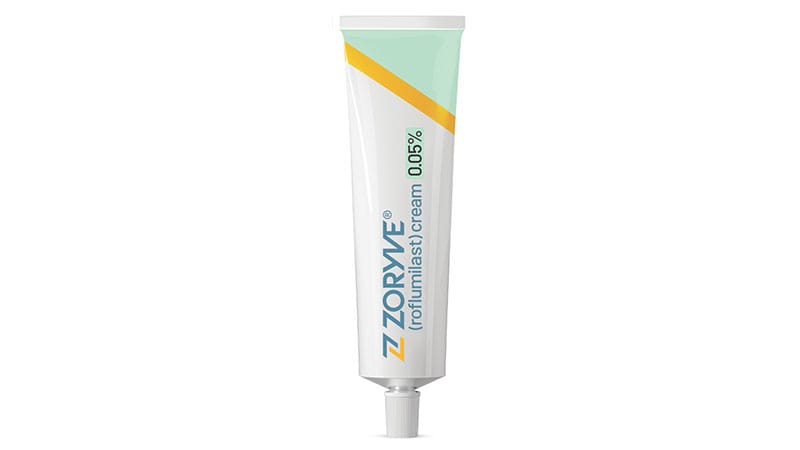
DENVER – Topical roflumilast (Zoryve) cream 0.05% showed favorable efficacy and safety in children 3 months to up to 2 years of age with mild-to-moderate atopic dermatitis, according to new data presented at the annual American Academy of Dermatology 2026 Annual Meeting.
For example, 34.4% of 96 infants treated daily for 4 weeks successfully achieved a score of 0 (clear) or 1 (almost clear) with a two-grade improvement on the Validated Investigator Global Assessment for Atopic Dermatitis (vIGA-AD). Two thirds of parents also reported a 25% improvement in their infant’s itch within 4 hours of the first application, in the open-label, single-arm INTEGUMENT-INFANT trial.
“There's truly a clinical need for expanded nonsteroidal treatment [for children] under 2 years of age,” Lawrence Eichenfield, MD, chief of pediatric and adolescent dermatology at Rady Children’s Hospital-San Diego, and professor of dermatology and pediatrics, University of California, San Diego, said in an interview prior to the meeting. “We know atopic dermatitis is incredibly common, beginning in the first few months of life, and there's a paucity of specifically studied therapies in that 3-month to 2-year age group.”
Eichenfield presented phase 2 results of the INTEGUMENT-INFANT trial here during a late-breaking research session at the AAD meeting, adding to results released in February. Those findings revealed that 58% of participants achieved a 75% improvement in Eczema Area and Severity Index (EASI-75) at week 4.
Background and Context
If approved by the FDA, roflumilast would join crisaborole (Eucrisa), another PDE-4 inhibitor, as an option with an approved indication for treating infants in this age group with mild-to-moderate atopic dermatitis.
The FDA approved the nonsteroidal topicals, calcineurin inhibitors tacrolimus and pimecrolimus, in 2000 and 2001, respectively, to treat atopic dermatitis in adults and children, but they are not indicated for children under 2 years of age. Historically, topical steroids are used to treat atopic dermatitis, but concerns over safety can limit their duration of use.
Roflumilast is a targeted inhibitor of PDE-4, an intracellular enzyme that decreases inflammation in the skin. The 0.05% topical formulation was approved in October 2025 for treating mild-to-moderate atopic dermatitis in children 2-5 years old; a 0.15% formulation was approved in children 6 or older with mild-to-moderate atopic dermatitis; and a 0.30% foam is approved for treating psoriasis of the scalp and body in children and adults ages 12 years or older.
An official indication for very young children “makes sense from a clinical-need standpoint,” Eichenfield told Medscape Medical News. About 60% of children with atopic dermatitis develop symptoms within their first year. The condition can disrupt sleep for the infant and family, increase the risk for skin infections, and have negative developmental and emotional impacts.
Infants and children aged 3 months up to 2 years also often present with a higher body surface area affected by eczema and a higher body surface area-to-volume ratio, which is a consideration in treatment dosing and absorption.
Four-Week, Open-Label Trial
The multicenter INTEGUMENT-INFANT study evaluated the safety and tolerability of roflumilast cream 0.05% applied once daily over a 4-week period vs vehicle only in 101 infants aged 3 months to less than 24 months.
Investigators rated response to treatment on the 5-point vIGA-AD scale, reporting eczema severity from 0 (clear) to 4 (severe). They also specifically rated response to scalp dermatitis, which can be a more challenging area to treat.
Key Results
The baseline body surface area was around 30% in the study, which is “an impressive extent of the disease,” Eichenfield said in the interview. “And yet, despite that, the outcomes were really quite good, with 34.4% making it to that vIGA-AD treatment success.”
Almost half (49%) of infants achieved a vIGA-AD score of clear or almost clear (0 or 1) at week 4 compared to 24% in the vehicle group.
Caregivers also rated treatment response using the Worst Scratch/Itch Numeric Rating Scale (WSI-NRS). About 60% of participants achieved a 4-point or greater improvement in WSI-NRS scores by 2 weeks and almost 73% by week 4, which was defined as a successful response. Furthermore, 47% of infants achieved at least a 25% improvement from baseline in pruritus — based on the Dynamic Pruritus Score (DPS-25) scale — at 10 minutes, 59% by 1 hour, and 67% by 4 hours.
“So, I do think it showed both that there's a good effect on itch as well as the objective outcome measures of the eczema with the traditional vIGA-DA scores,” Eichenfield said.
From the Top
There can be extensive scalp pruritus and eczema in younger children, Eichenfield said. “It's been a difficult issue from a treatment standpoint, depending upon how severe it is and how much hair there is. We were really pretty pleased that scalp was looked at because it is an area of significant concern to the families of these infants. They bring it up a lot.”
Almost 37% of participants achieved successful investor global success of scalp treatment at 2 weeks, as did just over two thirds at 4 weeks.
For those infants with at least mild scalp involvement at baseline (n = 40), 67.5% achieved vIGA-AD scalp success — scalp clear or almost clear (0 or 1), with a 2-point improvement from baseline at week 4.
“This is a novel outcome that hasn't been looked at, to my knowledge, in eczema trials in this age group,” Eichenfield said.
Safety Findings
Adverse events reported in 3% or more of participants included diarrhea, nasopharyngitis, upper respiratory tract infection, and vomiting.
“The safety data was really quite good in the study,” Eichenfield said. There were no serious adverse events reported, and one patient left the study for a treatment-emergent adverse event, application-site urticaria. “That is very consistent with that prior data.”
About 98% of infants experienced no irritation at the application site through 4 weeks, based on investigator ratings of local tolerability. “The general takeaway is that it showed very good efficacy with an excellent safety profile,” Eichenfield said.
“There is no reason to suspect that its efficacy would be substantially different in this very young population than in older children, for whom we already have more data ,” said Aaron Drucker, MD, head of dermatology in the Department of Medicine at Sunnybrook Health Sciences Centre and a dermatologist in the Department of Medicine at Women’s College Hospital in Toronto, when asked by Medscape Medical News to comment. “It is reassuring that there were no new safety concerns among young children in this small study,” he added.
Filing an sNDA Soon
The manufacturer, Arcutis Biotherapeutics, plans to submit a supplemental New Drug Application for roflumilast cream 0.05% for the 3 month up to 2 year age group in the second quarter of 2026.
Damian McNamara is a freelance contributor to Medscape Medical News. He worked full-time for Medscape and WebMD from 2018 to 2024. Damian has a BA in chemistry and an MA in science, health, and environmental reporting/journalism.
Facts Only
Topical roflumilast (Zoryve) cream 0.05% was evaluated in the INTEGUMENT-INFANT trial for treating mild-to-moderate atopic dermatitis in infants aged 3 months to under 2 years.
The trial was presented at the American Academy of Dermatology 2026 Annual Meeting in Denver.
34.4% of 96 infants achieved a vIGA-AD score of 0 (clear) or 1 (almost clear) with a two-grade improvement after four weeks of daily treatment.
Two-thirds of parents reported a 25% improvement in itch within four hours of the first application.
58% of participants achieved a 75% improvement in EASI-75 by week 4.
The study was an open-label, single-arm trial involving 101 infants.
Roflumilast is a PDE-4 inhibitor already approved for older children and adults with atopic dermatitis.
The FDA approved roflumilast cream 0.05% for children aged 2-5 years in October 2025.
Adverse events included diarrhea, nasopharyngitis, upper respiratory tract infection, and vomiting, with no serious adverse events reported.
Arcutis Biotherapeutics plans to submit a supplemental New Drug Application for this age group in the second quarter of 2026.
The trial was led by Lawrence Eichenfield, MD, chief of pediatric and adolescent dermatology at Rady Children’s Hospital-San Diego.
The baseline body surface area affected by eczema was around 30% in the study.
Executive Summary
Topical roflumilast (Zoryve) cream 0.05% demonstrated promising efficacy and safety in treating mild-to-moderate atopic dermatitis in infants aged 3 months to under 2 years, according to data presented at the American Academy of Dermatology 2026 Annual Meeting. In the INTEGUMENT-INFANT trial, 34.4% of 96 infants achieved a score of 0 (clear) or 1 (almost clear) with a two-grade improvement on the Validated Investigator Global Assessment for Atopic Dermatitis (vIGA-AD) after four weeks of daily treatment. Additionally, two-thirds of parents reported a 25% reduction in itch within four hours of the first application. The study also found that 58% of participants achieved a 75% improvement in the Eczema Area and Severity Index (EASI-75) by week 4. Roflumilast, a PDE-4 inhibitor, is already approved for older children and adults, and this trial addresses a significant unmet need for nonsteroidal treatments in very young children, where options are limited. Safety data were favorable, with no serious adverse events reported, and the manufacturer plans to file for FDA approval in this age group in mid-2026.
The trial highlights the challenges of treating atopic dermatitis in infants, including high body surface area involvement and scalp dermatitis, which can be particularly distressing for families. While the results are encouraging, the open-label, single-arm design of the study means further research, including placebo-controlled trials, may be needed to confirm these findings. Experts note that the safety profile aligns with previous data, and the potential approval of roflumilast for this age group could provide a much-needed alternative to topical steroids, which have safety concerns with prolonged use.
Full Take
The strongest version of this narrative is that roflumilast cream 0.05% offers a safe and effective nonsteroidal treatment option for infants with atopic dermatitis, addressing a critical gap in pediatric dermatology. The data presented—including rapid itch relief and significant improvements in disease severity—are compelling, especially given the limited alternatives for this age group. The study’s focus on scalp dermatitis, a particularly challenging area, adds depth to the findings, and the safety profile aligns with prior research. The narrative effectively highlights the unmet medical need, framing roflumilast as a potential game-changer for families struggling with early-onset eczema.
However, the open-label, single-arm design of the trial introduces potential bias, as placebo effects or observer expectations could influence outcomes. The lack of a control group means the results should be interpreted with caution until confirmed by randomized, double-blind studies. Additionally, while the safety data are reassuring, the small sample size (101 infants) and short duration (4 weeks) limit the ability to detect rare or long-term adverse events. The narrative leans heavily on the clinical need for nonsteroidal options, which is valid, but it could benefit from acknowledging the limitations of the study design more prominently.
The root cause driving this narrative is the long-standing challenge of treating atopic dermatitis in infants, where topical steroids—though effective—carry risks with prolonged use, and nonsteroidal alternatives like calcineurin inhibitors are not approved for children under 2. The push for roflumilast’s approval reflects a broader trend in dermatology toward targeted, nonsteroidal therapies with favorable safety profiles. The implications for human agency are significant: parents and caregivers would gain a new tool to manage a condition that disrupts sleep, increases infection risk, and impacts developmental outcomes. However, the cost of the medication, once approved, could limit access, particularly for families without comprehensive insurance coverage.
Bridge questions: How might the lack of a placebo control in this trial affect the interpretation of efficacy? What long-term safety data would be necessary to fully assess roflumilast’s suitability for infants? How does the cost of roflumilast compare to existing treatments, and what barriers might this pose for widespread adoption?
Counterstrike scan: If this narrative were part of a coordinated influence campaign, the playbook would emphasize the "unmet need" and "safety" to create urgency for approval, while downplaying study limitations. The actual content does highlight the clinical need but also presents the data transparently, including adverse events and study design constraints. No structural alignment with a manipulative playbook is detected.