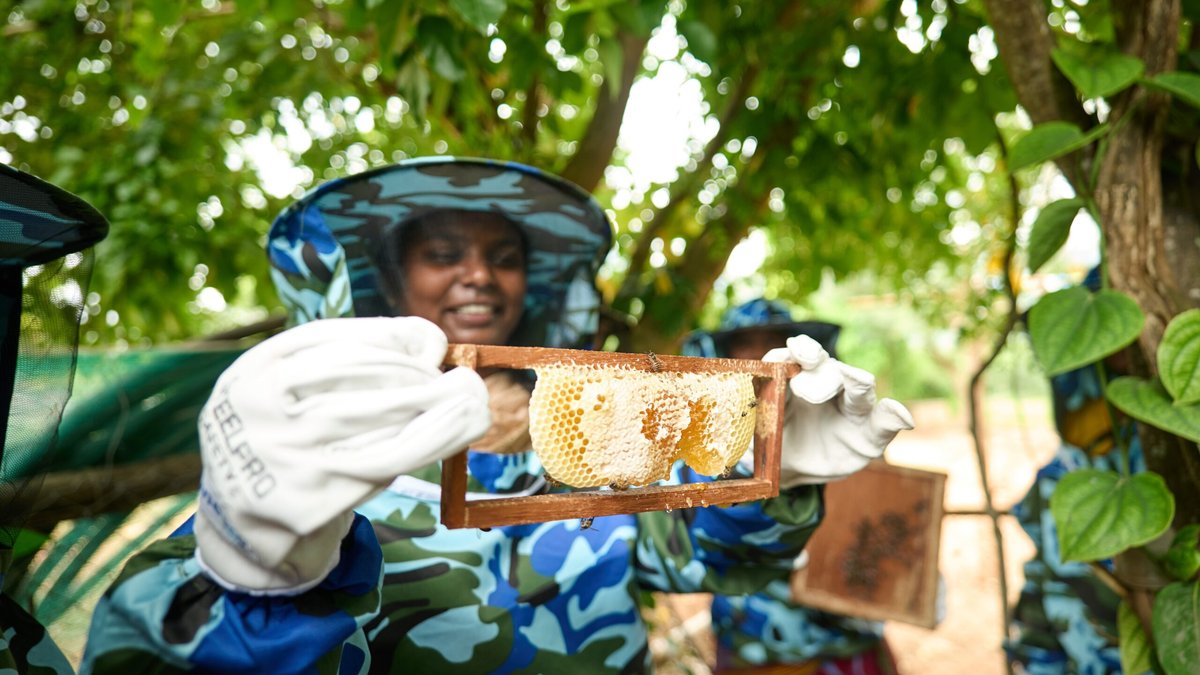
- Fifty women from indigenous communities across Kerala and Tamil Nadu have been trained to rear honeybees, providing them with a better alternative to traditional wild honey collection.
- Women report that beekeeping is strengthening their financial independence while fostering community resilience.
- Using native Asian honey bees offers ecological and agricultural benefits beyond honey production.
Neelavathi (37), an Irula woman from Vazhaithottam village in Tamil Nadu’s Nilgiris district, has had several reasons to celebrate over the past few months — a new occupation, a higher income, and enough money to celebrate the annual festival at her village temple, Mariyamman Kovil.
“I have already sold around six litres of honey,” she says with pride. “Since I am the beekeeper at home, my family lets me keep the income for my own needs.” Apart from buying new clothes for herself and her kids, Neelavathi could buy two stone dosa griddles with the income from honey sales over time.
Nine Irula women from the Sigur Plateau, including Neelavathi, gathered in a small community hall in Vazhaithottam to share with Mongabay-India their experiences of learning beekeeping. Over the past year, they have been trained to manage bee colonies in hive boxes, grow fruit trees that provide nectar for the bees, and harvest honey — an enterprise that has significantly boosted their household incomes.
Women trained on beekeeping as a livelihood
In April 2025, UNESCO partnered with the Nilgiris-based non-profit Keystone Foundation to bring its Women for Bees project to India. The Nilgiris Biosphere Reserve was chosen as the programme’s first site in the country, with activities launched across five locations in two states — Kerala and Tamil Nadu.
Fifty Indigenous women from Sigur, Pillur and Kuzhiyoor in Tamil Nadu, and Wayanad and Nilambur in Kerala, enrolled in the programme to learn beekeeping as a livelihood. “The women were selected through community meetings with village elders. Those who expressed an interest in beekeeping volunteered to join the programme,” says Shiny Rehel, a programme coordinator at Keystone Foundation.
Most participants had little or no prior experience in beekeeping, explains Malavika Jayakrishnan, who leads the project along with Srishti Kumar, both programme assistants in Natural Sciences at UNESCO. Following focus group discussions and surveys, interested women were selected and trained on beekeeping.
“The programme began with classroom sessions covering the basics of beekeeping, followed by hands-on training, equipment support and regular follow-up mentoring. Participants were provided with bee boxes, protective gear, extraction equipment and continuous technical guidance throughout the first year,” Jayakrishnan adds.
For Saritha (43), handling bees was intimidating at first. But with training and practice, her confidence grew. “I was stung a few times, probably because I didn’t know how to handle them properly. But now I’m used to them,” she says. She now manages seven bee boxes, each with honey ready to be harvested.
“As their confidence grew, many women who were initially hesitant to handle bees began managing hives independently. Several participants described beekeeping as becoming a regular part of their daily routine, alongside existing livelihoods such as farming and jasmine harvesting,” Kumar says.
From wild honey to box honey
Traditionally, many Indigenous communities of the Western Ghats, including the Kurumbas, the Irulas and the Kattunayakas, were skilled wild honey hunters. They ventured deep into the forests, risking stings from wild honey bees to harvest honey that often fetched them meagre returns in the market. However, their access to forests became increasingly restricted following the implementation of the Wildlife (Protection) Act, 1972. Although the Forest Rights Act, 2006, sought to address some of the historical injustices faced by forest-dwelling communities by recognising their rights over forest resources, restrictions on activities such as wild honey collection continue in many areas, particularly within the core zones of protected areas.
Beekeeping using managed hive boxes has made honey collection safer and more predictable for the women. “Earlier, we had to search for wild bee colonies, climb trees to reach the hives, and harvest only a portion of the honey. We collected it not just to sell but also for our own household use,” says 43-year-old Vijayarani. “Now, we know exactly where the honey is. There’s certainty about what we will get and how much we will harvest.”
The women rear the Asian honey bee (Apis cerana indica), rather than the more widely farmed European honey bee (Apis mellifera). Although A. mellifera dominates commercial apiculture worldwide because of its higher honey yields, A. cerana is increasingly favoured by small-scale beekeepers in Asia due to its adaptability to local conditions.
Both species are cavity-nesting bees, but studies have found A. cerana to be hardier, more resistant to diseases and parasites, and able to tolerate a wider range of temperatures. It is also smaller and less aggressive than A. mellifera. A 2023 study comparing the two species notes that while their life cycles are broadly similar, A. cerana exhibits stronger hygienic behaviour (social immunity in bees) and is better able to defend its colonies against threats and disturbances.
Research has also highlighted the pollination benefits of Apis cerana. A 2023 study on rapeseed found that the bees foraged for up to eight hours a day, significantly improving both the quantity and quality of seeds through pollination.
Similar findings emerged from a 2025 study evaluating the role of A. cerana in bitter gourd cultivation. The study reported a little over 27% increase in crop yield in fields pollinated by the bees. It also found that hives placed within cropped areas produced higher honey yields, underscoring the species’ dual value in enhancing agricultural productivity while generating an additional source of income for farmers.
Some of the Indigenous women involved in beekeeping have also observed improved flowering and higher yields in the fruit farms surrounding their apiaries. While these observations are encouraging, they remain anecdotal. No comprehensive study has yet been conducted to assess the project’s impact on biodiversity or crop pollination. “We are planning to study this because one of the key benefits of beekeeping is the biodiversity gains it can generate,” says Rehel.
Financial independence as key
For many of the women, financial independence has been one of the programme’s most significant outcomes.
“The first honey harvest has been particularly encouraging. Women in Wayanad and Nilambur reported good yields, while those in Sigur were able to market their honey at premium prices because it comes from the Mudumalai landscape,” says Jayakrishnan.
Lakshmi Babu, a Kattunayaka woman from Appankappu tribal settlement in Kerala’s Nilambur Elephant Reserve, recently bought a washing machine with the income she earned from selling honey. She says she harvested more than 18 kgs of honey over the past six months.
“I’ve bought gold earrings in the past. My husband is unwell, and we meet his medical expenses through honey sales. Even after all the expenditure, I’m able to save some money,” Lakshmi says over the phone.
Studies suggest that Apis cerana can also be economically advantageous for small-scale beekeepers. Although A. mellifera typically produces more honey per colony, A. cerana often proves more profitable in local conditions because it requires less intensive management, simpler equipment and smaller foraging areas. The 2023 comparative study also found that A. cerana produces valuable hive products such as beeswax and is better adapted to seasonal temperature fluctuations than A. mellifera.
Beyond generating income, the programme has also helped build resilience. “In Wayanad, where landslides had previously destroyed the bee boxes and livelihoods of several traditional beekeepers, participants said the project had given women an opportunity to restart beekeeping and rebuild their incomes,” says Kumar.
For Lakshmi, however, the biggest change has been the sense of community that beekeeping has fostered.
“There are 12 houses in our settlement. We hardly interacted before we took up beekeeping. Now we meet regularly to exchange knowledge and discuss the challenges we face,” she says. Lakshmi adds that she has encouraged several other women to take up the vocation. “Bees have brought a lot of joy into my life. The bees work hard and take very good care of those who care for them.”
A member of the Kattunayaka community, traditionally known for wild honey hunting, Lakshmi says she only came to appreciate the ecological importance of bees after joining the programme.
One of the programme’s most notable achievements has been its retention rate. “Not a single participant has dropped out since the project began,” says Jayakrishnan. Interest continues to grow, with more women from the region expressing a desire to join. While discussions are underway on a possible second phase, the long-term goal is to expand the model to other biosphere reserves after consolidating its success in the Nilgiris, according to Kumar.
Banner image: A beekeeper in the Nilgiris harvests honey from her hive. Image by Shawn J. Stephen/Keystone Foundation.
Read more: India’s native dwarf honey bee faces a quiet urban crisis
Sentinel — Human
This article is a well-structured human report that effectively blends quantitative data with rich, specific qualitative narratives from the participants.