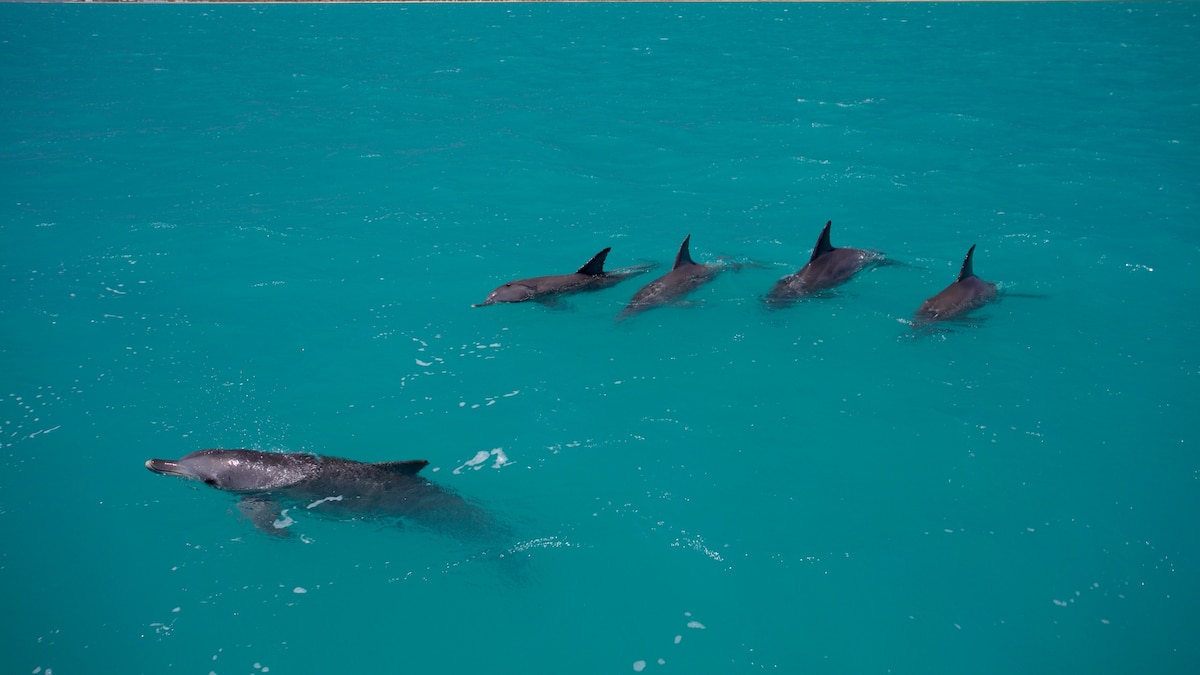
A new study suggests female bottlenose dolphins may have a strategy for steering clear of males with a history of pushy mating tactics.
Female bottlenose dolphins may be keeping mental tabs on the behavior of males in their social circles by noting their unique signature whistles—thus remembering which males to avoid, according to a new study.
The research, conducted in Shark Bay, Australia, found that female Indo-Pacific dolphins were more likely to steer clear of males with a history of consorting females, a mating strategy in which alliances of males work together to keep a female close for up to weeks at a time so they can mate with her. During consortships, males may bite, hit, or charge the female, chase them, and produce threat vocalizations that appear to intimidate females and control their movements.
“Male dolphins seem to have quite advanced social cognitive abilities to form these alliances and cooperate with each other to mate, but what about the females?” says Alice Bouchard, lead author of the study, published in the journal Proceedings of the National Academy of Sciences, and animal behavior researcher at the University of Bristol in the UK. While male alliances and behavior have been extensively studied in Shark Bay, less is known about the females’ behavior toward males, she adds. This study yields new insight on that front.
(Do these Florida dolphins have a language? Scientists are finding new clues.)
“Females are using knowledge of individuals. That to me is super interesting,” says Laela Sayigh, a dolphin communication scientist at Woods Hole Oceanographic Institute in Massachusetts, who was not involved in the study. “To my knowledge, this is the first time that there really has been a study of how these communication signals are used in mate choice.”
What’s in a name
To investigate how females respond to males, the scientists turned to sound.
Bottlenose dolphins are famous for their signature whistles, unique calls that function much like names. Dolphins use these whistles to identify themselves, and other dolphins can recognize one another based on those vocalizations.
Through long-term data collection and tracking of individual dolphins, researchers can then identify those signature whistles too.
To begin their research, Bouchard and her team collected 34 whistles that had been recorded from males between 2013 and 2017. Once they found a small group of females resting or traveling, Bouchard and her team used underwater microphones, called hydrophones, deployed from a boat to play recordings of those whistles. The researchers then documented the females’ reactions both acoustically and behaviorally with drones.
(Dolphins can identify their friends by taste.)
“Playback experiments are extremely challenging to do—and it is impressive that the authors accomplished this,” says Janet Mann, a dolphin biologist at Georgetown University who also works in Shark Bay but was not involved in the study. It requires a lot of things lining up at once, from good weather to locating specific dolphins, positioning them correctly relative to the boat, operating a drone overhead, playing sounds underwater, and recording responses simultaneously.
The females didn’t react vocally. But their behavior revealed a clear response.
“When we were playing back these male whistles, sometimes the females freaked out and they really left and went away,” says Bouchard. “So, of course, after that, we analyzed which criteria seemed to affect the responses of the females.”
And thanks to 40 years of consistent monitoring, the researchers know the history of the dolphins quite well, she says.
How females responded to certain males
The study showed that females swam away from the sound of males that had higher rates of engaging in consortship in the past. Not only that, the females didn’t respond based solely on their own past interactions with a male. Instead, they appeared to be responding to that male's broader history with females in the population, says Bouchard.
“We know that consortships are aggressively maintained from many years of studying this population,” says Stephanie King, senior author on the study and behavioral biologist at the University of Bristol in the U.K. Although it is not universal, researchers have observed clear signs of male coercion in about half of all documented consortships, and King says the true figure is likely much higher because much of it occurs out of sight underwater.
The study further showed that females who were able to become pregnant, based on their age and time in their cycle, had a bigger reaction than those who were not, moving farther away from the boat. In species where males can be aggressive or controlling during mating, like chimpanzees, females benefit from paying attention to male behavior to avoid risks and improve their chances of successfully reproducing. King says the stronger response from female dolphins that could become pregnant suggests they may be doing something similar, using information about individual males to avoid those who are more coercive.
(Dolphin moms use ‘baby talk’ with their calves, rare among non-human species.)
Another possibility, she adds, is that females avoid males they've already mated with. This could be a female strategy to mate with many males so that no male knows for sure whether a calf is his—a theory that Sayigh says is also strong. This could help protect calves from being harmed as infanticide is a documented behavior in male dolphins.
For Mann, it’s not necessarily surprising that females would avoid specific males, especially when they are likely to be cycling. Previous research has shown that female dolphins in Shark Bay avoid adult males generally when more than one male is present, which is when they tend to be more aggressive, she says.
“What is unique is showing that females are responding to specific male signature whistles,” she adds.
Sayigh agrees. “The fact that they use their knowledge of signature whistles and of the individuals that are linked to those signature whistles to guide socially informed decisions is a really important contribution,” she says.
There is still more to uncover about their relationships and choices during mating, and the mechanism underlying how females are making this choice to avoid males, whether it's associating a male's whistle with past experiences, recognizing specific males and remembering their behavioral history, or learning about males by observing how they treat other females.
“Males and females in this population have complicated social lives,” says King. While more coercive behavior is seen during mating season, scientists also observe the males and females maintaining social bonds and spending time engaging in gentle petting and rubbing.
Bouchard notes that some females were also more likely to approach certain males based on their whistle, although more work needs to be done to really understand that pattern. Going forward, she’d like to understand what makes a male attractive rather than aversive and whether those preferences ultimately influence which males end up fathering calves.
For her, one of the exciting aspects of this study is that “it gives us a clearer picture of what females are actually responding to. We now know that a male's overall consortship rate shapes how strongly females avoid him, which tells us something important about which male traits females are tracking.”
Facts Only
Researchers conducted a study in Shark Bay, Australia, on female Indo-Pacific bottlenose dolphins.
The study was published in *Proceedings of the National Academy of Sciences*.
Female dolphins were exposed to playback recordings of male signature whistles.
Females reacted by fleeing when hearing whistles from males with a history of consortship behavior.
Consortships involve male alliances coercively isolating females for mating, sometimes using aggression.
The study used 34 male whistles recorded between 2013 and 2017.
Researchers documented female responses using underwater hydrophones and drones.
Females did not respond vocally but showed clear behavioral avoidance.
Females avoided males based on their broader history of consortships, not just personal interactions.
Fertile females had stronger avoidance reactions than non-fertile females.
The research builds on 40 years of dolphin monitoring in Shark Bay.
Some females approached certain males based on their whistles, though this pattern requires further study.
Executive Summary
Full Take
This study offers compelling evidence of female dolphins' social cognition, but its implications extend beyond marine biology. The findings suggest a sophisticated system of individual recognition and risk assessment, challenging assumptions about non-human decision-making. However, the methodology—while innovative—has limitations. Playback experiments rely on controlled conditions, and the sample size (34 whistles) may not capture the full complexity of dolphin social dynamics. The study also assumes females associate whistles with past behavior, but the mechanism remains unclear. Could females be responding to acoustic cues linked to aggression rather than specific identities?
The broader pattern here is the framing of animal behavior through human-like agency. While the study avoids overt anthropomorphism, the narrative of "female choice" and "avoidance strategies" aligns with evolutionary psychology tropes. This isn't necessarily misleading, but it risks oversimplifying dolphin cognition into familiar human categories. The research also highlights a tension in animal behavior studies: the line between describing behavior and attributing intent.
Real-world implications hinge on replication. If dolphins indeed use signature whistles to navigate social risks, this could reshape understanding of cetacean communication. But the study's focus on avoidance leaves open questions about attraction—do females also use whistles to seek out preferred mates? And how does this system interact with male alliances, which are known to be highly cooperative?
Bridge questions: How would female responses change if exposed to whistles of males with mixed behavioral histories? Could this avoidance mechanism be exploited in conservation efforts to protect females from aggressive males? And critically, does this study reflect a broader trend in animal behavior research toward attributing human-like social strategies to non-human species, or is it a genuine breakthrough in understanding dolphin cognition?
Counterstrike scan: A coordinated influence campaign might exaggerate the study's findings to push a narrative about "female empowerment" in nature, framing it as evidence of universal gender dynamics. However, the actual content avoids such overreach, focusing on observable behavior rather than ideological framing. No structural alignment with manipulation patterns detected.
Patterns detected: none
Sentinel — Human
The article presents compelling, evidence-based findings regarding dolphin social cognition, effectively synthesizing complex behavioral data through the lens of communication and evolutionary strategy.