Behind the nation’s greatest college basketball teams is a steady flow of donations from billionaires with varying industry backgrounds and connections to the schools.
Among them are the cofounder of the Carlyle Group, one of the world’s largest investment firms; the owner of the NFL’s Dallas Cowboys, and a Houston hospitality mogul whose name is flashed on an entire arena. Several powerhouse teams bankrolled by billionaires are favored to advance far in this year’s March Madness tournament.
Considering the global sports entertainment industry is estimated to be worth more than $3 trillion, it’s no wonder America’s wealthiest are eager to throw money at the nation’s best college athletics programs.
This year’s March Madness tournament is particularly flush with billionaire money. The Big Ten alone sent six teams to the Sweet 16, meaning the financial stakes for some of the country’s wealthiest athletic boosters have never been higher. This year’s men’s tournament is expected to have more than $270 million in payouts, with each of the 135 available units (games) valued at roughly $2 million, paid out to conferences over six years (that’s about $350,000 per year).
That money flows directly to conferences, not schools. That’s why wealthy alumni and other billionaire boosters step in to fill the gap, pouring hundreds of millions into facilities, NIL deals, and recruiting budgets that tournament checks can’t offer.
Fortune has compiled a sampling of billionaire donors to schools participating in this year’s Sweet 16. Note, this list is not exhaustive.
David Rubenstein is backing Duke
Rubenstein, cofounder of The Carlyle Group, grew up in Baltimore and earned his undergraduate degree from Duke University in 1970, where he has made generous donations over the decades.
He cofounded The Carlyle Group in 1987 with just $5 million in capital, but grew it to one of the world’s largest private equity firms with $477 billion in assets under management. Rubenstein is worth an estimated $4.2 billion.
Rubenstein has donated more than $60 million to his alma mater, including a $10 million gift to Duke Athletics in 2012. He said he made the donation because of Duke’s “success in so many sports over so many years, [and] because of the program’s commitment to academic achievement and excellence.”
The Carlyle cofounder has made several other multimillion-dollar donations to Duke over the years, including a $20 million scholarship endowment for first-generation students in 2017 and a $25 million gift to support the arts. The billionaire also served on Duke’s board of trustees from 2005 to 2017, including a term as chairman.
Duke, the No. 1 seed in the NCAA Tournament’s East Region, faces St. John’s on Friday at 7:10 p.m. EST on CBS. The Blue Devils are favored to advance.
Jerry Jones credits the University of Arkansas for his success
Jones, the longtime owner of the Dallas Cowboys, has a deep connection to one of this year’s Sweet 16 schools. He’s a University of Arkansas alum and played for the Razorbacks football team in the 1960s before he went on to become a successful oil businessman and the owner of the Dallas Cowboys in 1989. Jones is currently worth an estimated $19.4 billion, with the Cowboys worth approximately $13 billion.
In 2015, Jones donated $10.65 million to Arkansas’ athletic program, which he credited for his success. The gift supported Arkansas’ Student-Athlete Success Center.
“My experiences at the University of Arkansas as a student-athlete under the legendary Coach Frank Broyles helped shape me as a man and guide me on my future career path,” Jones said at the time of the donation. “I would not be where I am today without those life lessons learned as a student-athlete at the University of Arkansas.”
Arkansas faces No. 1 seed Arizona on Thursday at 9:45 p.m. EST on CBS. The Razorbacks are considered a significant underdog, but freshman star Darius Acuff Jr. has made them one of the tournament’s most exciting teams to watch.
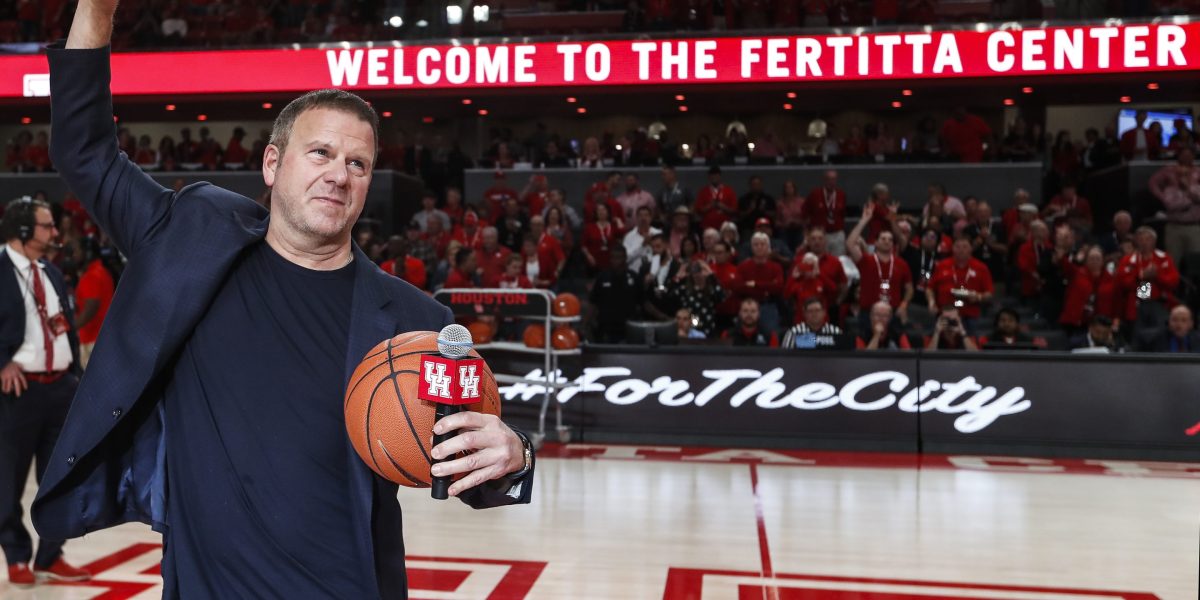
Tilman Fertitta supports his hometown
Fertitta is the definition of a hometown billionaire backer. The CEO of Fertitta Entertainment and owner of the NBA’s Houston Rockets, he is Houston’s richest sports owner with an estimated net worth of $11.2 billion—a fortune built on hospitality, gaming, and entertainment through his Landry’s restaurant and hotel empire with more than 600 dining, entertainment, and gaming locations nationwide.
In 2016, Fertitta pledged $20 million to the University of Houston’s athletics program to renovate the school’s on-campus basketball arena. This was the largest individual athletic donation in UH history at the time. Fertitta attended UH, although he left before finishing his degree. But the school awarded him with an honorary doctorate in August.
“This gift is personal,” Fertitta said when he made the 2016 donation. “It represents a commitment from my family and me to support the University of Houston in its quest to strengthen our nationally competitive institution, both in academics and athletics.”
“Upgrading our athletics facilities shows we are serious about competing at the highest levels of collegiate sports for many years to come,” he continued.
The arena was subsequently renamed Fertitta Center. He made an additional $50 million pledge to UH’s medical school in 2022.
Houston, the No. 2 seed in the South Region, faces Illinois on Thursday at 10:05 p.m. EST on TBS. The Cougars are favored to win.
Larry Ellison is behind Michigan’s makeover
Ellison cofounded tech giant Oracle and is currently one of the world’s wealthiest individuals with a net worth of nearly $200 billion.
He also reportedly underwrote the richest recruiting flip in college football history. Ellison reportedly helped the University of Michigan fund a name, image, and likeness sports package to poach quarterback recruit Bryce Underwood from Louisiana State University in November 2024. While Ellison didn’t have a prior connection to the Wolverines, his wife, Jolin, is a Michigan alumna.
Michigan, the No. 1 seed in the Midwest Region, faces Alabama on Friday at 7:35 p.m. EST on TBS. The Wolverines, who are favored to win on Friday, have three projected first-round NBA draft picks on their roster.
Daniel Gilbert funds alma mater, Michigan State
Gilbert founded Rock Financial in 1985, which would eventually become mortgage behemoth Rocket Companies. The fintech and homeownership services company has a $40 billion market cap, and Gilbert has an estimated net worth of $29.4 billion. He also owns the NBA’s Cleveland Cavaliers.
Gilbert donated $15 million to his alma mater, Michigan State University, in 2016 for use toward the school’s basketball program. Both he and his wife, Jennifer, attended Michigan State and said that, at the time, the school had “played a large role in both of our lives.”
Michigan State, the No. 3 seed in the East Region, faces UConn on Friday at 9:45 p.m. EST on CBS. UConn is slightly favored to win.
Jimmy Haslam has donated $50 million to University of Tennessee
Haslam is a University of Tennessee alum and the owner of the NFL’s Cleveland Browns, a franchise he purchased in 2012. He and his family built their fortune through Pilot Flying J, the nation’s largest truck-stop chain, which they sold to Berkshire Hathaway in a deal that totaled $13.65 billion over several years. Haslam is worth nearly $10 billion today.
The Haslam family has donated $50 million to the University of Tennessee, one of the largest gifts in school history, supporting academics and athletics at the Knoxville campus. The family’s name adorns Haslam College of Business at UT.
Tennessee, the No. 6 seed in the Midwest Region, faces Iowa State on Friday at 10:10 p.m. EST on TBS. Iowa State is currently favored to win.
Facts Only
David Rubenstein, cofounder of The Carlyle Group, donated over $60 million to Duke University, including $10 million to Duke Athletics in 2012.
Jerry Jones, owner of the Dallas Cowboys, donated $10.65 million to the University of Arkansas' athletic program in 2015.
Tilman Fertitta, CEO of Fertitta Entertainment and owner of the Houston Rockets, pledged $20 million to the University of Houston in 2016 for basketball arena renovations.
Larry Ellison, cofounder of Oracle, reportedly funded a NIL deal to recruit quarterback Bryce Underwood to the University of Michigan in 2024.
Daniel Gilbert, founder of Rocket Companies, donated $15 million to Michigan State University's basketball program in 2016.
Jimmy Haslam, owner of the Cleveland Browns, and his family donated $50 million to the University of Tennessee.
The 2024 NCAA Tournament is expected to generate over $270 million in payouts, with each game unit valued at roughly $2 million.
Duke, Arkansas, Houston, Michigan, Michigan State, and Tennessee are among the Sweet 16 teams with billionaire backers.
The University of Houston renamed its basketball arena the Fertitta Center after Tilman Fertitta's donation.
Jerry Jones played football for the University of Arkansas in the 1960s before becoming a successful oil businessman.
David Rubenstein served on Duke’s board of trustees from 2005 to 2017, including as chairman.
The Haslam family's donation to the University of Tennessee is one of the largest in the school's history.
Executive Summary
The article highlights the significant financial contributions of billionaires to elite college basketball programs, particularly those competing in the 2024 NCAA March Madness tournament. Key donors include David Rubenstein (Duke), Jerry Jones (Arkansas), Tilman Fertitta (Houston), Larry Ellison (Michigan), Daniel Gilbert (Michigan State), and Jimmy Haslam (Tennessee). These individuals, with net worths ranging from $4.2 billion to $200 billion, have donated millions to their alma maters or affiliated schools, funding athletic facilities, scholarships, and NIL (name, image, likeness) deals. The financial stakes are high, with the tournament generating over $270 million in payouts to conferences, though these funds do not directly benefit individual schools, prompting wealthy alumni to fill the gap. The article underscores the growing influence of private wealth in college sports, where billionaire backing can enhance recruiting, facilities, and competitive success.
The narrative presents a dual perspective: on one hand, these donations are framed as altruistic investments in academic and athletic excellence, with donors often citing personal gratitude for their educational experiences. On the other, it raises questions about the increasing privatization of college sports funding and the potential inequities created by reliance on ultra-wealthy benefactors. The article does not delve into broader systemic critiques but focuses on the tangible impact of these donations on the schools' athletic programs and their performance in high-stakes tournaments like March Madness.
Full Take
The strongest version of this narrative highlights the symbiotic relationship between elite college sports and billionaire philanthropy, where private wealth fuels athletic success while also supporting broader institutional goals. The article credibly documents the scale of these donations and their direct impact on facilities, recruiting, and program competitiveness. It also acknowledges the personal connections many donors have to their alma maters, framing their contributions as both strategic and sentimental. This perspective is valid and well-supported by the facts presented.
However, the narrative also subtly reinforces a pattern of systemic inequity in college sports, where success is increasingly tied to the whims of ultra-wealthy individuals rather than equitable funding mechanisms. The article does not critically examine the broader implications of this trend, such as the potential for undue influence over athletic programs or the widening gap between schools with billionaire backers and those without. The focus on individual donors and their contributions could be seen as an appeal to authority (ARC-0012), where the prestige of these billionaires lends unquestioned legitimacy to their role in shaping college athletics. Additionally, the framing of these donations as purely benevolent overlooks the potential for strategic investments that may yield indirect benefits, such as enhanced brand visibility or networking opportunities for the donors.
At its core, this narrative reflects a broader paradigm of privatization in higher education, where public institutions increasingly rely on private capital to sustain competitive programs. The unstated assumption is that this model is both inevitable and desirable, without exploring alternative structures that might democratize access to resources. The implications for human agency are significant: while student-athletes and programs benefit from these investments, the concentration of power in the hands of a few billionaires could undermine the autonomy of educational institutions and exacerbate disparities in collegiate sports.
Bridge questions to consider: How might this reliance on billionaire funding distort the priorities of college athletic programs? What safeguards, if any, exist to prevent undue influence from wealthy donors? And what would a more equitable funding model for college sports look like?
Counterstrike scan: If this narrative were part of a coordinated influence campaign, it might aim to normalize the outsized role of billionaires in college sports, framing their involvement as altruistic and necessary while downplaying potential conflicts of interest. The actual content does not fully align with this pattern, as it presents the facts without overtly advocating for or against the trend. However, the lack of critical scrutiny could inadvertently serve such a purpose by omitting countervailing perspectives.
Patterns detected: ARC-0012 Appeal to Authority
Sentinel — Human
The article shows strong signs of human authorship, with natural variation and specific, verifiable details, though some templated structure in donor profiles is present.