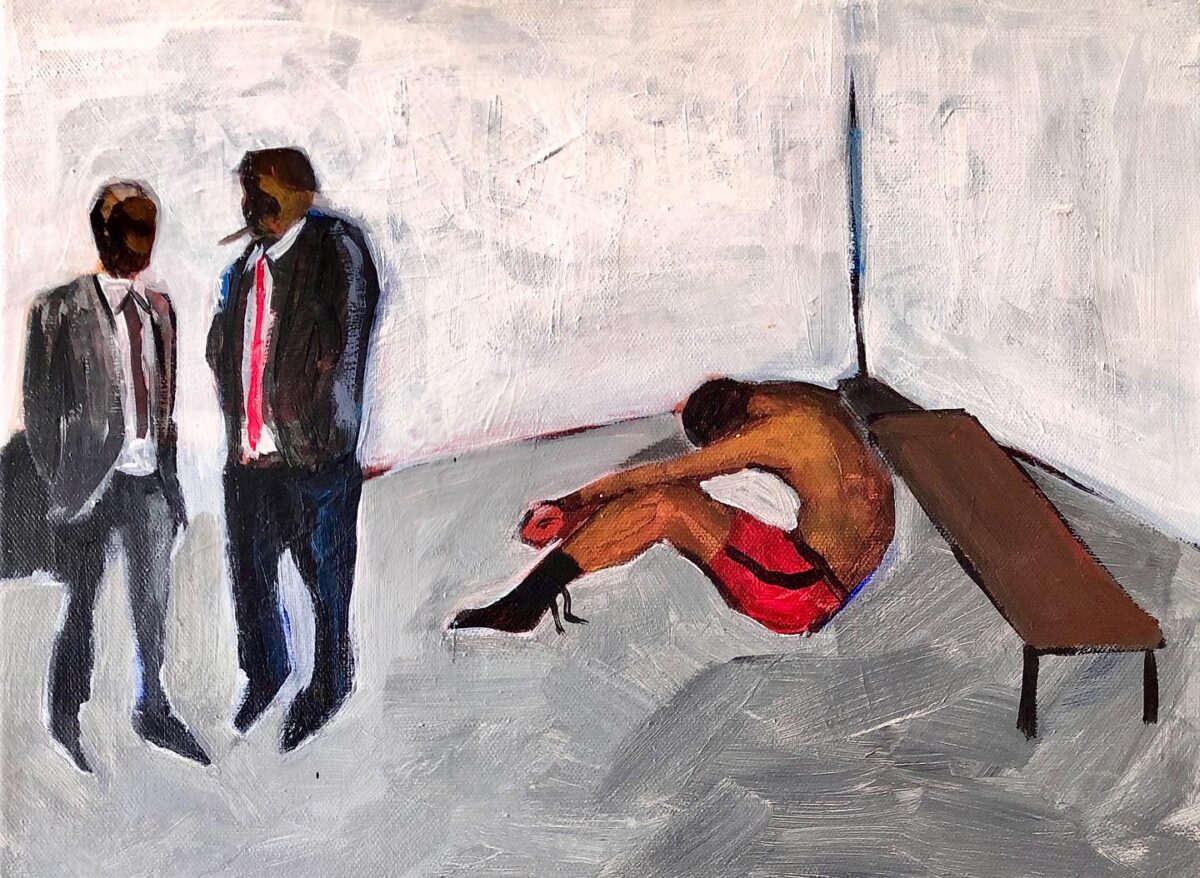
Ring is excerpted from Youssef Rakha’s forthcoming collection of essays, Postmuslim, forthcoming from Graywolf Press in September 2026.
ONE
A mutual friend texts me offering their condolences. I’m having an espresso outdoors on the way to boxing practice, and I have no idea what they’re talking about. “I’m so sorry,” they say. “I thought you knew.” Late afternoon, beautiful weather. It takes a while to register what happened to Mohab last night.
This also happens to be the week after the first ceasefire—Israel has started demolishing Gaza again—kids losing limbs or heads every hour. I had been stupid enough to think it was over. I had also been stupid enough to think I’d see Mohab again, though I hadn’t really thought about him since it started. I know he’s back in Alexandria for good now. He hasn’t told me himself, but I know. There is an unacknowledged fight between us, an upset over something I said in an online video. Mohab had repeatedly made the claim that, unlike its European counterpart, in its entirety Arab intellectual history was a moral sham, an opportunistic performance intended to achieve political and personal gains without having any effect on reality. When it came up in the online discussion in question, I respectfully suggested that, for such a statement to have historical validity or make verifiable sense, it needed to be research-based and confined to specific contexts. That upset him—and I’d been hoping it wouldn’t be long before we acknowledged that and were reconciled. Now the birds are singing and he is dead.
But I never did see Mohab often. By the time we grew close he was living in Kuwait with his second wife, working as a cultural journalist. I was in love that year. The real reason I was at the literary event that brought me together with Mohab was to spend time with the older writer I loved. She lived far away, said she was coming just to see me, but once there she acted so busy, so uninterested, and so careful that no one notice the two of us were close, I felt spat on. It was hurtful but—even worse—confusing, because after two days of this I really had nothing at all to say to her, this person I’d been thinking of spending my life with against the odds. I had three free days before I flew back to Cairo, and I didn’t know what to do with myself.
Then Mohab turned up like a savior. He was a conventional-looking intellectual, civil-servant conventional but recognizably intellectual, with a George Costanza-style bald pate and old-fashioned clothes like W. G. Sebald’s, and he cut a strange figure in the canned luxury of the globalized hotel foyer. I’d known him a little from my visits to Alexandria, when he still worked as a schoolteacher while helping to edit an alternative magazine I wrote for. I admired his intelligence, but his seeming conservatism and his tendency to moralize had kept me away. When he mentioned wanting to visit the old harbor of Bur Dubai now I jumped on the opportunity.
It turns out he was just as alienated by the writerly hustling and schmoozing, though not for personal reasons, and from then till I left the hotel for the airport I spent practically all my time with him. I never said a word about the lover who hurt me, but when I discussed the Egyptian middle class and the moral failure of the Arab intellectual—social criticism is what Mohab and I would always do together—that’s what I was telling him about.
The amateur slugger on his way to training is not the person I was then, but he still misses that therapy. Being here and doing nothing for the Palestinians has felt unbearably wrong, and the first thing that hits me when I get the text is this is another thing to feel guilty about. Surely I should’ve . . . But I’m not feeling guilty. I’m not feeling anything. Usually, when I’ve heard someone has died, my impulse is to contact people who know them. This time all I can think is I have five minutes to get to boxing practice. I wonder if there’s going to be sparring. I have my mouth guard but I don’t know if I want to get punched now. I put my backpack on my back, the gloves dangling from the straps the way I learned to carry them from my teenage teammates, and I set off.
As I stride along the world looks a little different from the way it did before I got that text, a little foggier or heavier, it talks to me less and makes less sense when it does, but I’m not convinced this is about Mohab. I’m still feeling nothing as I unzip my backpack, five minutes before the warm-up, and from its dark depths a brand-new pair of hand wraps, bright yellow, pop out at me. I bought them in the lull of that past week, when the world looked relatively habitable and I believed I could understand or be in it. Then the onslaught restarted and I totally forgot about them.
The first feeling I acknowledge now: beneath my damp amusement at seeing the hand wraps, cloud banks of sorrow like wobbling tofu. I recall that yellow, in Arabic, is the color of fake smiles. Then, tearing them out of plastic, I realize I am scared, I don’t know of what but my hands are shaking, my mouth dry, the ground trembling slightly under my feet. And because of that the mechanical chore of wrapping nylon gauze around one, then the other hand, holding the wrist and thumb in place, padding the knuckles, it all takes on a therapeutic meditativeness. As always at boxing practice, I’m in the groove of panting and sweating before I know it.
There’s sparring, I’ll be getting punched. To warm up for sessions like this, the coach gets us to jump rope and shadow box by turns. Anxiety slides into exertion as I try to reach fifty counts without tripping, or to add footwork to a longer combo. I’m thinking about neither Gaza nor Mohab but why I chose yellow when I usually choose blue. It’s evocative of the beach—two years since I’ve been anywhere near sea spray—but it’s also evocative of malnourishment, disease, the pale faces of those whose world is rent, their loved ones hacked before their eyes. For just a moment, I imagine talking with Mohab. I remember the solace it gave me.
Not just that time in Dubai but later, when I told him about my love for the writer I met there and he told me about his for the late Student Movement icon Arwa Salih. She was older than him too, and a few years after they broke up, she killed herself. Mohab and I got to talk when we traveled to the same places and when he was on holiday in Egypt, but in between meetings, along with the entire cultural community, we had Facebook. By the time my relationship with that writer ended for real, the 2011 revolution had broken out and, resuming our ongoing social-criticism seminar, Mohab and I would discuss what this new, seemingly ideology-free path could mean for the future.
I had just published the first big book I wrote, Mohab was writing poems again after a decade’s hiatus, and the historical moment felt generative. “History opening its door can only be a good thing,” I remember him telling me over Facebook chat, “even if at first only monsters and mutants come through.” We both knew who those might be. As a college student Mohab had plunged into and out of the Muslim Brotherhood, and when he lived with Arwa Salih in Cairo he was exposed to the mean-spiritedness of the wannabe autocrats who dominated the left: the Student Movement leaders. He got to see the way they abandoned Arwa to her death, then went on to appropriate it as a loss of their own.
The Islamists had shown, repeatedly, what conniving populists they were, ready to betray both their fundamentalist principles and the liberal democracy to which they claimed to marry them. Meanwhile, beyond individual meltdowns or demotion to Islamist sidekick in the ranks of the opposition, the Student Movement had imploded without a trace. Mohab and I agreed that, deep down, the status quo had been a kind of synthesis of those two failures, and we embraced the revolution because the new activist community promised a third option. I was working on a new book by then, molding my heartache and the revolution into a Bolañoesque history of the nineties, and talking with Mohab was giving me more than just solace. It was giving me a sympathetic but rigorous readership of one, anecdotes and insights to work with, a sense of political communion.
He was so generous with his emotions that it never occurred to me he could be unsure of himself. But when I failed to secure a publishing contract for the book of essays the two of us thought about writing together, he grew quiet in a way that suggested he took offence. Since you don’t care about collaborating with me—this was the message I eventually got—then I won’t be going out of my way to make it happen. But I did care, and bringing up something important, humbling himself enough to stick with it, should not feel like going out of his way. It was something I’d see him do again and again with his own poetry. Whether in terms of publishing or promoting it, if people didn’t take the initiative—and people almost never do—Mohab wasn’t interested.
By 2012 the revolution was devolving into a maelstrom. Innocent activists were held without charge while, freshly released from prison, jihadis convicted of terrible atrocities held forth on TV. Protests led to counterprotests, violence to counterviolence. The activists I had trusted to point the way in a new direction turned out to be just as dogmatic, just as illiberal as their Student Movement predecessors. The difference was—whereas members of the Student Movement were Arab nationalist and Marxist, these people were ideologically muddled. They fought for neoliberal reforms in the same breath as they called for world revolution. They insisted on treating the right-wing, rabidly capitalist Muslim Brotherhood as if it was a beacon of Marxist liberation. But they showed the same, no-longer-convincing high-minded hysteria.
The sense that history’s door could eventually let through something meaningful was fading, though Mohab and I remained virtual comrades in arms. For opposing the Islamists’ rise to power, we both got into fights within revolutionary and intellectual circles. But something in Mohab’s Facebook posts was bothering me. They were getting longer, more pedagogic. They were tending more and more toward abstraction. Whereas before he described the situation as it was, Mohab now spoke with categorical conviction of what it should be. And when he made comparative statements, it was never clear what the yardstick was. Often what he believed were specifically Arab-Muslim problems—that intellectuals turned culture from a way to engage society at large into a form of niche careerism, for example—was equally true of the implied reference, the West.
His political commentary hadn’t always been that way, or perhaps I just hadn’t noticed? I didn’t disagree with much of what he said, but as soon as I started to respond critically, I could see how badly he took to being argued with. It was then I realized the way he went about publishing and promoting his work reflected the same inability to compromise. In time I tactically withdrew, maintained less intimate contact, and focused on poetry and personal conversation. By the time Mohab showed symptoms of the heart condition that would kill him, I had deleted my Facebook account. When I heard his first heart attack had started literally during a Facebook argument, I laughingly said I told you so. And from then until what I said in that online video, there was a kind of plateau.
For three minutes at a time now, not remembering any of this, I spar with different partners, one after the other. It’s grueling. Training is always tough. With the other things you do, if you stop, you just look bad. But if you’re sparring and you stop you might fall, get hit, you get hurt, you suffer. The only safe way to stop while sparring is to signal I give up, which is humiliating, and even then you might not do it fast enough to avoid your head flying. The anticipation of impact keeps me on my feet however exhausted I am. I block, I parry, I pull back. I try to buy a few seconds in which to think of a sequence of moves. If I have enough energy I dance. And then it’s over—relief, a brief respite before the next round.
It never fails to move me when, at the end of a round or a bout, two people who were just trying to kill each other warmly touch gloves or embrace. The look on their faces moves me: the passionate regard they have for each other. Each knows exactly what the other has been through.
That’s what makes me think of Mohab during the last round. It makes me think of the poems we wrote to each other. In different ways, we both paraphrased that profane line of Baudelaire’s, famously Catholicized by T S Eliot: Hypocrite lecteur, – mon semblable, – mon frère. He chastised me for using obscene words and images, and I reminded him of how criminal propriety could be. This was the closest Mohab and I came to blows, and it felt just as warm afterward.
When I get home that night—my right brow slightly bruised, my chin smarting, my left temple throbbing with a dull pain—I’ll be angry with him. His debilitating sensitivity, his neurotic sense of being in the right. His romanticism—and he might’ve argued with this label, but in the sense of having an idealized view of reality, of measuring everything against an impossible ideal, Mohab was definitely a romantic. But it didn’t have to be that way. There was so much we could’ve said and done if he wasn’t sulking his way to a new embolism. At least he could’ve let his beautiful poems have a wider audience.
Though there is no connection between them, that anger I feel toward Mohab will dissolve into the rage I’ve been feeling about Gaza, or the rage will dissolve into the anger, till I can no longer tell whether it’s Mohab or the world that is maddening me, the kids being killed or the fact it is no longer possible to drive alongside the Nile at night with him in the passenger seat, laughing and theorizing about the fellahin. He was in that passenger seat when he confessed to the love affair that was to end his marriage, eventually bringing him back from Kuwait even though it was over almost as soon as it started, refusing to tell me who it was.
Mohab died alone and more isolated, it suddenly seems to me, than ever before in his life. That is the punch. The full terror of his loss will register when I feel it. Then something like shame will start dripping, burning me inside.
TWO
“On the day of his mother’s funeral in 1811,” writes Kasia Boddy in her definitive Boxing: A Cultural History, “Byron called for his page to bring his boxing gloves for his daily exercise rather than follow the coffin to the family vault. The sparring that day, the page recalled, was more violent than usual.”
For Romantic poets, Boddy is saying, sparring is a mourning rite.
I too sparred hard minutes after getting news of a dear person’s death, a poet friend named Mohab, though it didn’t feel like mourning. Later, I started to wonder about boxing and writing in relation to dying. Poetry had been part of my sense of self for much longer than any sport, and it was a familiar way of dealing with death, a kind of defense against it.
Whatever else it was, on the other hand, boxing was a form of violence. In the ring, Antonio Monda writes, violence “has found its alibi to become unpunishable.” Boxing, he says, “not only transcends sport, but also ethics. The ring is the only place in the world where a man can kill another without being pursued by the law.”
Now I could see I was drawn to boxing because it acknowledged a murderous impulse that I understood to be part of me and, however partial or faulty, provided a framework to accommodate it. Its existence belied the notion that being civilized, even being a poet precluded the capacity for physical violence, which considering what modern civilization had wrought in the way of catastrophic destruction had always struck me as hypocritical. Is this the reason that I box? To feel real?
What I wanted to know was if this mode of being could also serve as a way to mourn the dead—by working as an emotional release, reminding practitioners of the fragility of the human body, the inevitability of its demise . . . The question made me think about my life, about human life in general, as a mourning rite. Then again, writing is not just a defense against death. It’s a defense against violence, both boxing-level and psychopathic violence. Writing, I feel, frees the victim of their victimhood. By giving their subjectivity form, honoring their reality, it liberates them of a space in which, unwritten, they will be confined.
To speak of Gaza, for example—even as a mere witness—is to render Gaza a reality beyond the facts and figures of so much unnecessary cruelty. And in the absence of the possibility to fight meaningfully on behalf of Gaza, that feels important. It feels like an effective response to a violence that not only metes out suffering and death but also figuratively flattens those who suffer it. Turns them into a blank page.
“At the root of the sympathetic connection between writing and fighting,” writes Josh Rosenblatt, journalist and mixed martial arts practitioner, “lies solitude. . . . The terror of physical destruction and the terror of the blank page are the same thing.” Not because the blank page indicates the same kind of defeat, but because its blankness—like the inability to keep your existence intact in the face of an assault—implies a kind of silence, of preexistent emptiness, gaining the upper hand.
Summoning all those ghostly opponents to spar with on the page or screen, to write is to confront your terror exactly as you do when you fight. The boxer-poet Geffrey Davis—referencing Li-Young Lee—says martial arts are ultimately an attempt to be safe from harm; and one way this can be achieved is when by sheer force of your presence the person intending to harm you is compelled to show you love. “Perhaps, then,” Davis extrapolates, “writing is the highest form of martial arts because of its ability to embody love.”
Perhaps the raw romanticism of boxers—their extreme moods, their brittle bravado, their all-or-nothing outlook on the world—ultimately does hold something of poetry’s essence. This is what Roberto Bolaño said when he was asked the question:
I don’t know. I don’t know what poetry is. . . . Poetry for me is an act . . . it’s a gesture more than an act—of adolescence. A fragile, unguarded adolescence that bets what little it has on something it is not known very well what it is. [He almost paused.] And generally loses.
My poet friend was like that—something unbelievably fragile about him. When I reviewed his book my piece couldn’t be published on schedule, and he was petulant as a child waiting for it. If someone said they liked the first half of his poem more than the second, he would ghost them. He spoke constantly of the need for intellectuals to connect with the masses, to be approachable and unpretentious, but the social critique he published was abstruse even to his literary friends.
I never confronted him about it but sometimes I felt he unwittingly embodied the object of his censure. “There is an extremely fine distinction between the writer creating interactive and critical images of reality as a way to connect with humanity at large,” he once said, “and the writer creating those images to hide behind them, to shield himself against society.” In the end he died hiding—shielded even from me. And, aware of the unresolved violence between us, I didn’t know what to feel.
My poet friend is one of many Arab writers who remain nonexistent in the West even though their work is of the same caliber as figures like the German writer W. G. Sebald. Something about Sebald’s earnest intellectualism, dry humor, and bookish distance from worldly things reminds me of my poet friend, that’s why he’s the example I think of.
Mohab’s death says something about the Arabs’ absence from Western consciousness: the fact that, while what happens in our part of the world is always of interest and often in the news, our existence as active agents of our own destinies remains unmentionable. But there is another thing about Sebald that feels relevant to mourning my poet friend: the theme for which he is most vigorously celebrated is never mentioned in his books, not once.
After his first visit to America—it was some five months before 9/11—Sebald was killed in a car accident almost as soon as he returned to England, where he lived. “I’ve always felt that it was necessary above all to write about the history of persecution, the vilification of minorities, the attempt well-nigh achieved to eradicate a whole people,” he told Michael Silverblatt while there. “And I was, in pursuing these ideas, at the same time conscious that it’s practically impossible to do this. To write about concentration camps in my view is practically impossible.”
Maybe my initial, blank response to a dear person’s death reflected the same kind of allusive silence. Not that I hadn’t written directly about the terrible things that were happening in the background. But maybe, when I felt I didn’t know how to mourn my poet friend, it was because his death felt like a way to take stock of those things without mentioning them—making Sebaldian sense of them—because a friend’s death is to the demise of whole cities full of people what boxing is to war. It is an image small and bearable, indeed beautiful enough to write about. A kind of emblem.
“For some commentators,” Kasia Boddy writes, the function of the games described in the penultimate book of the Iliad “is to ‘purify’ combat—that is, to imitate it but conceal its true deadly character.” Likewise Monda: “In every match, even the poorest and most provincial, boxers repeat the challenges of knights and soldiers, ready to do anything for their country, for their honor, and sometimes, for survival.”
Mourning was a major subject of early Arabic verse, and it often involved talk of the enemy’s inferiority as a warrior compared to the greatness of the dead man, the valor of the dead man’s tribe compared to the enemy’s, or the necessity of revenge. James Montgomery, one of the translators of the seventh-century poet al Khansaʾ, the most famous practitioner of the genre, wrote movingly about connecting with her work after a car hit his seventeen-year-old son, immobilizing him and changing both their lives forever. In grief, Montgomery writes:
Experience, memory, artifice and art are confronted by the absence of comfort, and earlier versions of a poet’s selves are rehearsed and re-inscribed. . . . An event like the one I am describing rips to shreds the veil of the commonplace and the mundane, and memory is charged with the task of remembering the future . . . for such events reveal to us that the future is little more than a memory.
That must be what I was doing while wondering what I felt: rehearsing earlier versions of myself that include my poet friend, remembering a future that had already been erased where I spar knowing he’s alive, and where boxing isn’t wondering how to mourn him while feeling unbelievably unsafe.
Perhaps feeling unsafe is the very core of grief, grief denuded of its usual trappings. It’s the condition of being that impels me to write and to fight, whatever else it is. The more aware of death you are the more your hands shake—even as you actively fend off the feeling by doing what makes you feel safer. In the face of death you realize that activity is but an analgesic, a distraction from fear.
In the emblematic sense, a poem is a priceless thing, but I’ve often been frustrated and offended by the onslaught of poetry-positive statements I’ve encountered online: Poems will save humanity; Poems can change the world; Politicians and military leaders are afraid of poets . . . As if poetry could ever have a concrete footprint in the shifting, deadly terrain of human misery—it’s insulting.
According to the Syrian poet Adonis, the most emphatically modernist figure in contemporary Arabic letters, a poem is an exercise in “the power to dream,” including of a better world, but unless it functions as polemic, propaganda—and then what will be left of its substance?—it cannot be expected to interface with anything wider than an individual consciousness.
In times of war, a poem emerges sovereign out of the filthy morass of subservience and pain. At best, it can be a testimony, an artifact of subjective power, an incantation that sensitizes and consoles, but has little relevance to consensual reality. Only the worst verse, it seems to me, will step directly into the political ring to aid in—generally futile—activism while the violence of history goes down.
All known odes by al Khansaʾ, perhaps the most famous of the female pre-Islamic poets, are laments for her two brothers killed on the battlefield, and they almost all open with the poet commanding her eyes to shed tears. But, whether extolling her brothers’ skills or urging their kinsmen to avenge their death, her grief involves as much violence as sorrow. “Offense rippled your heart,” she writes in praise of one brother, “you who like a blazing arrowhead irradiated night.”
A perceived offense made my poet friend stop talking to me. In poetry, he used to say, attitude—tone is everything. Our feud didn’t pretend to be poetry any more than it involved fists or blows, but maybe my tone had the effect of a nasty hook to the head. Yet his refusal to get past that moment was an equally vicious right-hand. It was, if not a violence in its own right, then a terminal blank page, a nonexistence, because there was no way to make contact once he died. Even while he was alive, after offending him, there was no way to break through the estrangement.
In The Fight, talking about Muhammad Ali’s preparations for The Rumble in the Jungle, Norman Mailer says, “In heavy training, fighters live in dimensions of boredom others do not begin to contemplate. . . . The boredom creates an impatience with one’s life, and a violence to improve it. Boredom creates a detestation for losing.” The boredom to which my poet friend confined himself created a detestation for what might be called success. It created an impatience with the mediocrity, hypocrisy, and easy practicality of his milieu, and a violence to stay clear of it even at the cost of being unseen. I suppose by disappointing or—to his mind—disrespecting him, I became part of that milieu. But where had he gone from there? In “The Cruelest Sport” Joyce Carol Oates describes the ideal conclusion of a fight as “a knockout in the least ambiguous sense—one man collapsed and unconscious, the other leaping about the ring with his gloves raised in victory, the very embodiment of adolescent masculine fantasy.”
This image has come to sum up the end of my relationship with my poet friend, though it is never clear in my mind which of us is on the canvas, which jumping around with his arms raised. It is not clear whose defeat his death marks, whether it was the terminal blow he gave me or an unconscious murder on my part.
To field a punch in boxing, you either intercept it with your hand or dodge it with your head. Instead of countering, the way you’re supposed to after your adversary makes contact, my poet friend dodged me so deftly I was no longer there for him. As if I’d disappeared.
I think that happened with every one of my poet friend’s fights. The immobilized body of his adversary would disappear while he stood alone, surrounded by the ropes, staring at the empty canvas, wondering where on earth everyone’s gone. Maybe the ring itself vanished. The pain he felt would persist in the form of tremendous poems, memories of the future, but afterward—quietus. Oates doesn’t go so far as to say the knockout should be fatal but she might as well.
Before his 1947 World Welterweight Championship fight with Jimmy Doyle, Sugar Ray Robinson, is supposed to have dreamt he killed his adversary. Taking it as an omen, the legendary fighter refused to step in the ring until a priest persuaded him it would be okay. That evening in the eighth round, when Robinson knocked him out, the twenty-two-year-old Doyle never got up again. Robinson went through a long legal battle to prove it was not his fault but, when your punch has killed your fellow fighter, how are you supposed to grieve?
When I heard my poet friend died, I struggled to reconstruct our time together: the camaraderie that enabled us to step into the ring in the first place, the initial exchange of jabs and catches, slips, what I said in that online video turning into the right hand that stopped him, but also his refusal to counter. The only thing that was vivid in my mind was the power of his poetry, which was a different kind of blow. To mourn him, I said to myself, just read him—that’s all you have to do: to read him as if you never met him, accepting that he will be no longer. And that is the way it is.
I’m more and more convinced the real fight is to live with the blows—the lies, the betrayals, the sorrow: all that can happen in the monstrous and unending ring of human relations—knowing that you will inevitably lose.
“Obviously, victory is often nothing more than an illusion destined to become a bitter disappointment,” Monda says. And Mailer: “For if we are our own force, we are also a servant of the forces of the dead. So we have to be bold enough to live with all the magical forces at loose between the living and the dead. That is never free of dread.”
Now I’m reading my poet friend again, letting him hurt me as I bear witness to his existence and remember what was happening when he died. Embracing dread.
Facts Only
Poet friend: deceased
Online video: mentioned but not detailed
Boxing metaphor: used to describe their relationship
Sugar Ray Robinson: mentioned as an analogy for the poet's death
Jimmy Doyle: mentioned in relation to Sugar Ray Robinson's fight
Executive Summary
Full Take
This piece can be seen as a contemplation on life, death, and human relations, using the metaphor of a boxing match. The author employs this metaphor to explore the complexities of their relationship with the poet friend, focusing on the give-and-take dynamics, the moments of connection and conflict, and the lingering sense of loss after the poet's death.
Patterns detected: ARC-0157 Metaphor, ARC-0024 Ambiguity
The use of metaphors allows for a more engaging exploration of abstract concepts such as human relationships and emotions. However, it also introduces ambiguity, as the literal interpretation of the boxing match may not align perfectly with the author's intended meaning. The author's reflections on their relationship with the poet can be seen as an exercise in self-reflection and emotional processing, but the metaphorical nature of the piece prevents a straightforward analysis of their bond.
Root Cause: The narrative appears to stem from the author's personal experiences and reflections on loss, artistry, and human relationships.
Implications: By sharing these deeply personal thoughts, the author invites readers to reflect on their own relationships and the emotions they evoke. This piece encourages empathy and introspection, reminding readers of the complex nature of human connections.
Bridge Questions: What role do metaphors play in our understanding of complex concepts? How can we use art and personal experiences to process loss and emotional turmoil? In what ways can shared activities help build and maintain relationships?