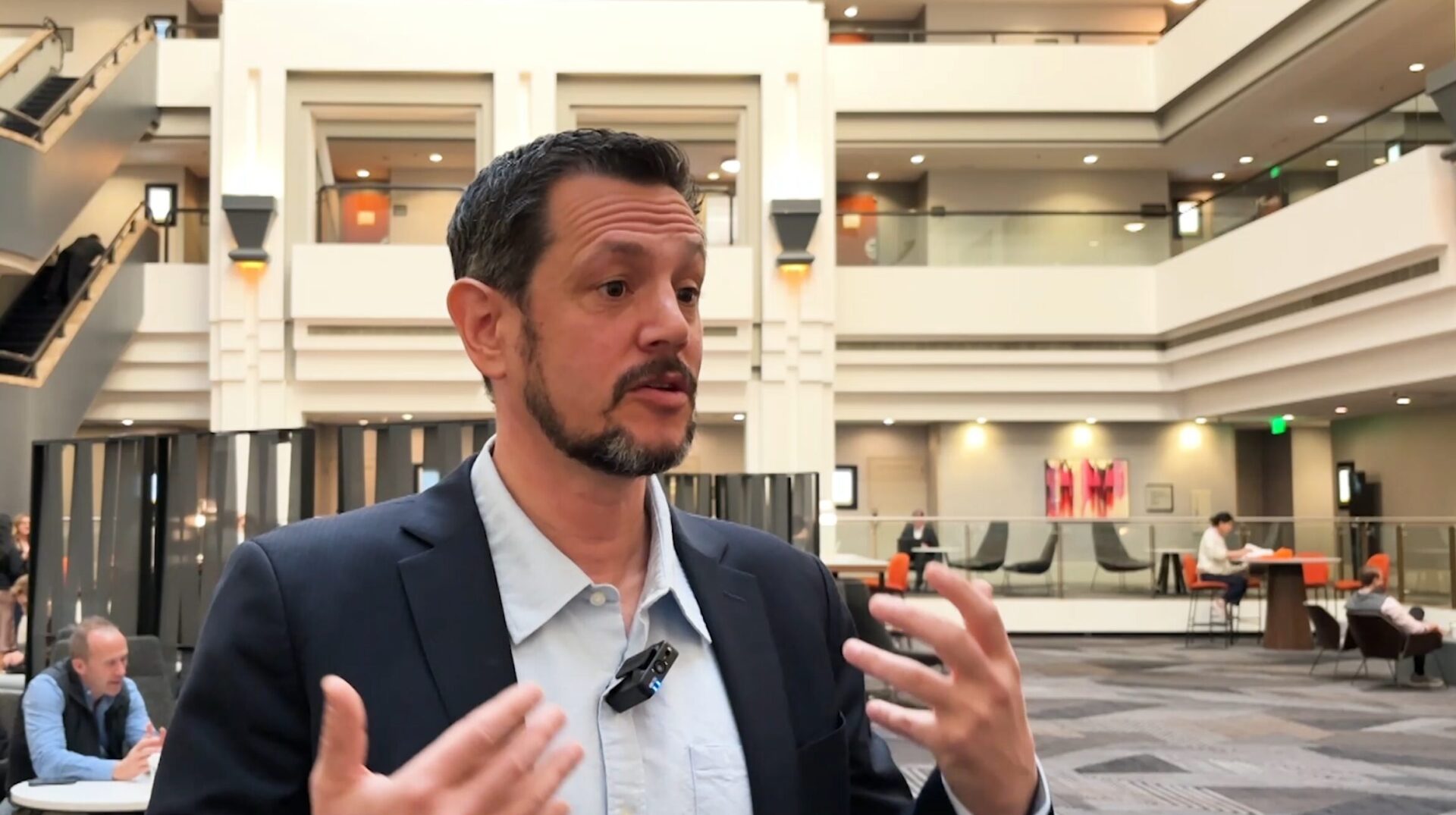
Theoretical physicist turned agtech entrepreneur Brad Zamft, PhD, at Google X spinout Heritable Agriculture, is on a mission to make plant breeding faster and cheaper.
AgFunderNews (AFN) caught up with Zamft (BZ) at World Agri-Tech in San Francisco to discuss digital twins for crops, AI-driven gene discovery, and how combining AI, genomics, and high-resolution environmental data could dramatically compress R&D timelines in crop development.
AFN: In simple terms, what does Heritable Ag do?
BZ: What Heritable provides is a comprehensive solution to improving crops. This spans the ability to simulate real plants in real fields. We make digital twins, incorporating soil and weather to 10-meter resolution anywhere in the world.
We also work on the ability to identify—for traits that are controlled by a few or a few dozen genes—the causative genes, and we’ve shown that we can do that with unprecedented accuracy.
Sometimes knowing those genes is not enough. You have to know how to control them, what tissues they should be expressed in, whether to turn them on, whether there’s a drought or a heat event.
This is where we learn from massive improvements in large language models. Just like we know the underlying grammar and syntax of human language, Heritable now incorporates the grammar and syntax of the DNA language into our models to understand the exact bases that are controlling these genes.
So I think a differentiator for us vs some others in the field is that we provide that comprehensive solution: digital plants growing in digital fields, working on traits that are sometimes controlled by thousands or tens of thousands of genes, and developing a fine tuned understanding of the few important genes for certain traits, understanding the important base pairs for control of those traits.
AFN: How have you validated your model?
BZ: That’s another place where I think we’re differentiated. Everything I said earlier about unprecedented biological information and our ability to do all of these things through AI, none of that matters unless it works in a real plants in a real environment. So we have validated all of our models with real plants growing in real environments.
In terms of digital twins, we’ve shown that we can simulate the varieties that our partners have been growing in new environments or environments that they haven’t told us about, and that we have high accuracy in creating that digital twin.
In terms of the gene discovery functionalities, we spent a lot of the time while we were at Google X running the full stack. So we would identify a trait, we would run a field trial. We would extract the tissues and sample the tissues, which is not trivial when you’re doing RNA.
We would train the model and based off of the omics we would identify the genes, and then we commissioned gene editing. Those plants were gene edited, and we watched them grow, and we saw how the genes that we identified actually did have an effect on the trait that we targeted.
We’ve done that in three species so far, and the efficiency numbers make it very clear that we have unprecedented level of accuracy in that gene discovery model.
AFN: Which crops are you working on?
BZ: Billions of dollars are spent in agricultural research on two crops: corn and soy, and one trait: yield. We recognized in the early days that once you move out of the major species, it’s the Wild West in terms of understanding the genome.
So we spent a lot of time learning how to run a field trial in a cost efficient way to get the right omics, how to build the model architectures that are efficient so you don’t have to have a huge spend on compute.
We spent our time at Google X figuring out how to do this for the rest of the agricultural world. All of the other wonderful species that we rely on for food and nutrition… vegetables, forestry, all of these things are unlocked if you can lower the cost and accelerate the timelines, and that’s what we’ve been developing.
AFN: What’s your business model?
BZ: We’ll work with anybody who wants to improve crops. And that takes multiple forms. Sometimes it’s as simple as giving a license to our software tool that allows breeders that have an existing collection of genetics and have them simulate new environments so that they can increase their market share. They can mitigate climate risk. They can mitigate geopolitical risk.
Sometimes we work in a traditional trait licensing model where we’ll identify the strategy to improve a trait, and then there’ll be a royalty on the improved trait. And what’s really exciting is our partnership with [indoor grower] Red Sun Farms, where we’re going to create a new, improved strawberry variety.
Traditionally, when you use linear statistical models, you have to make some sacrifices. You either have to focus extremely on yield, to push yield improvement faster, or other things. If you try to do them both at the same time, you make progress, but you don’t make as rapid progress as you could on either one.
Artificial intelligence allows us to do better than that. We can make more progress faster on multiple traits. And in some cases, having the models more constrained by focusing on multiple traits, makes the model better. What that means is that in our strawberry program, and in many programs, we’re focusing on many traits. These include grower traits, like yield and disease resistance, but it also includes consumer traits like flavor, fruit architecture, and color.
AFN: With your approach, I guess you could use this to inform a traditional breeding process or a gene editing process?
BZ: That’s right. That’s why I call it the comprehensive solution to crop improvement. There are certain traits that need breeding. They’re called quantitative traits. There’s thousands of low effect size genes that control that trait. It’s not going to be easy to affect that through a CRISPR pipeline, so breeding is here to stay.
The incorporation of the environment is an incredibly complicated task, and the way we’ve solved that is through our digital twin simulations.
There are also markets that are just not going to tolerate gene editing, either for regulatory reasons or in the court of public opinion.
Now there are some traits that are really going to be accelerated through a gene editing or other targeted mutagenesis pipeline. CRISPR is not the only solution to being able to make and edit exactly where you want. So we also provide the ability to lower the cost and accelerate the timelines of those pipelines.
AFN: Who are you partnering with?
BZ: We have disclosed partnerships with Syngenta; [German plant breeder] KWS; ArborGen, which is a tree nursery; and Red Sun Farms. Recently, we received a $5 million grant from the Gates Foundation to use the entire might and magic of all of the computational tools I just told you about to improve corn for the Sub-Saharan smallholder farmer.
AFN: Your mission is to make crop development cheaper and faster. What tools are key to enabling this?
BZ: There really are three technological disruptions that are happening right now that enable the reduction in cost and the acceleration of crop improvement timelines.
First off, the decrease in cost of DNA and RNA sequencing, which has been precipitous, plus concomitant improvements in things like measuring proteins, epigenetics, metabolites…. We now live in an era of unprecedented information about biological systems.
Second. We now have drones. We have satellites covering every meter of the planet. We have sensing equipment on farm equipment. That’s the second technological revolution. We live in an era of unprecedented information about our planet, the weather, soil, etc.
But there’s a challenge with swimming in unprecedented levels of information, all this genomics data, all this environmental data, how do you make sense of it all?
Enter the third technological revolution, AI, which is especially good at integrating this disparate, heterogeneous data. You know weather data is inches of rain, heating degree days… AI is excellent at separating signals from noise. It’s excellent at understanding very complex nonlinear processes. So these are the three things that, when you put them together, really enable a new agricultural system that is lower cost with faster timelines.
AFN: How much might you be able to compress the R&D pipeline?
BZ: It often takes upwards of a decade and sometimes even $100 million to improve crops, and that’s a major limitation to our food system.
I’m going to make a bold, ambitious claim: I think we’re going to get a new strawberry variety on supermarket shelves in four years from start to finish for a few million dollars, and this is just the beginning.
Further reading:
Resurrect Bio raises $8.1m to unlock plants’ innate disease resistance capabilities
Exclusive: Biographica raises $9.5m for AI-driven crop design, unveils partnership with BASF
🎥 Ag’s new toolkit: AI, genomics, and robotics converge at World Agri-Tech
Amatera raises $7m to accelerate climate smart crop development by tackling screening bottleneck
Tropic bags $105m to scale gene-edited bananas, deploy TR4 resistant bananas in 2027
Facts Only
* Heritable Agriculture: agtech startup spun out from Google X
* Brad Zamft, PhD: founder and theoreticial physicist turned agtech entrepreneur
* Billions spent on research: corn and soybeans, yield improvement
* Three species targeted for gene discovery: not disclosed
* Partners: Syngenta, KWS, ArborGen, Red Sun Farms, Gates Foundation
* $5 million grant: improving corn for smallholder farmers in Sub-Saharan Africa
Executive Summary
Full Take
Heritable Agriculture's approach to crop improvement through AI, genomics, and high-resolution environmental data has the potential to significantly reduce costs and accelerate timelines compared to traditional methods. By creating digital twins for crops that simulate real plants in real environments, identifying causative genes with unprecedented accuracy, and understanding the DNA language for gene control, Heritable Ag offers a comprehensive solution for crop improvement. The company's business model allows for licensing software tools or traditional trait licensing models, as well as partnerships to develop improved varieties of crops such as strawberries.
However, it is important to consider the potential risks and challenges associated with this technology. For instance, gene editing may face regulatory hurdles or resistance in the court of public opinion, and the impact on biodiversity and long-term sustainability remains unclear. Additionally, the company's focus on cost reduction and efficiency may prioritize short-term gains over long-term ecological and social considerations.
Questions for further inquiry: What are the potential environmental and social consequences of Heritable Agriculture's approach to crop improvement? How can we ensure that the technology is developed and implemented responsibly, balancing economic efficiency with ecological sustainability and social equity?
Sentinel — Human
This text appears to be human-written due to its natural interview style and conversational tone. The conversation is between AFN (AgFunderNews) and Brad Zamft, PhD, discussing digital twins for crops, AI-driven gene discovery, and potential implications in crop development.