Abstract
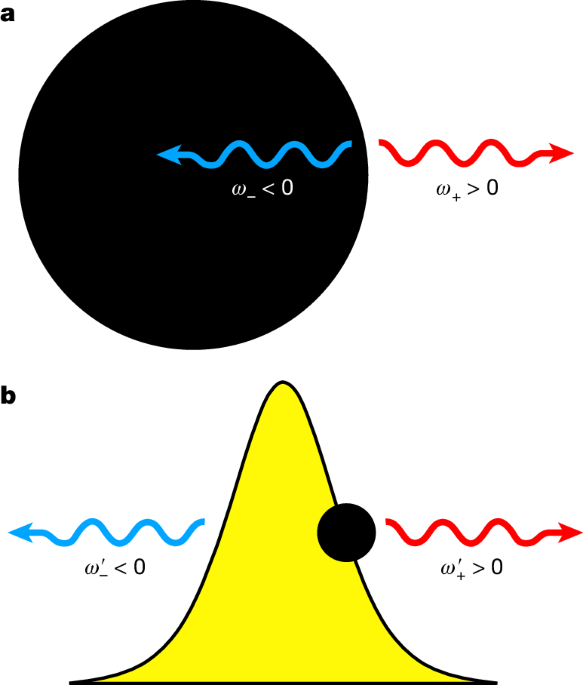
Hawking radiation1—the emission of quantum particles at the event horizon of a black hole2—connects gravity with quantum mechanics and thermodynamics3,4,5. But Hawking radiation has never been observed in astronomy, only in laboratory analogues6,7,8,9, and the chances of ever observing it in space are astronomically small9. The energy of Hawking radiation must come from the gravitational field around the black hole2, but how field quanta generate Hawking quanta has been unknown. Here we report on experimental and theoretical evidence for the process that generates Hawking radiation in a fibre-optical analogue of the event horizon10,11. There, as in gravity2, it has been believed that Hawking radiation comes from a complicated, cascaded process12; here we have identified theoretically a simple, direct process and observed experimentally how this process reacts back onto the field. Our findings suggest an equally direct process for other laboratory analogues6,7,8,13,14,15,16,17 and perhaps also for gravitational fields, shedding light on how black holes might radiate.
This is a preview of subscription content, access via your institution
Access options
Access Nature and 54 other Nature Portfolio journals
Get Nature+, our best-value online-access subscription
$32.99 / 30 days
cancel any time
Subscribe to this journal
Receive 52 print issues and online access
$199.00 per year
only $3.83 per issue
Buy this article
- Purchase on SpringerLink
- Instant access to the full article PDF.
USD 39.95
Prices may be subject to local taxes which are calculated during checkout
Data availability
Data are available on request.
References
Hawking, S. Black hole explosions? Nature 248, 30–31 (1974).
Brout, R., Massar, S., Parentani, R. & Spindel, P. A primer for black hole quantum physics. Phys. Rep. 260, 329–454 (1995).
Bekenstein, J. D. Black holes and entropy. Phys. Rev. D 7, 2333–2346 (1973).
Helfer, A. D. Do black holes radiate? Rep. Prog. Phys. 66, 943–1008 (2003).
Polchinski, J. String Theory. Volume II: Superstring Theory and Beyond Ch. 14.8 (Cambridge Univ. Press, 2007).
Weinfurtner, S., Tedford, E. W., Penrice, M. C. J., Unruh, W. G. & Lawrence, G. A. Measurement of stimulated Hawking emission in an analogue system. Phys. Rev. Lett. 106, 021302 (2011).
Euve, L.-P., Michel, F., Parentani, R., Philbin, T. G. & Rousseaux, G. Observation of thermality of Hawking radiation noise correlated by the Hawking effect in a water tank. Phys. Rev. Lett. 117, 121301 (2016).
Munoz de Nova, J. R. et al. Observation of thermal Hawking radiation and its temperature in an analogue black hole. Nature 569, 688–691 (2019).
Drori, J., Rosenberg, Y., Bermudez, D., Silberberg, Y. & Leonhardt, U. Observation of stimulated Hawking radiation in an optical analogue. Phys. Rev. Lett. 122, 010404 (2019).
Philbin, T. G. et al. Fiber-optical analog of the event horizon. Science 319, 1367–1370 (2008).
Agullo, I., Brady, A. J. & Kranas, D. Quantum aspects of stimulated Hawking radiation in an optical analog white-black hole pair. Phys. Rev. Lett. 128, 091301 (2022).
Webb, K. et al. Nonlinear optics of fibre event horizons. Nat. Commun. 5, 4969 (2014).
Nguyen, H. S. et al. Acoustic black hole in a stationary hydrodynamic flow of microcavity polaritons. Phys. Rev. Lett. 114, 036402 (2015).
Viermann, C. et al. Quantum field simulator for dynamics in curved spacetime. Nature 611, 260–264 (2022).
Steinhauer, J. et al. Analogue cosmological particle creation in an ultracold quantum fluid of light. Nat. Commun. 13, 2890 (2022).
Shi, Y. H. et al. Quantum simulation of Hawking radiation and curved spacetime with a superconducting on-chip black hole. Nat. Commun. 14, 3263 (2023).
Svancara, P. et al. Rotating curved spacetime signatures from a giant quantum vortex. Nature 628, 66–70 (2024).
Volovik, G. E. The Universe in a Helium Droplet (Clarendon Press, 2003).
Barcelo, C., Liberati, S. & Visser, M. Analogue gravity. Living Rev. Relativ. 8, 12 (2005).
Unruh, W. G. & Schützhold, R. (eds) Quantum Analogues: From Phase Transitions to Black Holes and Cosmology (Springer, 2007).
Faccio, D. et al. (eds) Analogue Gravity Phenomenology: Analogue Spacetimes and Horizons, from Theory to Experiment (Springer, 2013).
Jacquet, M. J., Weinfurtner, S. & König, F. The next generation of analogue gravity experiments. Philos. Trans. R. Soc. A 378, 20190239 (2019).
Unruh, W. G. Experimental black-hole evaporation? Phys. Rev. Lett. 46, 1351–1353 (1981).
Agrawal, G. P. Nonlinear Fiber Optics (Academic Press, 2019).
Amiranashvili, S. in New Approaches to Nonlinear Waves (ed. Tobisch, E.) 153–196 (Springer, 2016).
Amiranashvili, S. Modeling of ultrashort optical pulses in nonlinear fibers. Preprint at https://doi.org/10.20347/WIAS.PREPRINT.2918 (2022).
Zakharov, V. E. & Kuznetsov, E. A. Hamiltonian formalism for nonlinear waves. Phys. Uspekhi 40, 1087–1116 (1997).
Aguero-Santacruz, R. & Bermudez, D. Negative frequencies in pulse propagation equations and the double analytic signal. New J. Phys. 25, 103045 (2023).
Leonhardt, U. Essential Quantum Optics: From Quantum Measurements to Black Holes (Cambridge Univ. Press, 2010).
Rubino, E. et al. Negative-frequency resonant radiation. Phys. Rev. Lett. 108, 253901 (2012).
Conforti, M. et al. Interaction between optical fields and their conjugates in nonlinear media. Opt. Express 21, 31239–31252 (2013).
Unruh, W. G. Notes on black-hole evaporation. Phys. Rev. D 14, 870–892 (1976).
Unruh, W. G. & Wald, R. M. What happens when an accelerating observer detects a Rindler particle. Phys. Rev. D 29, 1047–1056 (1984).
Rosenberg, Y., Drori, J., Bermudez, D. & Leonhardt, U. Boosting few-cycle soliton self-frequency shift using negative prechirp. Opt. Express 28, 3107–3115 (2020).
Demircan, A., Amiranashvili, S. & Steinmeyer, G. Controlling light by light with an optical event horizon. Phys. Rev. Lett. 106, 163901 (2011).
Meinel, G., Neugebauer, G. & Steudel, H. Solitonen. Nichtlineare Strukturen (Wiley VCH, 1991).
Felipe-Elizarraras, R., Cruz-Ramirez, H., Garay-Palmett, K., U’Ren, A. & Bermudez, D. Measurement of analogue Hawking radiation stimulated by a single photon. Nat. Commun. https://doi.org/10.1038/s41467-026-73812-8 (2026).
Pitaevskii, L. P. & Stringari, S. Bose-Einstein Condensation (Clarendon Press, 2003).
Balbinot, R., Fagnocchi, S., Fabbri, A. & Procopio, G. P. Backreaction in acoustic black holes. Phys. Rev. Lett. 94, 161302 (2005).
Balbinot, R., Fagnocchi, S., Fabbri, A. & Procopio, G. P. Quantum effects in acoustic black holes: the backreaction. Phys. Rev. D 71, 064019 (2005).
Baak, S.-S., Holanda Ribeiro, C. C. & Fischer, U. R. Number-conserving solution for dynamical quantum backreaction in a Bose–Einstein condensate. Phys. Rev. A 106, 053319 (2022).
Butera, S. & Carusotto, I. Numerical studies of back reaction effects in an analog model of cosmological preheating. Phys. Rev. Lett. 130, 241501 (2023).
Patrick, S., Gooding, C. & Weinfurtner, S. Backreaction in an analogue black hole experiment. Phys. Rev. Lett. 126, 041105 (2021).
Marino, F. et al. Emergent geometries and nonlinear-wave dynamics in photon fluids. Sci. Rep. 6, 23282 (2016).
De Felice, F. & Clarke, C. J. S. Relativity on Curved Manifolds (Cambridge Univ. Press, 1990).
Maia, C. & Schutzhold, R. Quantum toy model for black-hole backreaction. Phys. Rev. D 76, 101502(R) (2007).
Krauss, L. M. et al. Listening to quantum gravity? Int. J. Mod. Phys. D 33, 2441006 (2024).
Susskind, L. Black holes and the information paradox. Sci. Am. 276, 52–57 (1997).
Calmet, X. & Hsu, S. D. H. A brief history of Hawking’s information paradox. Europhys. Lett. 139, 49001 (2022).
Haco, S., Hawking, S. W., Perry, M. J. & Strominger, A. Black hole entropy and soft hair. J. High Energy Phys. 2018, 98 (2018).
Couairon, A. et al. Practitioner’s guide to laser pulse propagation models and simulation. Eur. Phys. J. Spec. Top. 199, 5–76 (2011).
Akhmediev, N. & Karlsson, M. Cherenkov radiation emitted by solitons in optical fibers. Phys. Rev. A 51, 2602–2607 (1995).
Dudley, J. M. & Taylor, J. R. Supercontinuum Generation in Optical Fibers (Cambridge Univ. Press, 2010).
Acknowledgements
We are grateful to S. Amiranashvili, U. Bandelow, H. Cohen, J. Drori, M. Gelvan, F. König, Y. Rosenberg, S. Rotter and, most of all, the late Y. Silberberg for help, advice and scientific discussions.
Competing interests
The authors declare no competing interests.
Funding
L.M.P. and U.L. were supported by the Israel Science Foundation, the Murray B. Koffler Professorial Chair and U.L. by a Global Fellowship of the Vienna Institute of Technology. R.A.-S. and D.B. acknowledge the support of Conahcyt (Mexico) Ciencia de Frontera 51458-2019 and the Marcos Moshinsky Chair (2023).
Author information
Authors and Affiliations
Contributions
L.M.P. conducted, analysed and led the experiment. R.A.-S. and D.B. performed numerical simulations. U.L. developed the analytical theory. D.B. and U.L. carried out the data analysis, supervised the project and conceived the idea of this paper.
Corresponding author
Peer review
Peer review information
Nature thanks Francesco Marino, Baocheng Zhang and the other, anonymous, reviewer(s) for their contribution to the peer review of this work. Peer reviewer reports are available.
Additional information
Publisher’s note Springer Nature remains neutral with regard to jurisdictional claims in published maps and institutional affiliations.
Supplementary information
Rights and permissions
Springer Nature or its licensor (e.g. a society or other partner) holds exclusive rights to this article under a publishing agreement with the author(s) or other rightsholder(s); author self-archiving of the accepted manuscript version of this article is solely governed by the terms of such publishing agreement and applicable law.
About this article
Cite this article
Procopio, L.M., Aguero-Santacruz, R., Bermudez, D. et al. Backreaction of stimulated Hawking radiation in an optical analogue. Nature (2026). https://doi.org/10.1038/s41586-026-10720-3
Received:
Accepted:
Published:
Version of record:
DOI: https://doi.org/10.1038/s41586-026-10720-3